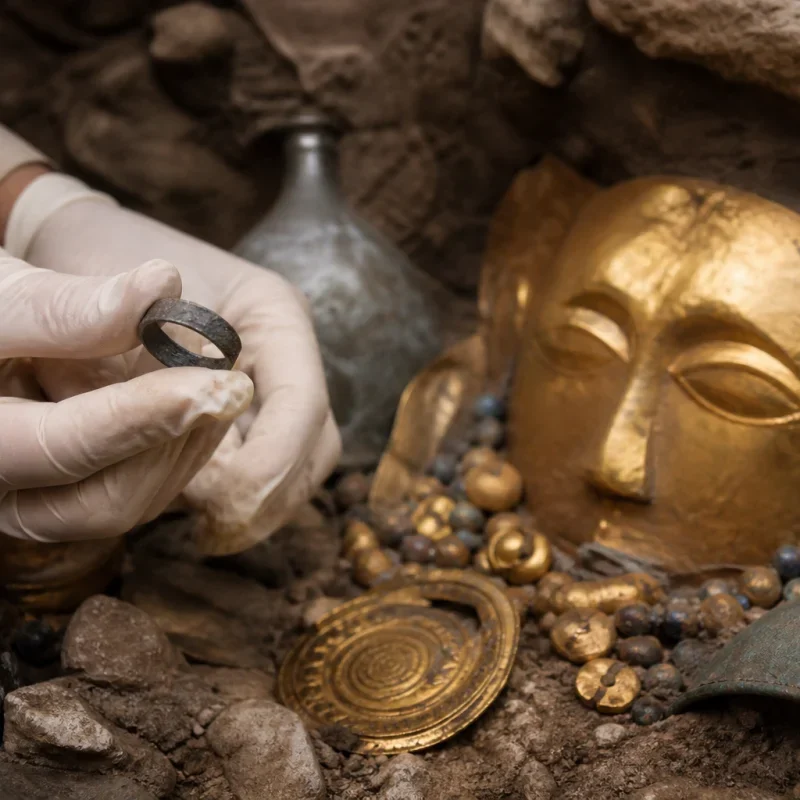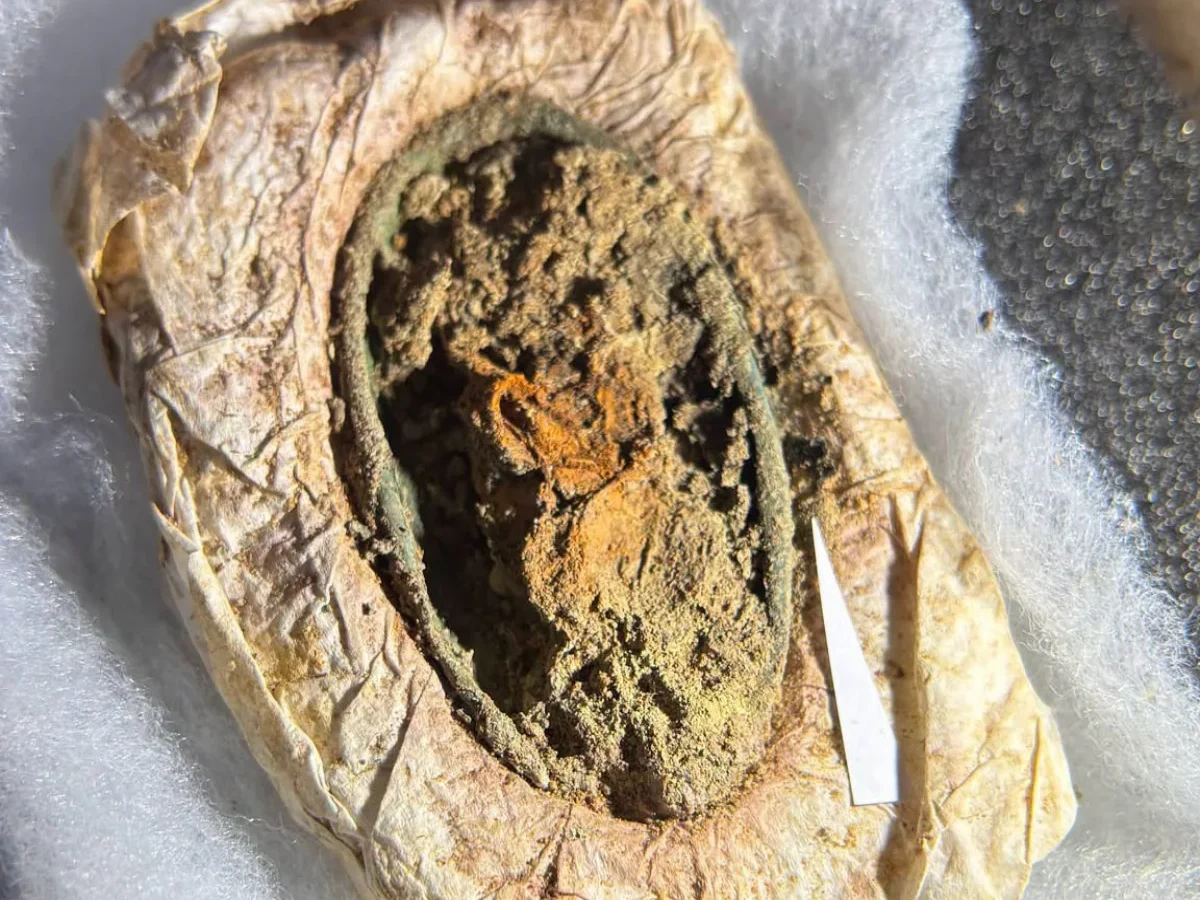
Fragments of clothing have survived inside an eighth-century Viking woman’s grave in western Denmark, giving archaeologists a rare chance to study what she wore. The pieces were found attached to two concave "scoop" brooches from a burial at Skonager, near Varde in Western Jutland.
Textiles normally disappear from Viking graves because plant and animal fibres are quickly broken down by moisture and microorganisms. In this case, salts released by the metal brooches appear to have inhibited some of that microbial activity. The fabric survived in small pieces around the fasteners, where it remained closely associated with the woman’s clothing and ornaments.
That context matters. A loose scrap of cloth can be difficult to identify, but a fragment still attached to a brooch can show how the garment was arranged. The two brooches were worn on the chest and would have helped secure a dress or outer garment. Their position gives specialists a starting point for reconstructing the clothing without treating a modern costume as proof of exactly how the original looked.
Keep exploring
Continue with Curiosmos
A burial that still has questions to answer
The excavation also revealed that one of the brooches had been repaired. That repair may mean the object had been kept and used for some time before it was placed in the grave, perhaps as a valued family possession. It is a small detail, but it gives the artefact a history that extends beyond the day of the burial.
The fragments are now being examined by the Vejle Conservation Center. Conservators are removing the surrounding sediment carefully, grain by grain, so the cloth is not separated from the objects that preserved it. This kind of work is slow because the archaeological information lies in the arrangement as much as in the fibres themselves.
Ancient textile specialist Lise Ræder Knudsen will study the surviving material for clues about the weave, the spinning, possible colours and the quality of the cloth. Even a small piece can show whether the threads were tightly or loosely spun, how the fabric was made and whether it was part of an outer layer or a garment worn closer to the body.
The woman’s teeth will provide a different kind of evidence. Researchers from the University of Southern Denmark plan to analyse them for information about her age, health, diet, migration and physical stress during childhood or adolescence. Teeth form in stages and can retain chemical signals from the places and conditions in which a person lived.
Those tests will not produce a complete biography. They can, however, add information that a grave’s objects cannot provide on their own. A brooch may suggest clothing and social connections; a tooth may reveal that the person spent part of her life somewhere else or experienced nutritional difficulty while growing up.
Why textile finds are so valuable
Viking-age clothing is often reconstructed from brooches, small metal fittings, written descriptions and much later comparisons. Direct textile evidence is rarer. Fabrics are especially vulnerable to decay, and the fragments that do survive are usually tiny, mineralised or displaced from the body.
The Skonager burial is useful because the cloth stayed with the brooches. That association can help researchers distinguish a garment fastened across the chest from other pieces of fabric that may have been placed in the grave as wrappings, bags or unrelated objects. It also allows the conservators to preserve the relationship between the person, the ornaments and the material she wore.
The results may eventually show that the clothing was made locally or from fibres obtained through wider networks. They may also clarify whether the repaired brooch was an heirloom, although that interpretation will remain tentative unless the wider burial evidence supports it.
The find does not give archaeologists a complete Viking outfit, and it cannot tell us how every Viking woman dressed. It offers something more precise: a small, well-preserved set of fibres whose position, construction and chemistry can be tested alongside the burial’s other evidence.
Curiosmos has previously looked at how Vikings moved from raiding to colonising parts of the North Atlantic. The Skonager grave adds a quieter piece to that history. It is evidence of one person’s clothing, belongings and life, preserved because the metal holding the garment together also helped keep the fabric from disappearing.