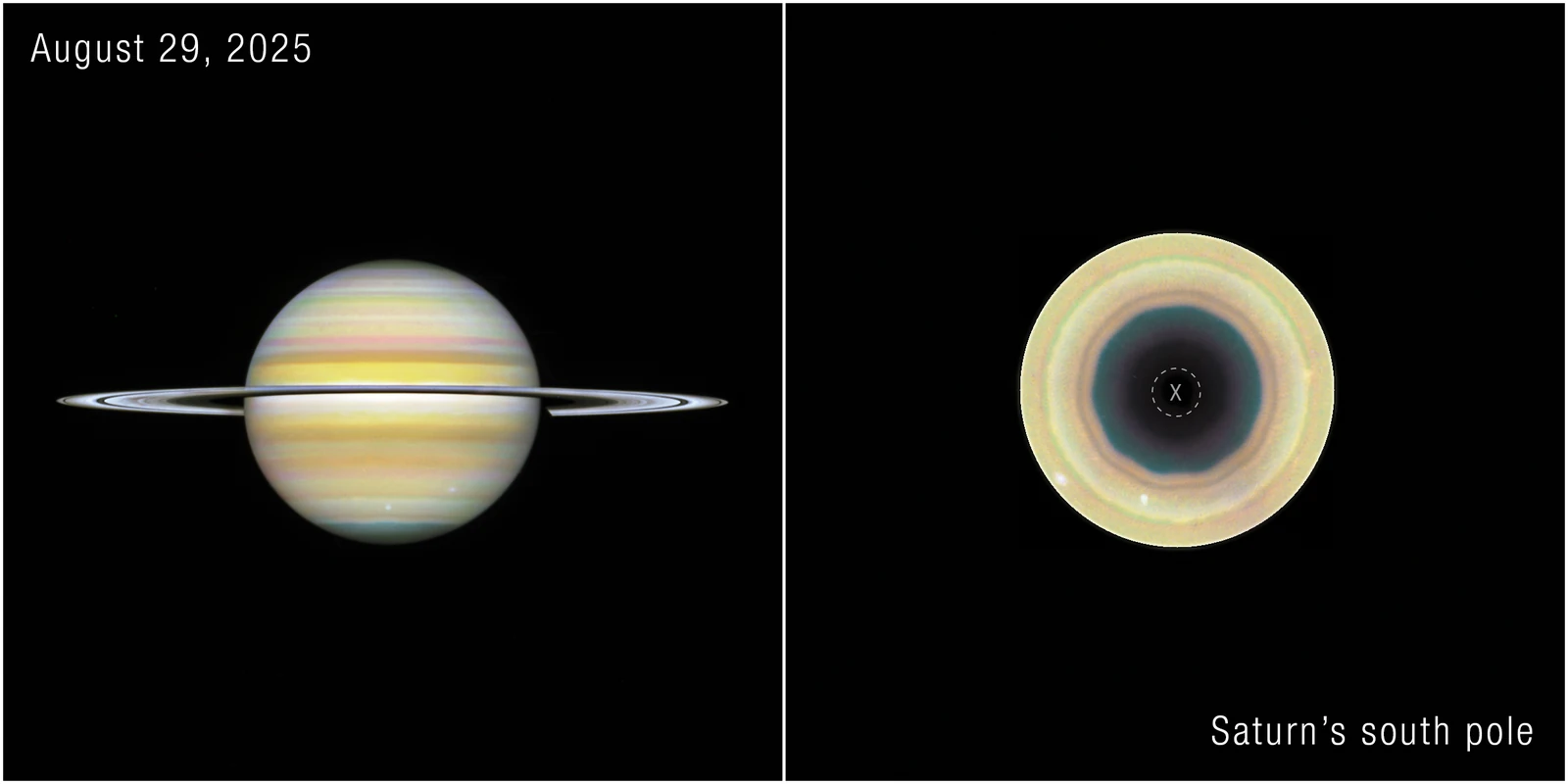
Saturn’s south pole has a ten-sided atmospheric wave, giving astronomers a new counterpart to the planet’s famous northern hexagon. The southern pattern appears to be evolving, raising a question that a single striking image cannot answer: will it become another enduring feature of the planet’s weather?
A study announced on September 2 traces the feature through Hubble observations back to 2023. Ground-based images from 2024 and 2025 helped bring the undulating band to attention. Changing seasons gradually improved the view of the southern pole from Earth.
The wave lies within a jet stream and appears at multiple atmospheric levels. Different wavelengths probe different heights, helping researchers establish that the pattern extends vertically. Its cause and likely lifetime remain open questions.
Keep exploring
Continue with Curiosmos
A polygon made by moving gas
The comparison with the hexagon helps explain what the new images show. There are no ten-sided walls on Saturn. The outline is a pattern in its atmosphere, just as the northern hexagon is associated with a wavy current of gas.
Cassini observations described in 2013 showed the northern feature spanning roughly 30,000 kilometres, with winds of about 320 kilometres per hour. Cloud structures and smaller vortices moved through a much longer-lived overall pattern. Gas can therefore travel rapidly even while the large-scale outline persists.
Those observations also revealed differences in haze particles inside and outside the hexagon. Its jet stream acts as a barrier to mixing, making the polygon more than a visual curiosity: it helps organise the atmosphere around the pole.
The hexagon has a much longer record
The northern hexagon has been observed for more than four decades. The southern decagon does not yet have a comparable history. An earliest detection in 2023 sets a point in the observational record; it does not, by itself, identify the moment the wave formed.
A study of the hexagon published in 2014 compared Cassini and ground-based observations from 2008 to 2014. It found that the pattern’s motion and the jet enclosing it remained remarkably stable through seasonal changes, including a period when the pole experienced darkness.
The researchers interpreted the hexagon as a vertically trapped Rossby wave, a large-scale atmospheric wave influenced by planetary rotation, with properties connected to deeper layers. That is a physical explanation for an organised outline in flowing gas. It does not establish that the southern decagon has exactly the same dynamics.
What the next observations need to show
The most informative comparison will track whether the southern outline keeps its shape and motion while individual clouds change. If the pattern drifts, strengthens or breaks apart, that evolution can help distinguish it from the stable northern case. Repeated measurements at different wavelengths can also test whether changes occur together at different heights.
In the accompanying Hubble image, the small X at the centre of the polar view marks missing data. It is not a physical hole. Keeping that distinction clear matters when a projected image becomes the basis for claims about the planet’s structure.
Saturn’s rings orbit outside the planet; these polygons belong to the atmosphere itself. The new southern wave gives researchers a second place to investigate how a gas giant sustains such orderly shapes amid constantly moving weather.