A brilliant X-ray source is not automatically a black hole. Matter falling toward a neutron star can also become intensely luminous, and some neutron stars have surprised astronomers by producing far more radiation than expected. Identifying the object requires evidence about its mass, its rotation and whether incoming gas encounters a material surface.
The distinction concerns what remains after collapse. A neutron star packs stellar mass into a city-sized object with a surface. A black hole has an event horizon, a boundary beyond which outward-moving light cannot escape. Astronomers generally study these objects through their effects on nearby matter and the signals that reach our instruments.
Weighing an object that cannot be seen directly
In a binary system, the motion of a visible companion can reveal the gravitational influence of an unseen object. Measurements of its orbit constrain the hidden mass. Interpreting that motion also requires accounting for the viewing angle and the companion’s properties; a projected motion does not supply every part of the orbit by itself.
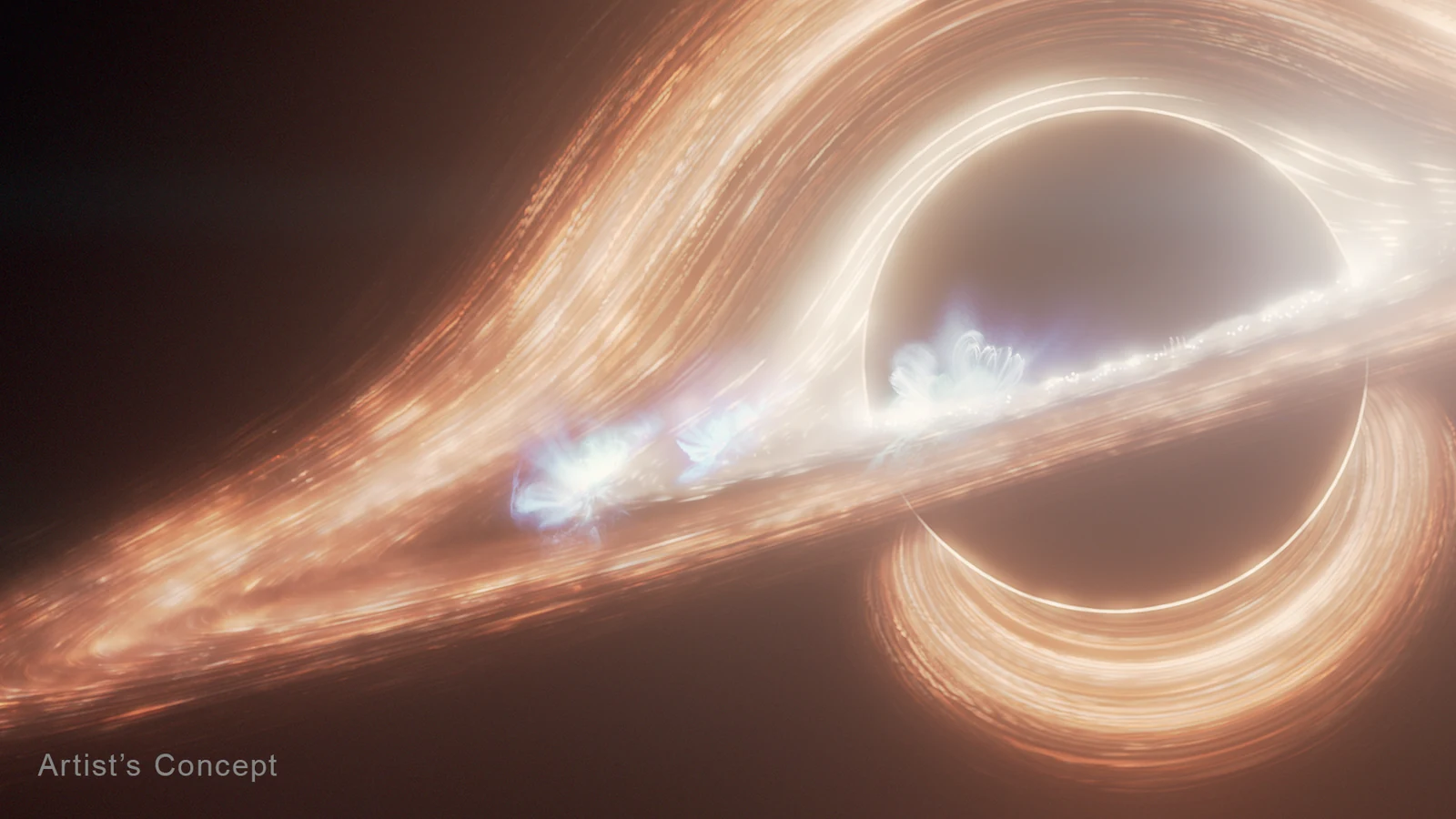
The observational case for black holes combines such gravitational evidence with radiation from their surroundings. Gas in an accretion disk heats as it moves inward and can emit X-rays. Those X-rays come from outside the event horizon.
A mass comfortably beyond what a neutron star can support strongly favours a black hole. Near the boundary, the interpretation is harder. The maximum stable neutron-star mass depends on the behaviour of matter at extreme density and on rotation, so a single rounded cutoff is a poor substitute for uncertainties in both the measurement and the physical model.
A pulse can change the identification
Some neutron stars produce beams of radiation that sweep past Earth as they spin. These pulsar signals provide a repeating clock. Detecting coherent spin pulsations from an accreting source can establish a neutron star even when the source’s exceptional brightness originally suggested something else.
That happened with M82 X-2. In observations reported in 2014, NuSTAR detected pulses from a source previously suspected to contain a black hole. The example remains useful because it exposes the weakness of classifying an object by luminosity alone.
The reverse inference does not work automatically. If no pulse is detected, a neutron star has not necessarily been excluded: its beam may miss Earth, or the signal may be too faint or obscured for the observations. An absence becomes informative only when the observing conditions and the expected signal are understood.
Bursts test whether there is a surface
A separate diagnostic comes from thermonuclear explosions in accumulated gas. Type I X-ray bursts occur when fuel on a compact star’s surface ignites. Research on these bursts explains why their presence supports a neutron-star surface, while their systematic absence from black-hole candidates contributes to the case for event horizons.
This is different from simply seeing an X-ray flare. A changing accretion flow can vary around either kind of object. The nature and timing of the signal matter, not just the fact that the source brightened.
For a newly reported candidate, the most useful question is what observation carries the identification. A measured orbit, a coherent pulse and a thermonuclear burst each address a different property. When those clues agree, the classification becomes much stronger than a dramatic image or a large brightness estimate could make it alone.