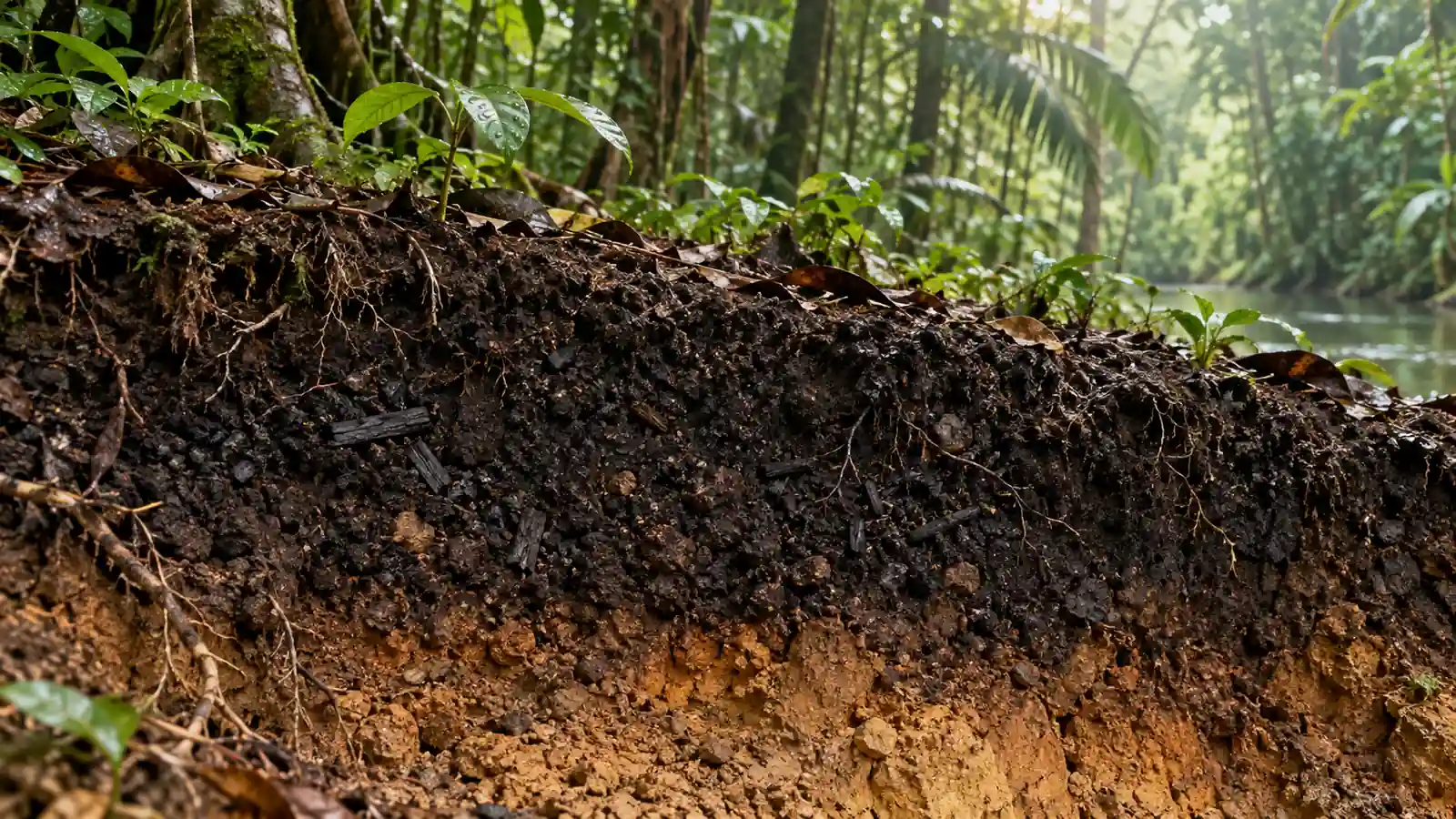
Dig into an old settlement in the Amazon and the ground itself can reveal that people lived there. Beneath the vegetation, patches of dark soil contain charcoal, broken pottery and the remains of everyday meals. The houses may have disappeared. The soil they helped create can still support crops.
Known as terra preta, or Amazonian dark earth, these deposits are among the most revealing traces of the region’s human past. They also pose a practical question: how did people create lasting fertility in places where growing crops can be difficult?
The answer begins with the materials they left behind—and what they did with them.
Keep exploring
Continue with Curiosmos
Why a green forest can stand on poor soil
A dense canopy makes the Amazon look like a place where almost anything should grow. Yet many upland soils are acidic and depleted of nutrients. Researchers studying dark earth describe this contrast as central to understanding why soil improvement mattered.
Terra preta stands out against that background. Its dark color reflects accumulated organic matter and charcoal. Compared with neighboring soils, it can contain more phosphorus and have a greater capacity to retain nutrients that plants need.
Charcoal helps explain the persistence. Some of the carbon produced when plant material burns incompletely resists decomposition, remaining in the ground long after more easily decomposed material has gone. Research summarized by soil scientist Johannes Lehmann at Cornell also describes how charcoal additions can reduce nutrient leaching.
Adding nutrients improves a soil’s supply; retaining them helps keep that supply available. Dark earth combines a history of added material with properties that can make the enrichment last.
Living knowledge connects ancient soil with modern gardens
The people cultivating these soils today offer a way into their history. In the Upper Xingu, researchers could watch soil management in practice, ask farmers about their choices and compare the resulting ground with deposits at ancient settlements.
A 2023 study in Science Advances brought several kinds of evidence together. Researchers worked with Kuikuro communities in Brazil’s Upper Xingu region, documenting soil-management practices and interviewing agricultural specialists. They also analyzed soils at modern villages and archaeological sites.
The present-day practices included spreading ash and organic material and cultivating enriched ground. Comparing old and modern settlements revealed similarities in both soil chemistry and the distribution of dark-earth deposits.
Those parallels support an interpretation of deliberate soil improvement in the ancient Upper Xingu. The argument draws strength from the combination: what people do, what they say about it, and the traces those activities leave underground.
It also places living Indigenous knowledge at the center of the explanation. The researchers could learn about soil management from people who practice it.
The history beneath a garden
The pottery fragments in terra preta are striking. They make an old human presence visible in something that might otherwise look like an unusually rich patch of ground.
Each fragment adds context to the soil around it. Pottery can record cooking, disposal and repeated occupation, while charcoal and food remains preserve other parts of life at the settlement. Together, those traces help researchers reconstruct how the deposits grew.
A 2022 analysis in Nature Communications examined the evidence for human formation of dark earth, including pottery-rich deposits, charcoal, bone fragments and settlement features. The authors also cautioned that chemical enrichment alone is a poor way to estimate ancient population size.
Settlement maps and dates add the scale and chronology needed to investigate how many people lived somewhere and for how long. The chemistry becomes more informative when it can be connected with that wider archaeological record.
That is why soil research complements the earthworks being revealed beneath Amazonian forests. A map can show the shape of a settlement; its soils can help explain the activities that sustained it.
A legacy that still feeds crops and stores carbon
Terra preta’s durability makes it especially interesting to soil scientists. Cornell’s research overview describes long-lasting fertility, alongside an open question about how long particular fields can sustain continuous cultivation.
Modern biochar research draws inspiration from these soils, investigating charcoal’s contribution to nutrient retention. The ancient deposits also preserve generations of organic additions and soil management, giving researchers a richer system to learn from.
There is a second legacy beneath the crops. By combining soil measurements with estimates of deposit area, the 2023 researchers calculated that individual ancient settlements held thousands of tonnes of carbon in their dark earth. Some of that carbon has remained stored for centuries.
A settlement can survive as more than walls, roads or pottery. It can survive in the chemistry of the ground—where the accumulated work of its inhabitants still affects what grows.