Imagine hearing a horn from inside a stone building, with its player hidden somewhere beyond the walls. Where would you think the sound was coming from? At Chavín de Huántar in Peru, that question leads archaeologists toward an intriguing possibility: architecture could help give a ceremonial place a voice.
The evidence brings together objects we usually study separately. There are shell instruments, passages through masonry, a carved stone figure and places where people could gather to listen. Put them together, and a different way of exploring the ancient site begins to emerge.
Start with a shell that still makes sound
In her account of the Chavín acoustic project, researcher Miriam Kolar describes 20 conch-shell trumpets excavated by John Rick’s team in 2001. These instruments, known as pututus, survived in playable condition. Wear around their working surfaces adds another clue that they were used.
Keep exploring
Continue with Curiosmos
Kolar reports that the team measured 19 of the instruments. Their readily produced tones fell between 272 and 340 hertz, approximately the range from C-sharp to F above middle C on a piano. That gives researchers something specific to compare with the building: a range of frequencies, rather than an impression that a room sounds impressive.
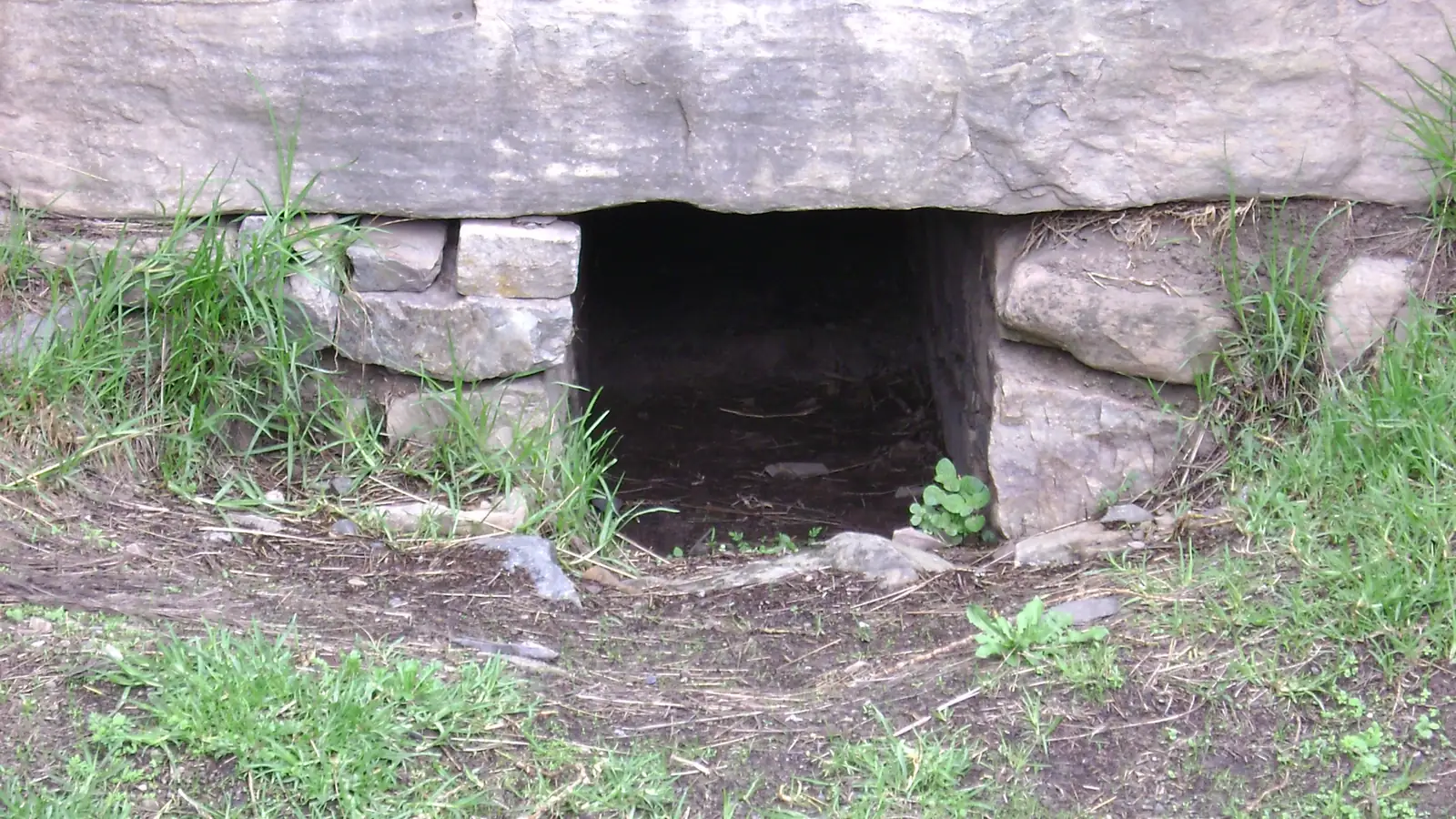
Her account describes ducts connecting the Lanzón Gallery with the Circular Plaza that preferentially strengthen those tones. The central passage also aligns with the mouth of the Lanzón, the great carved monolith inside the gallery. Could sound have helped connect that hidden figure with people outside?
The building becomes part of the instrument
In their 2012 study of the pututus and their architectural setting, Kolar and colleagues examine how the ducts filter sound. Different frequencies travel through them differently, changing the sound that reaches the other end. The researchers propose that this arrangement could have supported a sounding oracle.
Their explanation depends on the relationship between the player, the passage and the listener. Moving a sound source changes the routes available to its sound. The authors explore how the central and flanking ducts might direct a listener’s attention toward the building’s central axis.
They also identify an important reconstruction problem. Parts of the plaza have changed, including its surrounding structures. Measurements of the surviving setting therefore need to be combined with models to explore alternative ancient arrangements.
That is what makes the proposal testable. A reconstruction can specify the assumed walls and openings, place a sound source, and examine what changes when those assumptions change. The proposed ceremony remains an interpretation; the sound paths provide physical questions that researchers can investigate.
What does the listener actually hear?
A microphone records sound at a position. A person makes sense of it. Those are related questions, and an acoustic investigation benefits from both.
Kolar’s research on auditory perception at Chavín includes sound-location experiments in the Laberintos Gallery. Her description of the broader method brings direct measurements together with tests involving human participants and computer-based listening reconstructions, called auralizations.
For a reader, this provides a useful way to examine any claim about an ancient building’s sound. Ask what produced it, where it travelled and where somebody stood to hear it. Then ask which parts were measured and which were reconstructed. An echo alone tells only a small part of that story.
Chavín’s passages and carved monuments invite us to picture people moving through a remarkable place. Acoustic research adds another dimension to that journey. What might a visitor have heard before the person—or object—associated with the sound came into view?