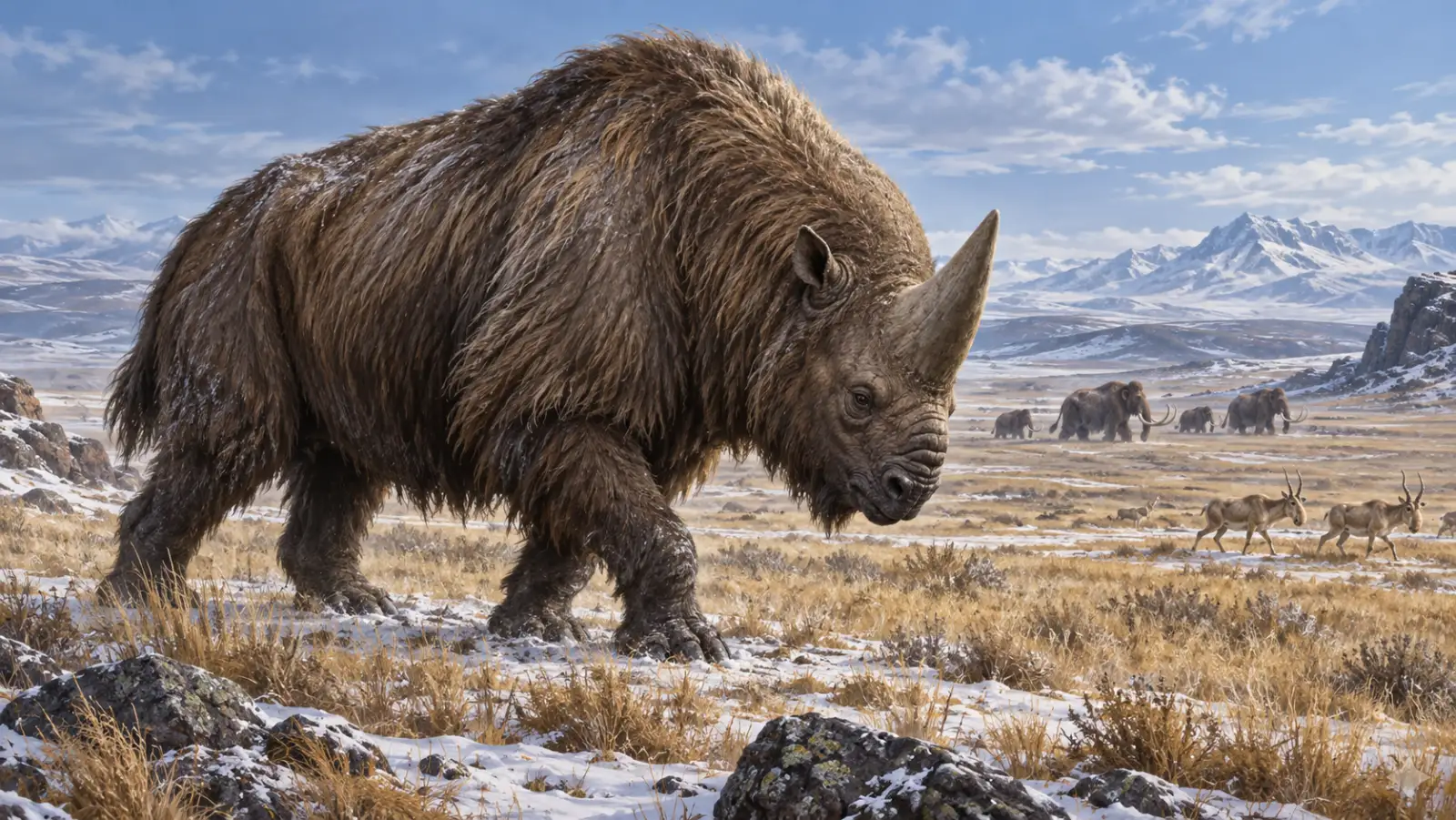
Picture a rhinoceros built for a cold, open plain: several tonnes of muscle, a skull with a high domed forehead, and a muzzle made for cropping tough grass. This was Elasmotherium sibiricum, the Ice Age animal later nicknamed the “Siberian unicorn.” The nickname is memorable, but it hides the more interesting story. This giant rhino survived far later than researchers once thought, and its disappearance may have had more to do with a narrow way of life than with a single dramatic event.
So when did it vanish, and what pushed it over the edge?
The date changed the animal’s story
For years, the last Siberian unicorns were placed roughly 200,000 years ago. That estimate made the animal a distant relic, long gone before our species occupied much of Eurasia. A 2018 study in Nature Ecology & Evolution changed the picture by applying accelerator mass spectrometry radiocarbon dating to 23 individuals from across the animal’s range.
Keep exploring
Continue with Curiosmos
The youngest securely dated remains were at least 39,000 years old. “At least” matters here. It marks the latest dependable evidence in the sample, rather than a precise extinction day. Still, it moves Elasmotherium into the same broad Ice Age world as Neanderthals and modern humans.
The researchers cross-checked the dates with compound-specific radiocarbon work, reducing the risk that old carbon or contamination had made the bones appear younger. Their result was not a story about an animal mysteriously returning from deep time. It was a correction to the timeline based on better measurements.
How can a bone preserve an extinction date?
Radiocarbon dating measures the decay of carbon-14 in preserved organic material. In a well-preserved fossil, collagen can hold the original carbon signal long enough for laboratories to estimate when the animal died. The method becomes difficult at older ages, where tiny contamination can matter, which is why the Elasmotherium team used careful pretreatment and an independent compound-specific test.
A last date is also different from a last sighting. Fossils are unevenly preserved and unevenly found. A 39,000-year-old specimen tells us that the species was alive then; it does not tell us whether a small population survived elsewhere for another thousand years.
A giant made for dry steppe
The same study used stable carbon and nitrogen isotopes to reconstruct the animal’s diet and habitat. The signal points to a grazer living on dry steppe rather than a flexible browser that could switch easily between shrubs, woodland and grassland.
That specialization explains why the Siberian unicorn’s size could be both an advantage and a trap. A huge body helps an animal travel and digest poor forage, but it also demands a steady supply of the right plants. When cold-steppe environments shifted, fragmented or became wetter, a specialist had fewer options than a generalist.
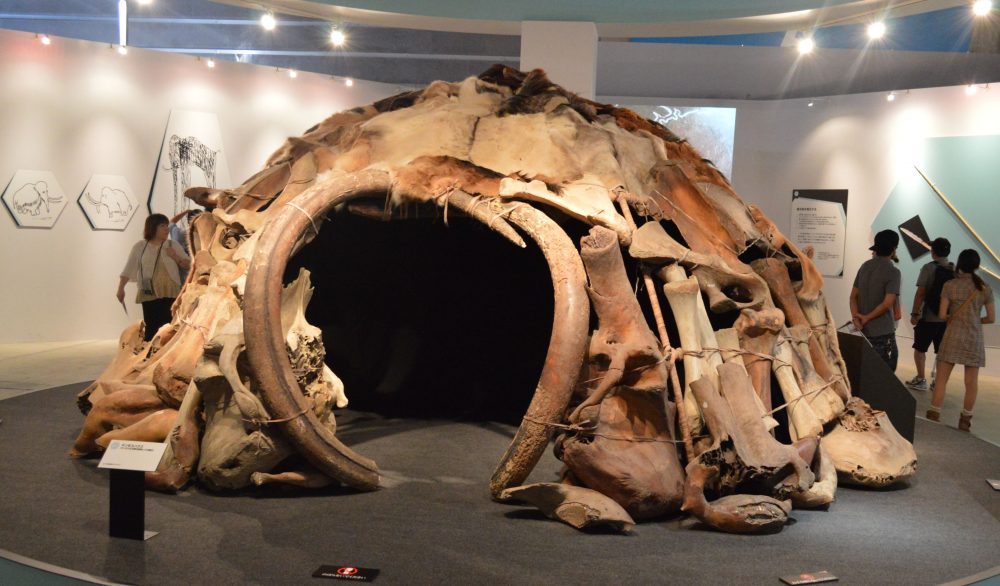
There is a useful comparison in the Curiosmos archive. A separate report on a 25,000-year-old structure made from mammoth bones shows how closely Ice Age people and megafauna shared the same changing landscapes. The comparison is not evidence that the two stories had the same cause; it is a reminder that climate, animals and human settlement were moving through one connected environment.
Did humans hunt it out of existence?
Humans lived in parts of the Siberian unicorn’s range, so the question is unavoidable. The 2018 research, however, found no evidence that people alone caused the extinction. The fossil record does not currently provide a chain of confirmed kill sites or a clear pattern of human butchery that would settle the case.
That leaves a more complicated possibility. A specialised grazer could have been weakened by habitat change, shrinking populations and the pressures that come with sharing a landscape with people. Those factors can interact without leaving one simple signature in the bones. At present, the evidence supports ecological vulnerability more strongly than a single human-driven explanation.
Was it really a one-horned “unicorn”?
The popular image is also less secure than the nickname suggests. Researchers infer a large horn from the animal’s skull and nasal anatomy, and reconstructions commonly place one horn above the nose. But, as the French National Museum of Natural History notes, no fossilised horn has been found. The horn in illustrations is a reasoned reconstruction, not a preserved object.
That distinction does not make the animal less remarkable. It makes the picture more honest. We have a massive rhinoceros skull, dated bones, dietary chemistry and ancient DNA—not a complete portrait of an animal waiting to be coloured in.
The last branch of an old rhino family
Genetic work places Elasmotherium on a deep branch of the rhinoceros family tree, separate from the line that produced living rhinos. Its extinction therefore removed an entire specialised experiment in rhinoceros evolution, rather than simply one local population.
That is why the Siberian unicorn still matters. Better dating brought it into a world of people, mammoths and rapidly changing steppe. The evidence does not point to a lost mythical creature. It points to a real animal that lasted longer than expected, depended on a demanding habitat and disappeared while the Ice Age was still in motion.
Sources and further reading
- Kosintsev et al., “Evolution and extinction of the giant rhinoceros Elasmotherium sibiricum,” PubMed record.
- The primary study in Nature Ecology & Evolution.
- Natural History Museum, “The Siberian unicorn lived at the same time as modern humans”.
- French National Museum of Natural History, “Was the Siberian unicorn really a unicorn?”.