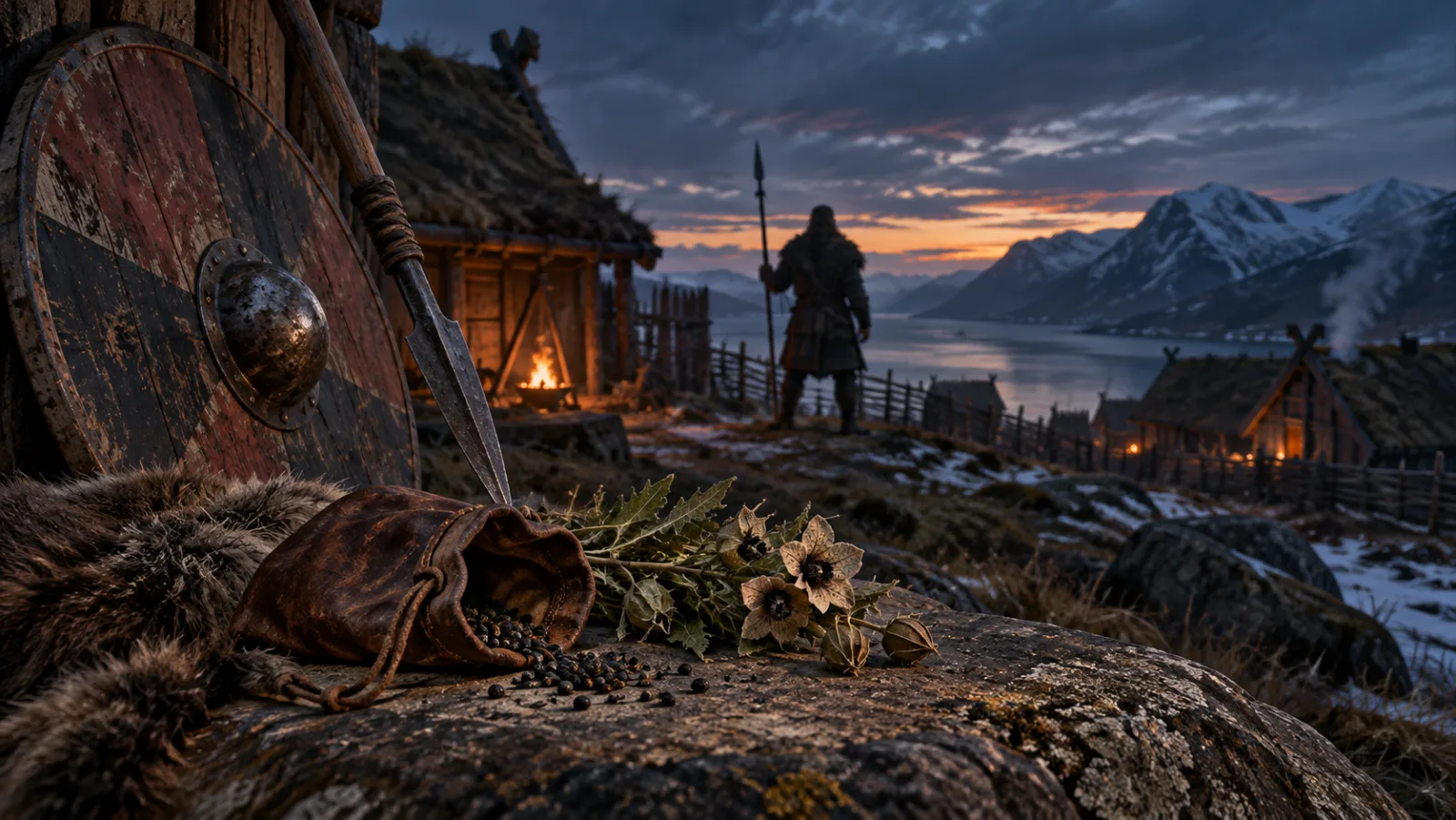
The Viking berserker is one of history’s most durable images: a warrior who howls, bites his shield and enters battle in a state that seems to sit somewhere between ritual and rage. One explanation has become especially popular in recent years. Perhaps berserkers took a psychoactive plant before fighting—possibly black henbane, a poisonous species known to produce delirium, hallucinations and agitation.
It is an arresting idea. It is also much easier to repeat than to prove.
Where did the henbane theory come from?
The theory is built from separate pieces of evidence rather than a single Viking account. A woman buried near the Viking ring fortress of Fyrkat in Denmark was found with several hundred henbane seeds, a metal staff, unusual imported objects and other items that have led archaeologists to identify her as a possible völva, or seeress.
The National Museum of Denmark treats the seeds as evidence that the plant had a special place in the burial. They might have been used for medicine, anaesthesia or ritual smoke. The grave does not, however, say that the woman supplied warriors with a battle drug. That step is an interpretation layered onto the objects.
What does henbane do?
Black henbane (Hyoscyamus niger) contains tropane alkaloids, including hyoscyamine and scopolamine. In the wrong dose, the plant can cause confusion, a racing heart, dry mouth, blurred vision, delirium and loss of coordination. Those effects are not the same as becoming stronger or gaining reliable control in a fight.
A 2019 paper in the Journal of Ethnopharmacology compared the symptoms associated with henbane and fly agaric mushrooms with descriptions traditionally linked to berserkers. The authors argued that henbane could fit some of the reported signs better than Amanita muscaria. They also acknowledged the central problem: there is not enough archaeological or historical evidence to establish that berserkers actually used it.
What does the Fyrkat grave prove?
The Fyrkat burial makes three points reasonably secure. Henbane was present in a Viking Age grave. The seeds had been gathered and kept together, probably in a small container or pouch. The woman’s burial included objects associated by archaeologists with unusual ritual or specialist roles.
It does not identify the plant’s purpose. Seeds can be carried as medicine, a poison, a raw material or a symbol. The National Museum notes that henbane smoke can produce a mild hallucinogenic effect and that the plant was used in later periods for medicinal and magical purposes. Later use helps us understand the plant’s possibilities; it does not turn a tenth-century grave into a written instruction manual.
Why the famous mushroom story is shaky
The older popular explanation points to fly agaric mushrooms, the red-and-white fungi associated with Siberian and northern Eurasian ritual traditions. But no Viking text says that berserkers ate fly agaric before combat. The link was proposed centuries after the Viking Age by comparing Scandinavian stories with accounts from other regions.
That does not make the mushroom hypothesis impossible. It means the evidence is indirect. The henbane theory has one advantage in that a Viking burial provides a physical Scandinavian example of the plant. It still lacks the crucial bridge from one person’s grave to a class of male warriors described mainly in later literature.
What do the written sources actually describe?
Most detailed descriptions of berserkers come from medieval Icelandic texts written after the period they describe. They preserve valuable traditions, but they are not battlefield reports recorded by eyewitnesses. Their berserkers can be literary characters, social types, enemies or symbols of uncontrolled violence.
The word itself is debated, as are the behaviours attached to it. Some accounts emphasise animal skins and extraordinary strength; others describe a battle frenzy, exhaustion or a period of weakness afterwards. A chemical explanation must fit that uneven record without treating every dramatic saga scene as a clinical observation.
Could a plant have been part of the ritual?
Possibly. Viking communities knew useful and dangerous plants, and archaeobotanical evidence shows that seeds and herbs could travel with people. The Fyrkat woman’s grave is a strong reminder that plants could be part of ritual identities as well as ordinary medicine.
But a plant might have supported a ritual without causing a berserker trance. Smoke, scent, fasting, music, costume and group expectation can all alter how a ceremony feels. A warrior preparing for combat may have entered a highly focused state through a whole set of practices, with no intoxicant at all.
One Curiosmos report on a Viking silver hoard found in a Danish backyard offers a useful reminder about this kind of evidence: objects can show contact, wealth and movement, but they do not automatically reveal the intention behind every object. The same caution belongs here. Seeds can show presence; they do not, by themselves, show a battlefield dose.
So, did henbane make berserkers “go berserk”?
The honest answer is that we do not know. Henbane is pharmacologically capable of producing altered states, and the Fyrkat burial shows that it was present in Viking Age Denmark. A modern study has proposed that its effects fit some berserker descriptions better than the mushroom theory does.
Those are worthwhile clues. They are not proof of a berserker recipe. The strongest interpretation is narrower: henbane may have been one plant known to specialist practitioners in the Viking world, and it may have entered rituals associated with prophecy, healing or altered consciousness. Whether it was used by berserkers before battle remains an open question that archaeology has not yet settled.
Sources and further reading
- National Museum of Denmark, “A seeress from Fyrkat?”.
- Ristic et al., “Sagas of the Solanaceae: Speculative ethnobotanical perspectives on the Norse berserkers,” Journal of Ethnopharmacology (2019).
- Heath and Cooper, “Wearing the wolf skin: psychiatry and the phenomenon of the berserker in medieval Scandinavia” (2021).
- Karg and colleagues, “Viking Age garden plants from southern Scandinavia,” Danish Journal of Archaeology.