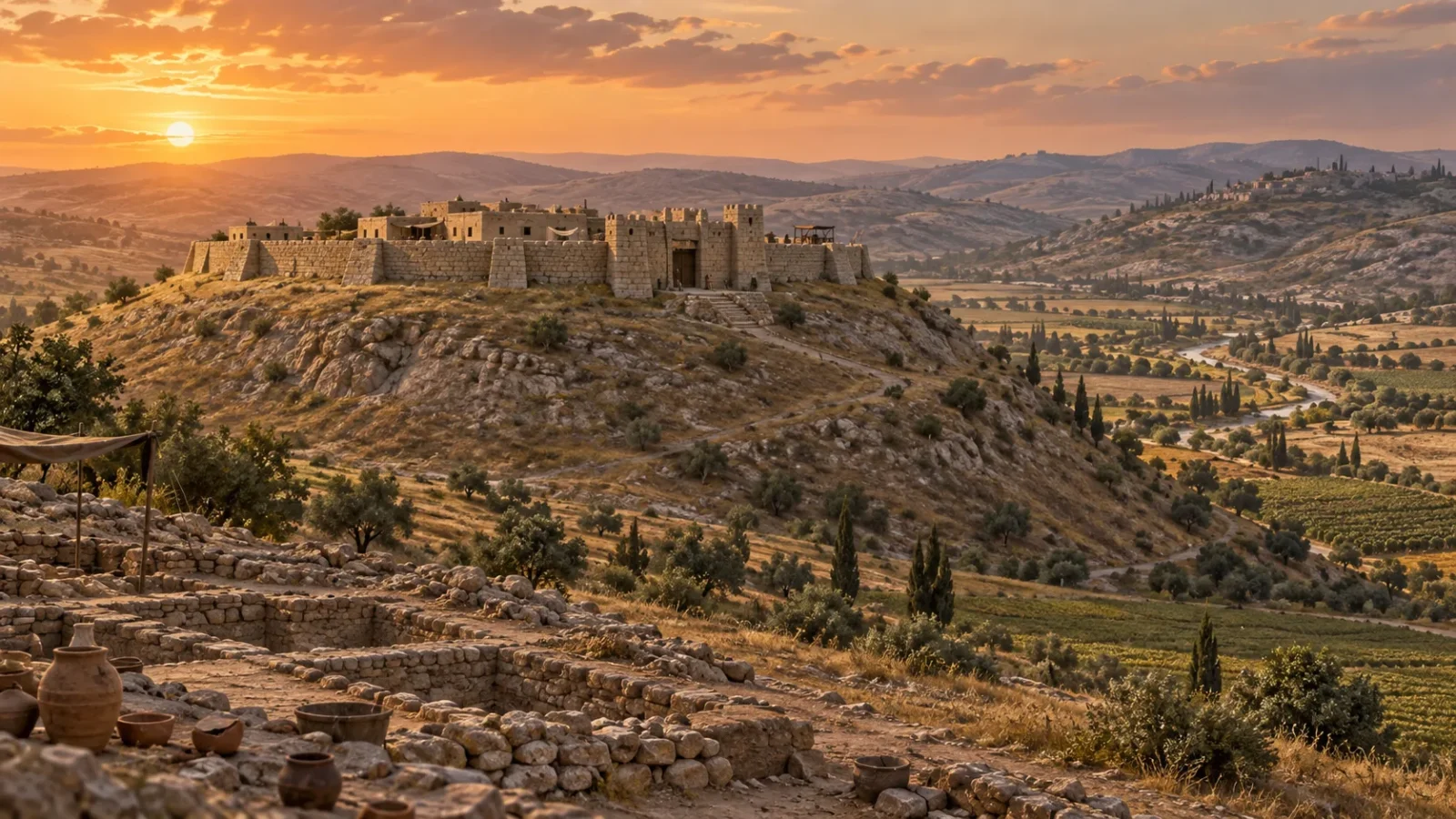
A low, flat-topped mound rises beside Nahal Guvrin in the Judean Shephelah. From Tel Burna, the ground opens toward the coastal plain in one direction and the hill country in the other. Archaeologists have found a settlement with Bronze and Iron Age layers here, and some believe the site may be the biblical city of Libnah.
The location makes the suggestion easy to picture. The excavated walls and gates give it substance. The name, though, has not turned up in an inscription, so researchers have to weigh the landscape, the dates and the remains together.
A settlement on a busy border
The Tel Burna project records occupation from the Bronze Age through the Persian period, with important phases in the Late Bronze Age and Iron Age. Nearby routes linked Judahite and Philistine territories. From the mound, residents could watch farmland and movement between the coastal plain and the hills.
Keep exploring
Continue with Curiosmos
A town in this position could have served as a fortified post or local centre without being a large capital. Its location helps explain why the site mattered; it does not settle what ancient people called it.
Why Libnah is part of the discussion
Libnah appears in biblical accounts as a town associated with Judah. The passages place it in different settings, including conflict with Judahite kings and an Assyrian siege. They also name Hamutal, a queen of Judah, as coming from Libnah.
Archaeologists consider Tel Burna a candidate because its position and periods of occupation fit parts of that picture. The site also has defensive architecture suited to a settlement near a contested border. Each clue adds weight, but none acts as a label on its own.
Walls, a gate and a changing summit
An Israel Antiquities Authority report describes a casemate fortification built during Iron Age IIA. The excavators have not yet settled whether its first phase belongs in the tenth or ninth century BCE. A casemate wall consists of parallel walls joined by partitions, leaving chambers within the defensive line.
The summit changed as people used it. Excavators found a later gate and a drainage channel. By the seventh century BCE, some inner chambers were no longer in use, while the outer wall remained. Houses and storage spaces altered the site again.
That sequence suggests a settlement adapting to new needs rather than a fortress frozen in time. The IAA report also describes the Iron Age occupation as possibly a smaller community centred on a stronghold, not necessarily a fully fortified city.
The name still has to be tested
No excavated inscription names Tel Burna as Libnah. The identification rests on geography, chronology and the type of settlement found on the mound. Other locations have also been proposed, which is why the case remains open.
A surface survey by Joe Uziel and Itzhaq Shai recorded Bronze and Iron Age occupation and argued that Tel Burna was important along the Judah-Philistine border. The authors presented Libnah as a possibility to examine, not a conclusion already settled by the finds.
More precise dates for the fortifications and clearer evidence about how the site was used could strengthen the comparison with the written accounts. An inscription would be a rare, direct answer; in its absence, the argument has to grow from several independent clues.
Stand on the summit and the site’s strategic position becomes obvious. You can see why people have looked for Libnah here. The open question is whether the walls and dates will continue to fit as the excavations reach older and newer parts of the mound.
Sources and further reading
- Tel Burna Excavation Project: About the Site
- Israel Antiquities Authority: Tel Burna preliminary report
- Uziel and Shai, “The settlement history of Tel Burna”
For a broader look at how archaeologists trace vanished settlements, see Ancient Lost Cities: How Archaeologists Find Places That Disappeared.