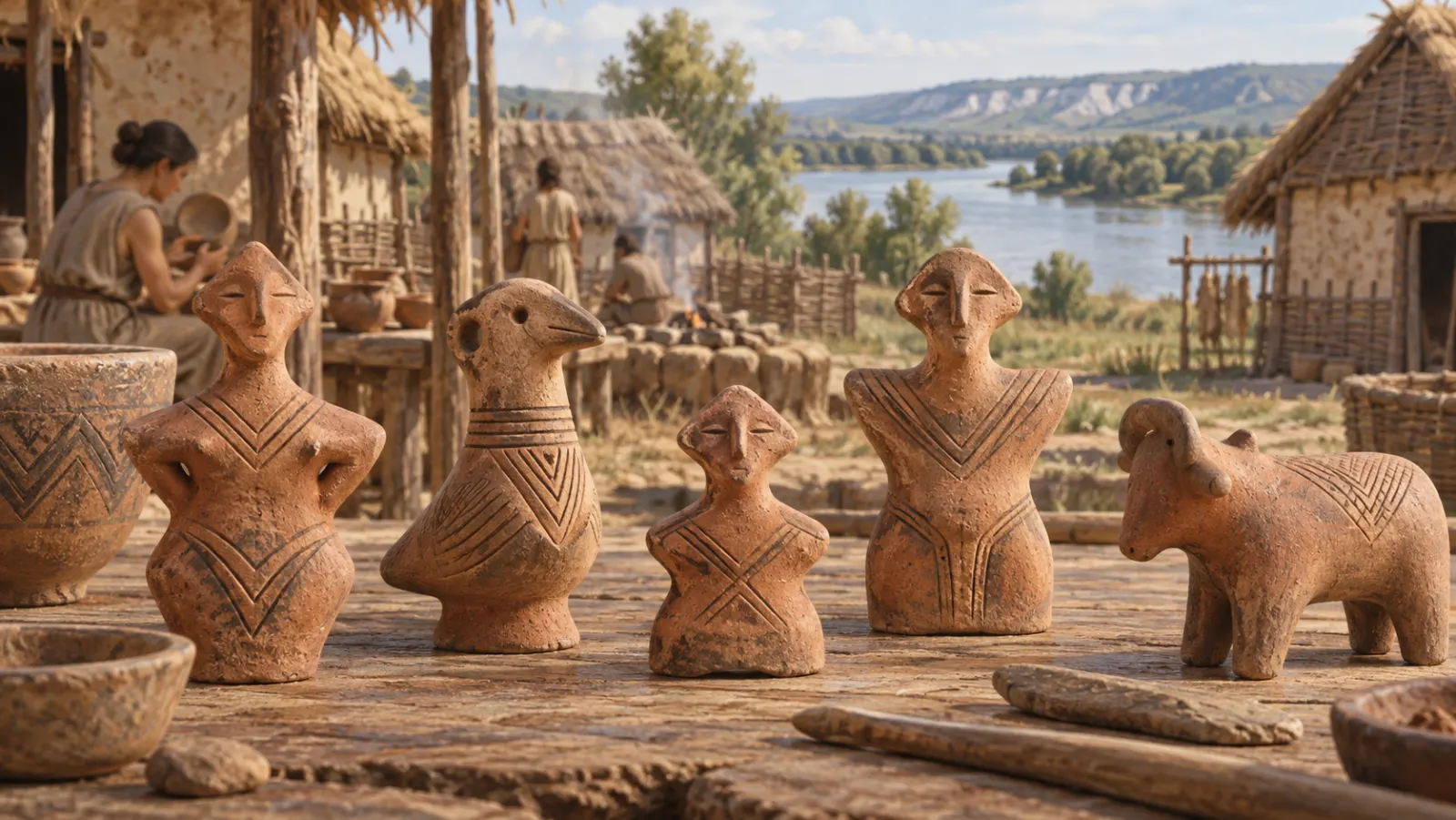
Some of the clay figures made in Neolithic Serbia stare out with wide eyes and sharp, bird-like faces. They are small objects, yet they have inspired large claims: goddesses, ancestors, toys, even visitors from another world.
At Vinča-Belo Brdo, near Belgrade, the figurines came from a settlement where people farmed, fished, built houses and worked clay between roughly 5300 and 4500 BC. They were part of that material world. Their exact roles remain uncertain, but their findspots and the way they were made offer more to work with than appearance alone.
A face made from clay
Vinča figurines are small ceramic forms, often with detailed faces, arms and clothing. Some are recognisably human; others combine human and animal features. Incised lines mark bodies and garments.
Keep exploring
Continue with Curiosmos
The National Museum Kraljevo preserves one striking example from Divlje Polje, a younger Neolithic settlement near Kraljevo. It was found in fragments. The figure has a bird-like face and arms resting across its abdomen. Parallel cuts around the neck may show clothing or body markings. A hole at the top could have let it hang from a cord; a spiral and a broken meander were carved into its back.
These are choices made by a craftsperson: how the figure would face, how its body would be marked, whether it could be carried or hung. The details invite questions, even though they do not provide a caption for the object.
Goddesses, ancestors and household figures
Earlier writers often grouped prehistoric female figures under the label “mother goddess.” The shape of a body or the care given to its face can suggest a sacred image to modern eyes, but a figurine could stand for an ancestor, a household member, a masked performer, a spirit or an imagined being. Some may have been made for display, teaching or play.
Nenad Tasić’s study of figures from recent Vinča excavations looks at their shapes and markings as evidence of symbolism, while leaving room for differences between objects. They do not all have to represent one deity or serve the same purpose.
Archaeologist Marko Porčić tried a different approach. He estimated how many figurines might have been in use across Late Neolithic Vinča households. His model compares the number of accumulated houses and figures under possible use patterns. One scenario, with about one figurine per household lasting roughly a generation, produces numbers similar to the archaeological record.
That is a thought experiment built on assumptions, not a census of actual homes. Still, it gives researchers a way to ask whether some figures were part of ordinary domestic life. A clay object kept near a hearth might travel with a family, be replaced or be broken when a house was rebuilt.
Broken figures and the rooms they came from
Many figurines survive in pieces. Heads, arms and bodies may have broken by accident, during later disturbance or through deliberate handling. Archaeologists look at where fragments were found, whether they fit together and whether the break happened before or after burial in the ground.
Findspot matters. A figure from a house floor invites different questions from one placed in a burial or special pit. A hole at the top may suggest suspension; a flat base may have let another figure stand upright. Similar-looking pieces can have had different lives.
Vinča-Belo Brdo was a long-lived settlement with successive building layers, farming, animal husbandry, fishing on the Danube and specialised ceramic production. The figurines belonged among houses, pottery, tools and ornaments. They were part of daily life even if their precise use remains a matter of study.
Why the faces still surprise us
Photographed alone against a dark background, the large eyes and pointed noses can look startlingly unfamiliar. In the settlement, those forms belong to a local visual tradition, alongside the shapes and markings used on other objects. The face may have mattered to its maker and owner without depicting a real person or a god.
A careful comparison between settlements may reveal whether certain features travelled, changed or belonged to a particular household practice. A well-documented floor, a sealed deposit or a residue on one figure could tell us more about use than another dramatic portrait.
Some figurines may have represented people; others could have carried meanings that changed from one home to the next. The surviving clay keeps the maker’s decisions and loses the words that accompanied them. What would you want to know first: who the figure represented, where it was kept, or why someone chose to break it?
Sources and further reading
- Anthropomorphic figurines from Vinča excavations 1998–2009, Nenad Tasić, Documenta Praehistorica 38 (2011).
- A Tentative Attempt to Estimate the Systemic Number of the Late Neolithic Vinča Culture Figurines, Marko Porčić, Issues in Ethnology and Anthropology 6(3) (2011).
- National Museum Kraljevo figurine record.
- Vinča–Belo Brdo archaeological-site overview.
- Belgrade City Museum: Belo Brdo archaeological site.
For a related Curiosmos look at an undeciphered object that has inspired competing readings, see The Phaistos Disc: A 3,800-Year-Old Archaeological Mystery.