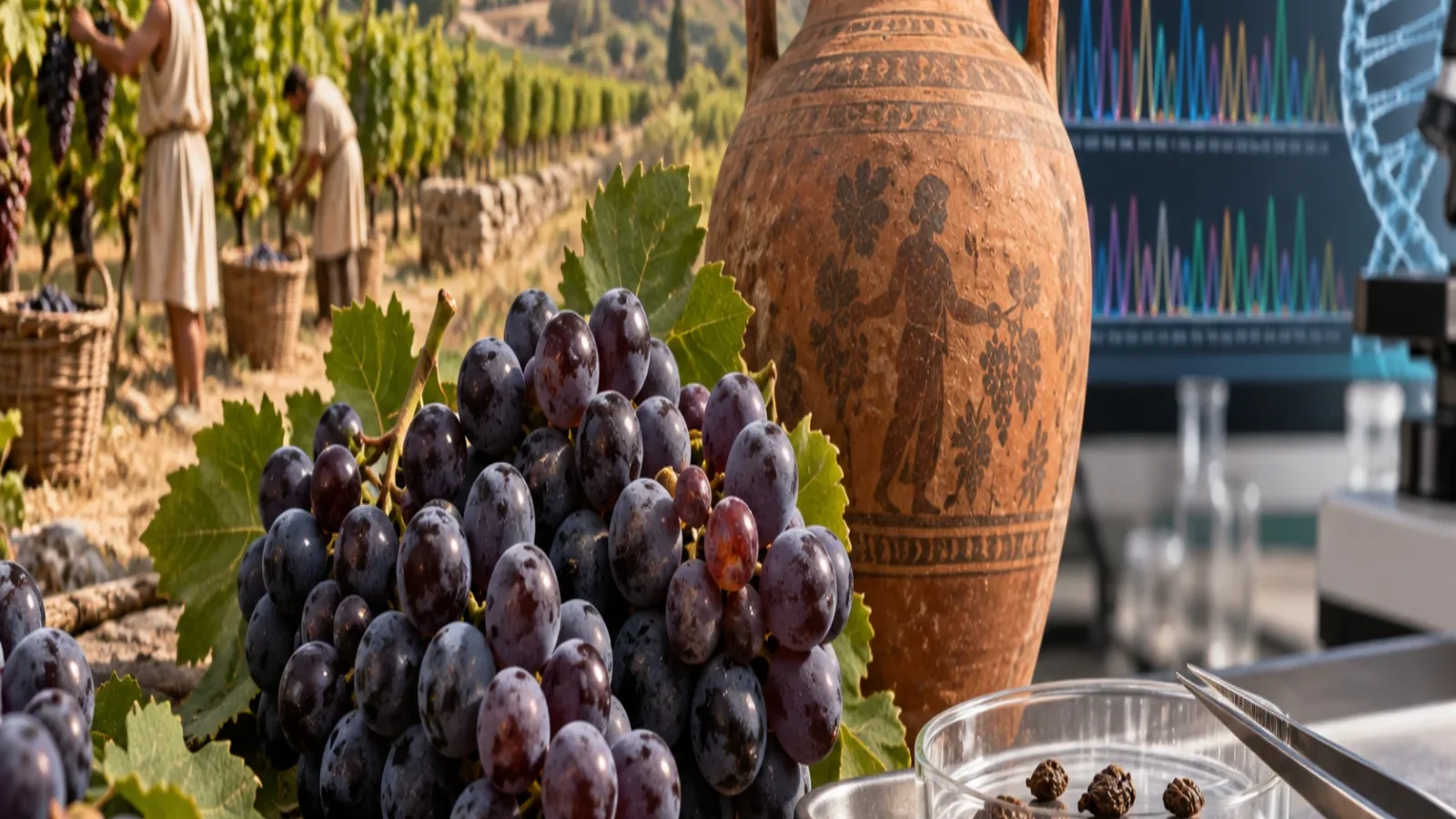
At Cetamura del Chianti, grape seeds survived in waterlogged wells long after the vines that produced them were gone. A 2026 study examined 80 seeds from deposits dated between about 300 BC and AD 1200. Their DNA links vineyards across time and distance, from Etruscan and Roman Tuscany to later grape varieties in France and Hungary.
The seeds are tiny, but they preserve more than a hint of what people once grew. Read alongside the wells and the archaeological record, they offer a way to trace how grape cultivation continued and changed as Roman rule spread through the region.
From a well to a genetic record
Wet, oxygen-poor deposits can preserve seeds and fragments of genetic material. The research team combined genome-wide DNA testing with near-infrared spectroscopy and geometric measurements. First, they assessed which seeds retained enough of their own DNA for comparison.
Keep exploring
Continue with Curiosmos
That step matters because soil can introduce modern material, while old DNA breaks into short, damaged fragments. The researchers report their sequencing data through the European Nucleotide Archive, where other teams can examine and compare the results.
Vines that crossed centuries
Most of the seeds studied came from domesticated grapevines associated with winemaking. One clonal line appears to have been maintained across several centuries, from the Etruscan into the Roman period at Cetamura. Another seed was closely related to a Roman grape from Mont Ferrier in southern France. A third showed an affinity with the modern Hungarian variety Baratcsuha szurke.
That last link does not mean a Tuscan farmer grew today’s Hungarian variety in exactly its current form. It points to a relationship between grape lineages. Vines can be propagated, moved and crossed while growers change how they tend them and what they make from the harvest.
White and dark grapes in ancient Chianti
Genetic markers suggest the dominant clonal line probably produced white berries. The team also found evidence consistent with dark berries. Ancient vineyards at Cetamura, then, were not necessarily all one colour.
Berry colour cannot tell us the flavour of a Roman wine. Pressing, fermentation, blending and storage all shape a drink. DNA helps identify inherited traits; other chemical and archaeological evidence would be needed to reconstruct a recipe.
Roman rule changed the region, not every vine
Viticulture was established in the Chianti area before the Roman conquest, and some grape material continued across the political change. The genetic links with distant seeds suggest that vines or cuttings also travelled through wider networks.
Earlier research on Chianti proposed that changes in grape-seed size around 200 BC reflected new ways of managing vineyards, rather than the sudden arrival of an entirely different grape. That fits a familiar pattern in farming: pruning, training and trade can reshape a vineyard even when some of its plants remain.
The Cetamura samples cannot name a Roman variety without a securely identified historical label. A single seed also cannot prove that a modern vineyard is genetically identical to an ancient one. What the study gives us is a set of comparisons that can be tested as more ancient and modern grape genomes are added.
Some vines may have survived through careful cutting and replanting; others branched into new varieties as growers moved them between regions. In those old wells, the seeds preserve a record of both continuity and change.