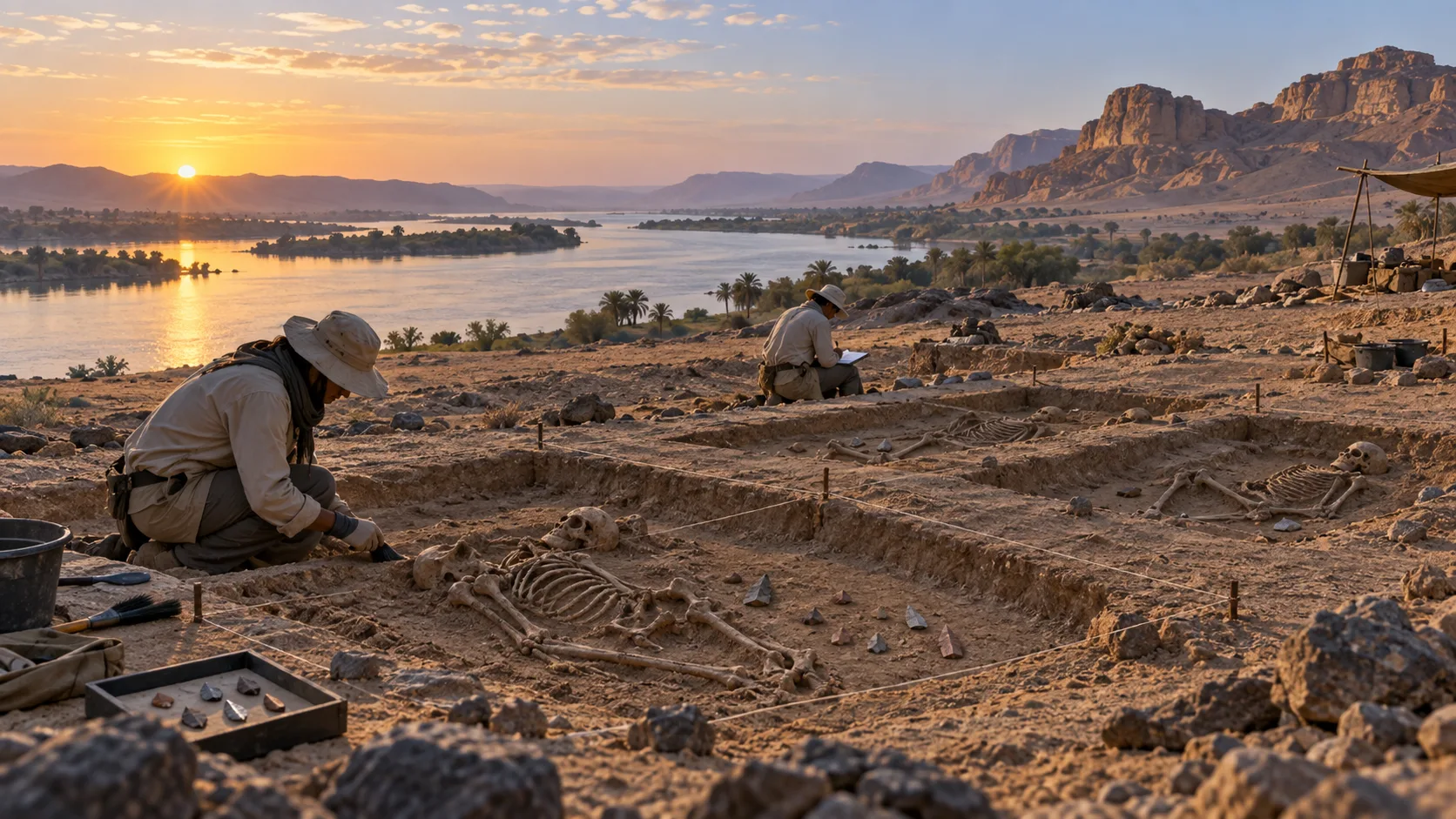
Jebel Sahaba, also known as Site 117, was excavated in the 1960s in what is now northern Sudan. The cemetery contained the remains of 61 people, including children. Many had injuries, and stone points were found with some of the burials. The evidence is real. The tidy story built around it was not.
Why was Jebel Sahaba called the first war?
The original excavation made the cemetery famous because so many skeletons showed signs of trauma. Some had marks consistent with projectile impacts. Others contained pieces of stone in or around the bones. Men, women and children were affected.
That pattern seemed to fit a dramatic explanation: an armed conflict had killed a community and left its dead together in one place. The phrase “the first war” was easy to remember, especially when the site was described as more than 13,000 years old.
But a cemetery is not a battlefield. The position of a body tells archaeologists about burial, not automatically about the circumstances of death. A group of people can be buried together after separate events, and a graveyard can be used more than once.
What did the new study examine?
In 2021, an international team returned to the Jebel Sahaba collection and reanalysed the human remains, the stone artefacts and the burial evidence. The study, published in Scientific Reports, identified more than 100 previously undocumented healed and unhealed lesions.
The researchers looked closely at the shape, location and microscopic character of each injury. They also reassessed the lithics found near the skeletons. Many were consistent with parts of composite projectile weapons rather than ordinary objects placed as offerings.
The distinction between healed and unhealed trauma matters. An injury that healed shows that a person survived an earlier violent episode. A wound sustained around the time of death shows a later event. When both appear in the same cemetery, a single massacre becomes a poor fit.
The team found that roughly 62 percent of the individuals with diagnosable remains had healed or unhealed trauma, while about a quarter showed injuries around the time of death. The exact percentages depend on which skeletons and lesions can be diagnosed, but the pattern is clear: violence happened repeatedly, and not everyone was killed in the same episode.
Was it a war between armies?
The reanalysis rejected the idea that Jebel Sahaba records one organized war. It instead supports recurrent, small-scale interpersonal violence—perhaps raids, ambushes or skirmishes involving groups that met repeatedly.
That does not make the evidence less serious. It changes the question. A war implies a defined conflict, opposing forces and a sequence that can be reconstructed. Jebel Sahaba does not provide that kind of record. It provides bodies, wounds, projectiles and a burial place used over time.
Some of the dead may have been victims of attacks. Others may have survived earlier encounters before being buried later. The cemetery may even have been a place where people from a wider region were brought after violent deaths. Archaeology cannot turn those possibilities into a single narrative without losing the uncertainty that the evidence demands.
Why might the violence have become recurrent?
The cemetery belongs to the end of the Late Pleistocene, a period when climate and landscapes were shifting. In the Nile Valley, groups who relied on fishing, hunting and gathering were living in a region where water, animals and usable ground were not distributed evenly.
The 2021 researchers argue that environmental and territorial pressure probably contributed to the violence. That is a context, not a simple cause. Climate change does not automatically produce conflict, and the bones cannot reveal the motives of the people who carried the weapons.
The pattern could reflect competition over places where food and water remained reliable. It could also reflect tensions between groups with different seasonal routes or social ties. The study cannot identify the language anyone spoke, the name of any group or the event that produced a particular wound.
What happened to the site?
Jebel Sahaba was excavated during a UNESCO-backed salvage campaign connected with the construction of the Aswan High Dam. The cemetery is now submerged beneath Lake Nasser. The collection, field records and associated objects later entered the British Museum’s Wendorf Collection, where they could be studied again with modern methods.
That history is part of the evidence. The reanalysis depended on comparing bones with excavation notes, photographs and associated artefacts. It also shows why old discoveries should not be treated as finished stories. New methods can change the interpretation without changing the objects themselves.
The site’s date has also been examined more carefully. Direct radiocarbon work places the cemetery at least 13,400 years old, with dates extending into the later part of the Late Pleistocene. The range makes Jebel Sahaba one of the earliest known cemeteries in the Nile Valley and one of the oldest places where repeated interpersonal violence can be studied at this scale.
What can the bones really tell us?
They can show that people were struck, cut or hit by stone projectiles. They can show which injuries healed and which did not. They can show that violence affected different ages and sexes, and that a burial place was reused.
They cannot tell us that a “world war” happened. They cannot name an enemy, recover a speech or prove that every person in the cemetery died during an attack. Those limits are not a weakness. They are the line that keeps a dramatic archaeological site from becoming a dramatic fiction.
Jebel Sahaba is better understood as a record of people living through repeated danger. Its story is not that war suddenly appeared in one terrible morning. It is that violence can become part of daily life when groups face pressure, move through the same constrained landscape and carry memories of earlier encounters.
For a wider look at how archaeology reconstructs lost societies from incomplete evidence, see How Do Archaeologists Know a Wall Was a Border?.
Sources and further reading
- New insights on interpersonal violence in the Late Pleistocene, Scientific Reports.
- PubMed record for the Jebel Sahaba reanalysis.
- Jebel Sahaba: A succession of violence rather than a prehistoric war, CNRS.
- Violence and climate change in prehistoric Egypt and Sudan, British Museum.
- Jebel Sahaba collection record, British Museum.