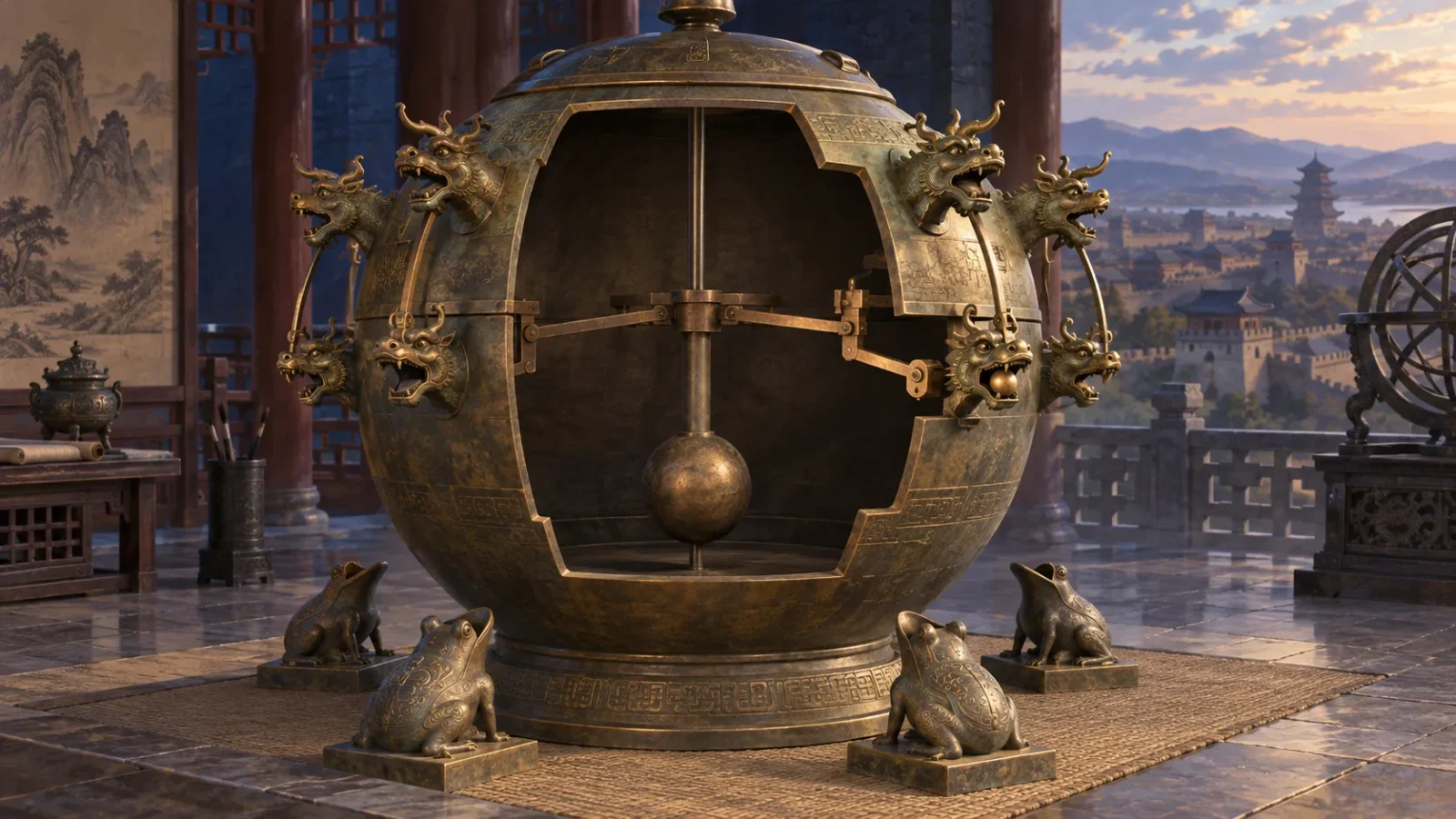
When an earthquake shook Longxi in AD 138, people in the Han capital reportedly felt nothing. Yet a bronze instrument in Luoyang released one of its balls and pointed toward the distant tremor. A messenger later confirmed the news, according to the account.
The story is striking, though it comes from a historical text written after Zhang Heng’s lifetime. The instrument itself has not survived. What we have is a description of a vessel designed to turn an unseen earthquake into a signal people could read.
A bronze vessel with eight dragons
The Book of the Later Han describes a large bronze vessel surrounded by eight dragons. Each dragon held a ball above a frog. When the mechanism inside was triggered, one ball dropped into the matching frog’s mouth. Its position showed the direction from which the shaking had come.
Keep exploring
Continue with Curiosmos
People often call it the first seismograph, but that word suggests a written trace or measurement. Zhang Heng’s device did neither. It was a seismoscope: it signalled that an earthquake had occurred and indicated its approximate direction.
The dragons and frogs made the result visible, and the falling ball would have made a sound. The delicate work was hidden inside the vessel, where a moving part had to react to a tremor without being set off by ordinary movement.
How could it detect shaking?
Most modern reconstructions use inertia. When the ground and the instrument move together, an internal mass resists the motion briefly. The difference between the mass and the vessel can release a catch; gravity then drops one of the balls.
The written description does not specify exactly how Zhang Heng arranged those parts. Engineers have proposed different internal mechanisms, and each replica reflects choices made by its designers. The Smithsonian’s display, for example, is a modern reconstruction, not a surviving Han original.
A 2006 engineering study compared the historical account with possible mechanisms. Later experiments have tested how reconstructed devices respond to motion from different directions. These models help show what could work. They cannot prove which design Zhang Heng actually built.
The famous Longxi test
The dropped ball followed by news from Longxi is often presented as proof that the seismoscope accurately located an earthquake. It is better treated as a report about the instrument’s intended use. We have no surviving measurements of the quake, a record of how the device was set up, or a series of trials against which to judge its precision.
Even so, the purpose makes sense. In a vast empire, word of a disaster could arrive slowly. A signal in the capital might tell officials where to send a messenger or organize help. The seismoscope could report shaking after it happened; it was not an early-warning system.
A lost device, an enduring idea
Modern seismometers use electronic sensors and networks of stations to measure ground motion. Zhang Heng’s instrument relied on a moving mass, a trigger and a falling ball. The technology is worlds apart, but both begin with the same physical problem: how to register movement at a place where people may not feel it themselves.
We may never know whether the internal mechanism used a suspended mass, a pendulum-like part or a design not yet proposed. Replicas can test the physics and make the old description easier to picture, but the original device is gone.
Its surviving account still captures an ambitious idea: a bronze vessel could turn a distant tremor into an event visible across a room, and point people toward the place where the ground had moved.
Sources
- Chinese Academy of Sciences, “Scientific Nature and Historic Contribution of Zhang Heng’s Seismometer.”
- “Reconstruction design of the lost seismoscope of ancient China,” Mechanism and Machine Theory.
- Smithsonian Institution, Chinese seismoscope replica.
- Chinese Text Project, historical account of Zhang Heng’s seismoscope.
For another look at the devices people built before modern machinery, see Curiosmos’ guide to ancient tools and inventions.