Did brass-making reach China by sea? Three Guangzhou brass crucibles offer new clues. Dated to the ninth or tenth century, they preserve the earliest direct evidence yet identified for brass production in East Asia. Chinese texts described brass earlier; what archaeologists lacked was a physical record of its manufacture.
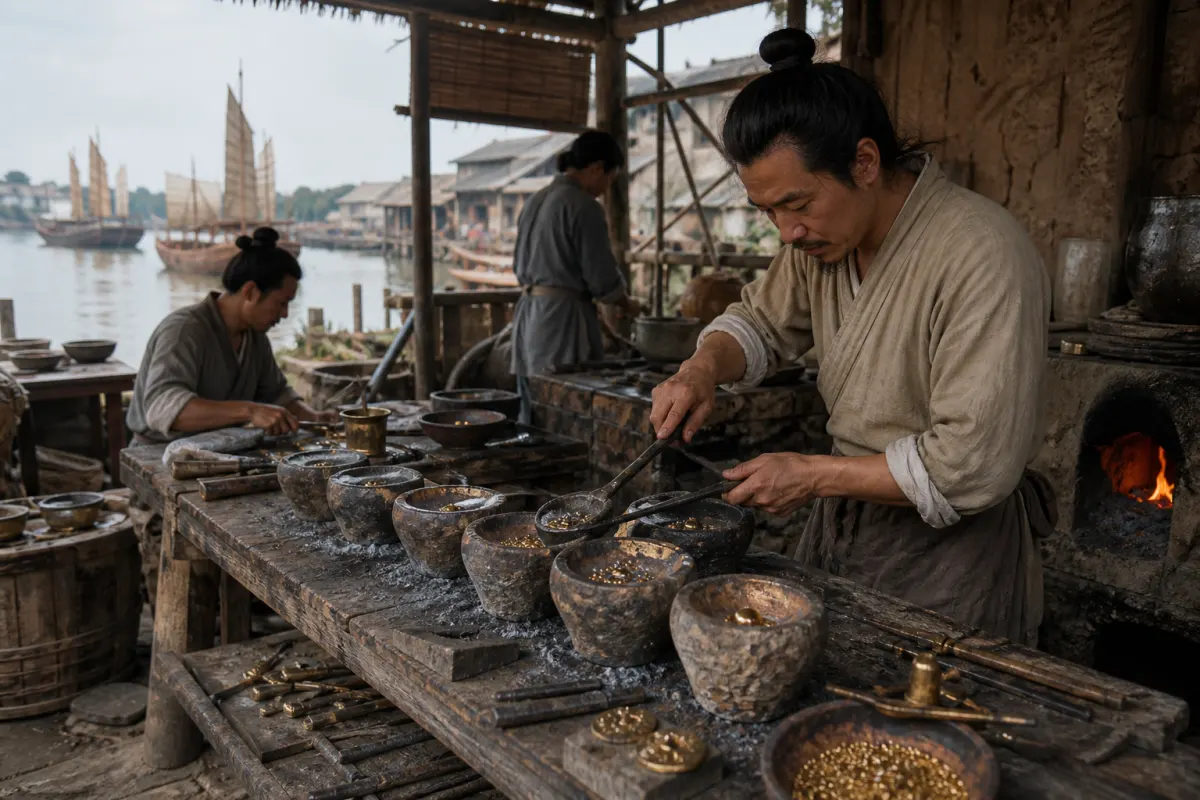
The find is not a single spectacular object. It is a workshop, a furnace, and tiny metal residues trapped inside ceramic crucibles. Together, those traces show that medieval Guangzhou was not simply receiving finished brass objects. Local workers were making the alloy in a port city tied to long-distance trade.
What the three Guangzhou brass crucibles actually show
Excavations at the Royal Palace of the Nanyue Kingdom, carried out between 1975 and 2007, uncovered a metalworking workshop. Nearly 80 complete crucibles and fragments have been found there. The study examined 51 crucibles and sherds from two chronological groups; three ninth- to tenth-century vessels contained the diagnostic residues that the authors identify as unequivocal evidence of brass-making.
Keep exploring
Continue with Curiosmos
Portable X-ray fluorescence revealed a sharp rise in zinc in the workshop material around the ninth century. That was an important clue, but not proof by itself: the technique detects elements, yet cannot establish the full process or product. The researchers then examined selected crucible cross-sections at higher resolution. They found brass droplets alongside zinc oxide and zinc-silicate minerals in the three vessels. The distinction matters: the chemical signal pointed toward a new process; the trapped alloy droplets showed that brass had actually formed inside the crucibles.
The residues preserve two recipes. In two crucibles, copper combined with zinc ore produced brass containing about 11–17 percent zinc. In another, a bronze base combined with zinc ore produced a tin-bearing copper-zinc alloy known as gunmetal. The authors interpret both as cementation: heating copper or bronze with zinc-bearing ore so that zinc vapor reacts with the metal.
The crucibles were small, holding about 0.2–0.3 liters. A reconstruction of the furnace suggests that roughly 19 could be used in one firing. From those dimensions, the authors calculate a theoretical maximum of 33–50 kilograms of brass per cycle. It is an estimate based on the reconstructed setup, not a surviving production tally, but it hints at how a workshop could scale output through many controlled batches.
What is still uncertain?
No lids have been recovered, but that absence does not prove the crucibles were always uncovered. The researchers note that lids used during cementation may have been removed and reused in later production cycles, leaving no trace in the excavation.
The raw materials may also have been local or regional. Lead-isotope ratios in the residues are consistent with sources in southern China’s Cathaysia geological province, although that signature is too widespread to identify a particular mine. The technique and the ingredients need not have traveled together: a method could have arrived through trade while workers used nearby ores.
Could the knowledge have arrived by sea?
Guangzhou linked China with Southeast Asia and the wider Indian Ocean. After Tang control weakened along parts of the overland Silk Road in the eighth century, maritime routes became increasingly important for long-distance exchange. The crucibles also share some technological features with medieval Islamic brass-making. Together, those clues make seaborne transmission plausible.
But the crucibles cannot identify a named craftsperson, prove where the technique began, or establish one route into China. The authors describe a potential influence from the Islamic world; the evidence supports that interpretation without settling it. More comparative crucibles and workshop remains across the Indian Ocean world could help test the idea.
That is what makes this find more than a story about a new alloy. The evidence shows local brass production in Guangzhou by the ninth or tenth century, while leaving open how the know-how reached the city. Did traders carry a recipe across the sea, did local metalworkers adapt an existing process, or did several routes meet in the same workshop? The tiny droplets answer one question—and leave the larger journey open.
For a comparison of how metallurgy could move along connected trade networks, see our report on an ancient iron furnace in Uzbekistan.