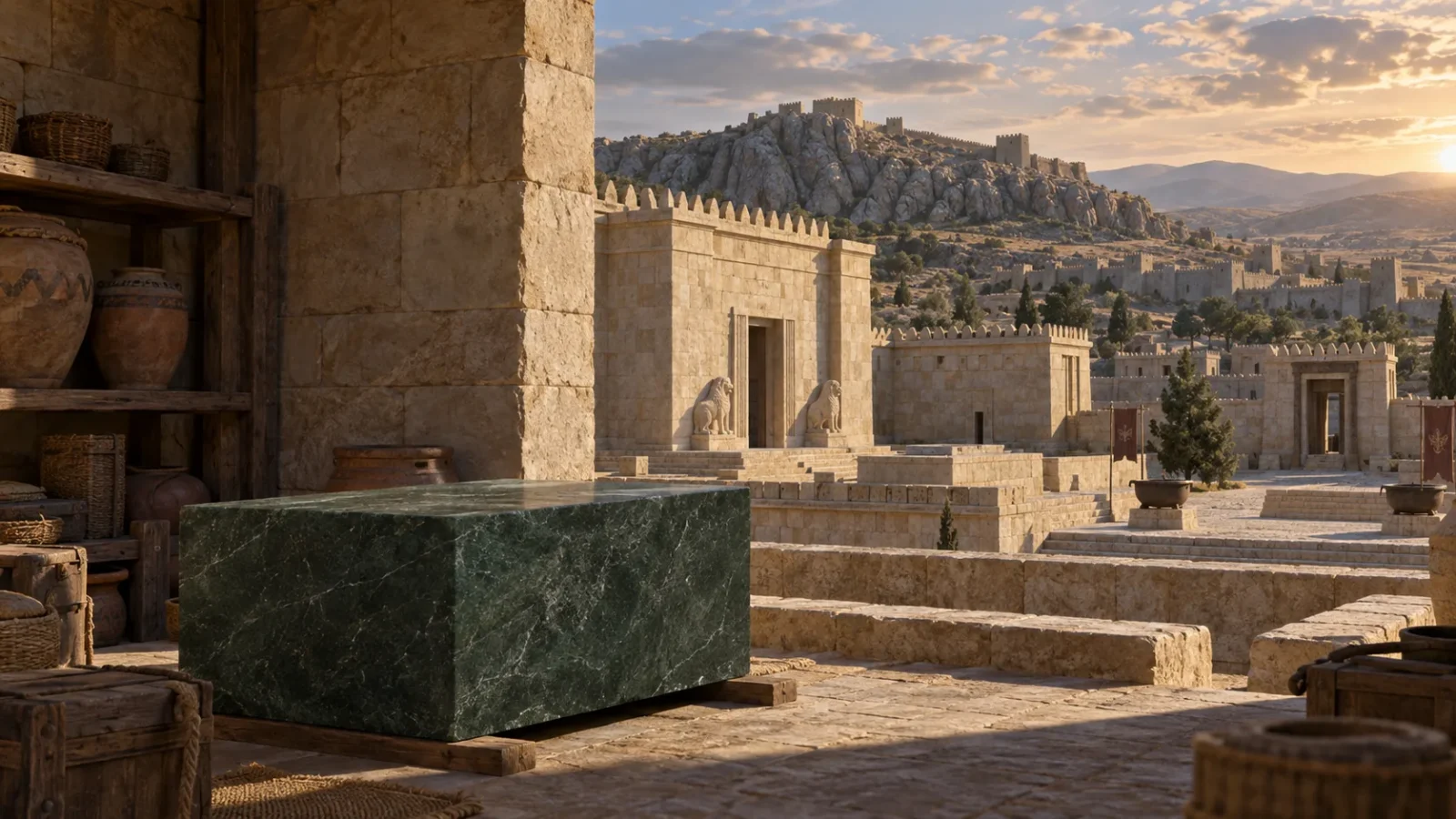
At Hattusa, a dark green block stands out against the pale stone of the Great Temple. It is polished, roughly cuboid and large enough to draw attention in a photograph. Visitors have called it jade, nephrite, a wishing stone and even evidence of lost technology.
The object is intriguing without those additions. The Hittite capital left tablets by the thousands, yet none so far identifies this block or tells us what it was for. Its colour and setting give us clues to where it belongs in the city’s history, but not a complete story.
A stone inside the Hittite capital
Hattusa, also written Hattusha or Ḫattuša, lies near Boğazkale in central Türkiye. UNESCO protects the remains of its temples, royal quarter, fortifications, gates and archives. The green block is associated with the Great Temple in the Lower City, a major religious complex linked with the Storm God of Hatti and the Sun Goddess of Arinna.
Keep exploring
Continue with Curiosmos
Storerooms, paved areas and work spaces surrounded the temple. The block was therefore part of a busy precinct, not an isolated object placed on a bare hill. Its location may matter, but a find inside a temple does not automatically make an object an altar or an idol. Temples were rebuilt, floors were raised and objects could be moved or reused.
What kind of rock is it?
Online descriptions often call the block nephrite. Other accounts use “serpentine” or simply “green stone.” Those names refer to different materials, and colour alone cannot distinguish them. A polished green surface makes for a memorable image; identifying the rock requires mineral analysis.
Published archaeometric work on the Great Temple has examined its limestone blocks using petrography, isotopes and trace elements. That work shows how researchers can trace stone sources when they have samples and measurements. It does not establish the composition of the green block. Until a documented analysis of that object is available, “nephrite” should be treated as a reported label, not a confirmed result.
A secure identification could change the questions to ask. If the stone came from a distant source, its route to Hattusa might point to exchange or royal movement. A local source would suggest a different history. At present, the rock’s origins remain open.
A purpose lost with the building
No surviving cuneiform text names the block. Hattusa’s tablets record rituals, diplomacy, administration and law, but none known to researchers explains this object. It may have held religious meaning; it could also have served as a base or belonged to an installation that was later altered.
The Great Temple changed over time. A block that now sits in one place may have been moved from another. Without a clear inscription, an undisturbed original setting or a close parallel elsewhere, assigning it one function would go beyond the evidence.
That gap leaves room for curiosity. What did Hittite visitors notice first: the stone’s colour, its smooth surface, or the way it caught the light inside the temple precinct? We cannot know, but the questions begin with the object as it survives, rather than a legend built around it.
The city around the stone
Hattusa’s landscape helps explain why the block attracts so much attention. The city’s fortifications ran for kilometres across rugged ground. Lions’ Gate, the Royal Gate and the Sphinx Gate controlled entrances into the capital. At nearby Yazılıkaya, reliefs of gods and rulers were carved into a rock sanctuary.
Thousands of clay tablets reveal a state that negotiated with Egypt, governed territories and organized elaborate ceremonies. The treaty associated with the battle of Kadesh belongs to that diplomatic world. Hattusa was a royal capital, but it was also a working city: people had to move food, water, stone and messages across difficult terrain.
By the end of the Late Bronze Age, the Hittite capital was abandoned amid wider political change. Archaeologists have found fire damage and signs of disruption, but those traces do not point to one spectacular cause. Later people returned to the area and used parts of the landscape again.
For now, the green block remains a polished stone in a temple precinct. Its exact mineral composition, route to Hattusa and original use are still unresolved. That is a more modest account than the online legends, but it leaves a real archaeological question standing in the middle of the Great Temple.
Curiosmos has also looked at how ancient stone sites change what archaeologists can ask, and at the evidence for iron made from meteorites. In each case, identifying the material is part of understanding how an object reached the place where it was found.
Sources
- UNESCO World Heritage Centre, “Hattusha: the Hittite Capital.”
- Republic of Türkiye Ministry of Culture and Tourism, Hattusa.
- Çorum Hattusa Guide, “Hattusa’s Green Stone.” Used for the visitor-facing description; not treated as a definitive mineral analysis.
- Yılmaz et al., “Geochemical and petrographic approach for the origin of the limestone blocks of the walls of the Great Temple of Hattusha,” Turkish Journal of Earth Sciences.