Arabic script was at the centre of a striking 2017 archaeology claim: researchers at Uppsala University had found the Arabic words “Allah” and “Ali” woven into Viking burial clothes. The idea seemed to redraw the map of the Viking world. It also raised a more basic question. Were the shapes actually writing?
The answer matters because the Viking Age did include real contact with the Islamic world. But the famous textile claim became a useful lesson in how a plausible interpretation can outrun the evidence.
What was found in the Birka material?
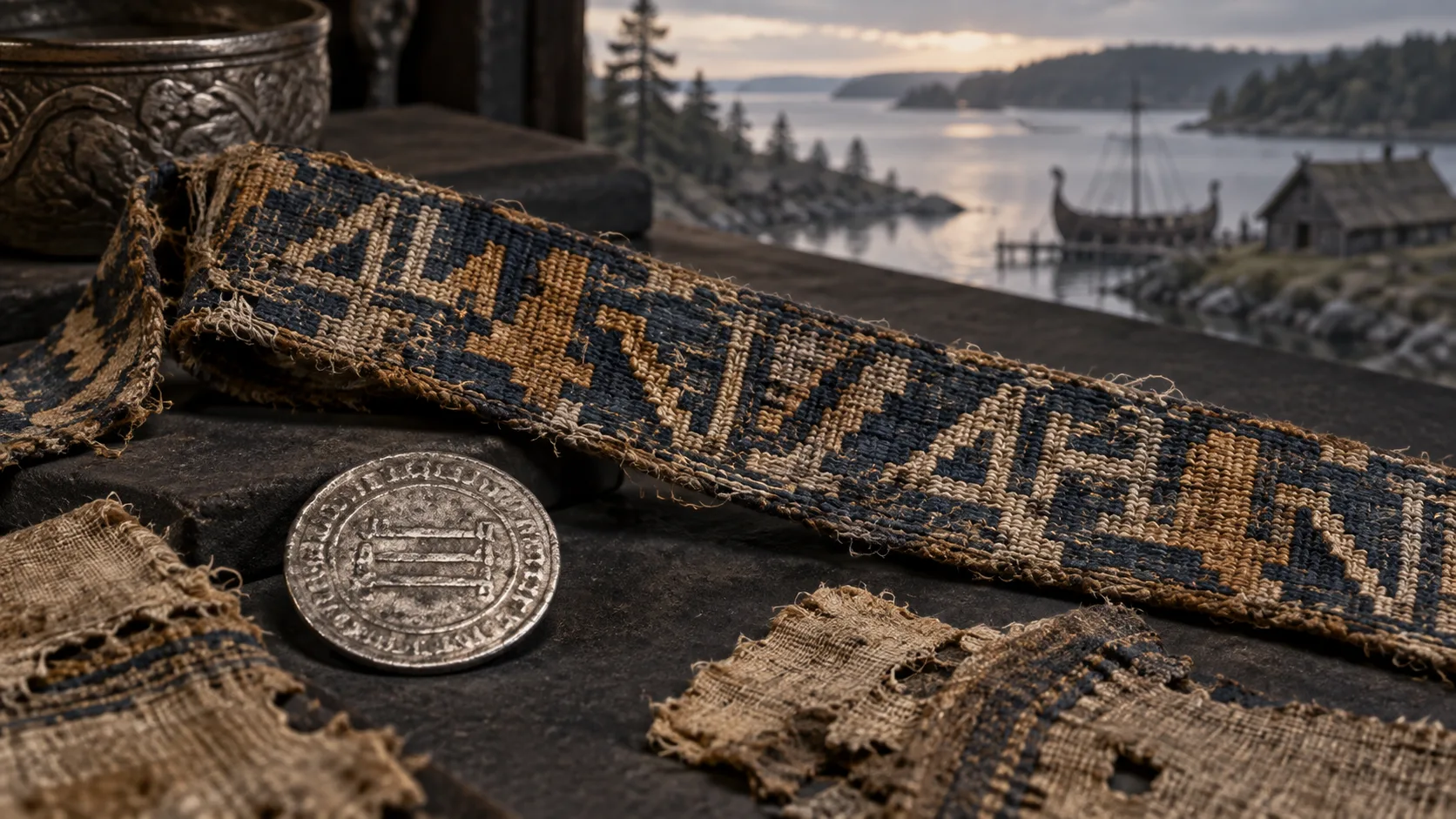
The story centred on narrow tablet-woven bands and other textile fragments recovered from Viking Age graves at Birka and elsewhere in central Sweden. The pieces had been excavated decades earlier and preserved in museum collections. When textile archaeologist Annika Larsson examined patterns prepared for a Viking clothing exhibition, she proposed that some of the angular forms resembled Kufic script.
Uppsala University’s 2017 exhibition notice said the mirrored forms could invoke Allah and Ali. The interpretation was presented as ongoing research, not as a finished, peer-reviewed reading. That distinction was easy to lose once the claim moved from an exhibition announcement into international news coverage.
Why did the interpretation attract so much attention?
Silk, silver thread and imported clothing already show that Viking communities were connected to long-distance trade. If the bands really carried Islamic words, they might also suggest the movement of religious imagery or ideas into Scandinavian burial customs.
That possibility is not absurd. The Viking trading centre of Birka contains objects from far beyond Sweden. The National Museum of Denmark describes the silver economy behind Viking hoards, with dirhams from Central Asian mints reaching Scandinavia through the Russian river routes. Contact between Norse communities and the Islamic world is therefore an archaeological fact. The textile question is whether these particular shapes record that contact as language.
What did the criticism identify?
Within weeks, Islamic-art specialist Stephennie Mulder and other researchers questioned the reading. Their objections focused on the shape of the motifs, the way the reconstruction extended the preserved fragment and the history of the script style being proposed.
Square Kufic is a highly geometric form of Arabic writing, but the version identified on the reconstructed band was difficult to reconcile with a tenth-century Scandinavian textile. Critics argued that the pattern could be decorative geometry rather than a sentence assembled from Arabic letters. A Swedish Radio report recorded the criticism and noted that the findings had not yet been reviewed by other scholars. Uppsala University subsequently acknowledged that the provisional status should have been clearer.
The problem was not that geometric patterns cannot carry meaning. It was that the reading depended on selecting and joining shapes across a damaged object. When a reconstruction supplies missing sections, it can make a proposed word look more complete than the surviving evidence allows.
Does that mean there was no Arabic influence in Viking Scandinavia?
No. It means the textile is a poor foundation for that conclusion. A separate object from Birka provides a much firmer case for contact: a silver ring from a ninth-century woman’s grave, set with coloured glass and engraved with an inscription that researchers read as “for/to Allah.” A technical study used microscopy and elemental analysis to examine the ring and concluded that it was probably made in, or strongly connected to, an Islamic-world setting.
The Swedish History Museum describes the reading as “may signify ‘for Allah’ or ‘to Allah’,” which is appropriately careful. The ring shows that an object bearing Arabic writing reached Birka. It does not show that the woman who wore it converted, that Birka had a mosque, or that the community adopted Islamic burial practice.
What can textiles tell us when the words are uncertain?
Even without a readable inscription, the fragments still contain evidence. Their fibres, weave, dyes, metallic threads and positions in graves can reveal access to luxury materials, craft knowledge and exchange networks. Textile research also has to account for how fragments were excavated, stored, drawn and reconstructed. A narrow band that has lost its ends can be especially vulnerable to an interpretation based on a repeating pattern.
This is where the Birka debate becomes useful beyond the disputed word. It shows why archaeologists compare the physical object with the history of a design, the date of the layer and the technical limits of a reconstruction. A pattern can resemble writing without being writing. A genuine imported textile can carry a style without carrying a religious message.
So, did Viking burial clothes carry Arabic script?
The strongest answer is narrower than the original headline. The 2017 “Allah textile” interpretation was announced as ongoing research and was challenged almost immediately by specialists; a later scholarly review describes the claim as disproven. The surviving pattern should not be presented as a confirmed Arabic inscription.
At the same time, Viking Age Scandinavia was tied to Islamic-world economies and craft traditions through trade, travel and the movement of objects. The Birka ring and the large flow of Arabic silver make that point without asking a damaged textile to carry more meaning than it can bear.
The most interesting story is therefore not that Vikings secretly wrote Arabic prayers into every burial costume. It is that one disputed pattern and one securely studied ring show two different levels of evidence—and why archaeology has to keep them separate.
Sources and further reading
- Uppsala University, “Exhibition: Viking Age patterns may be Kufic script” (2017).
- Sveriges Radio, “Kritik mot arabiskt forskarfynd i vikingagrav” (2017).
- Knutson and Ellis, “‘Conversion’ to Islam in Early Medieval Europe: Historical and Archaeological Perspectives on Arab and Northern Eurasian Interactions,” Religions (2021).
- Wärmländer et al., “Analysis and interpretation of a unique Arabic finger ring from the Viking Age town of Birka, Sweden,” Scanning (2015).
- National Museum of Denmark, “Silver’s route to Denmark”.