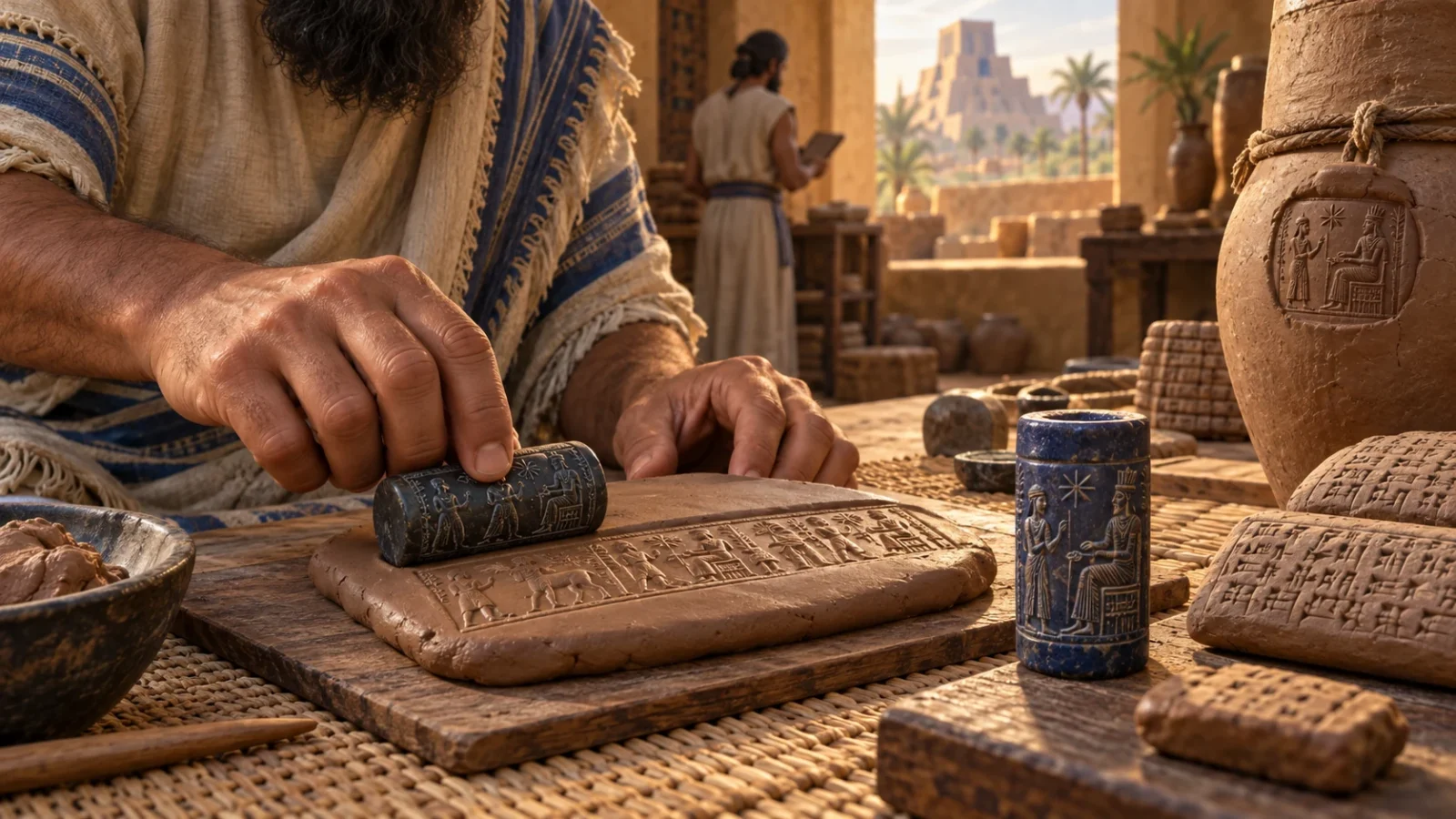
A carved stone no larger than a thumb could close a jar, mark a document and identify the person responsible for it. In ancient Mesopotamia, cylinder seals turned a private object into a public mark: roll it across wet clay and a continuous image appeared.
The seals are often displayed as miniature works of art. They were that, but they also did a practical job in societies where clay carried records of grain, trade, labour and law.
How a cylinder left its mark
A craftsperson cut a design into the surface of a small stone cylinder. When rolled across soft clay, the recessed lines left a raised impression. Unlike a stamp, the cylinder could make a longer scene in one pass.
Keep exploring
Continue with Curiosmos
Many seals were pierced lengthwise so they could be worn on a cord or attached to clothing. A person could carry the tool that marked their authority, rather than leave it in an archive. British Museum records show the range of cylinder seals and their impressions from ancient Iraq.
Closing a container or signing a record
People impressed seals onto clay used to close jars, baskets, doors and envelopes. They also rolled them across tablets connected with commercial or legal transactions. If a seal on a container was broken, someone had opened it. An intact impression showed whose mark had secured it.
Ownership, identification and security overlapped. The same seal could mark a person, an office or an institution. It could accompany a written record while communicating through an image rather than a line of cuneiform. That is why seals belong in the history of writing, even though their designs are not themselves a writing system.
Scenes carved in miniature
Seals depict worshippers before seated gods, animals in combat, rulers and protective beings. The scene might express status or a religious association, but it rarely gives us a complete story. Some cylinders carry cuneiform inscriptions naming an owner, a relative, a title, a ruler or a god. Many do not.
Museum collections help show how much can be learned from an object’s material, date and archaeological context, even when its owner is unknown. A motif can be compared with other examples; it cannot be translated into a full myth without further evidence.
More than royal property
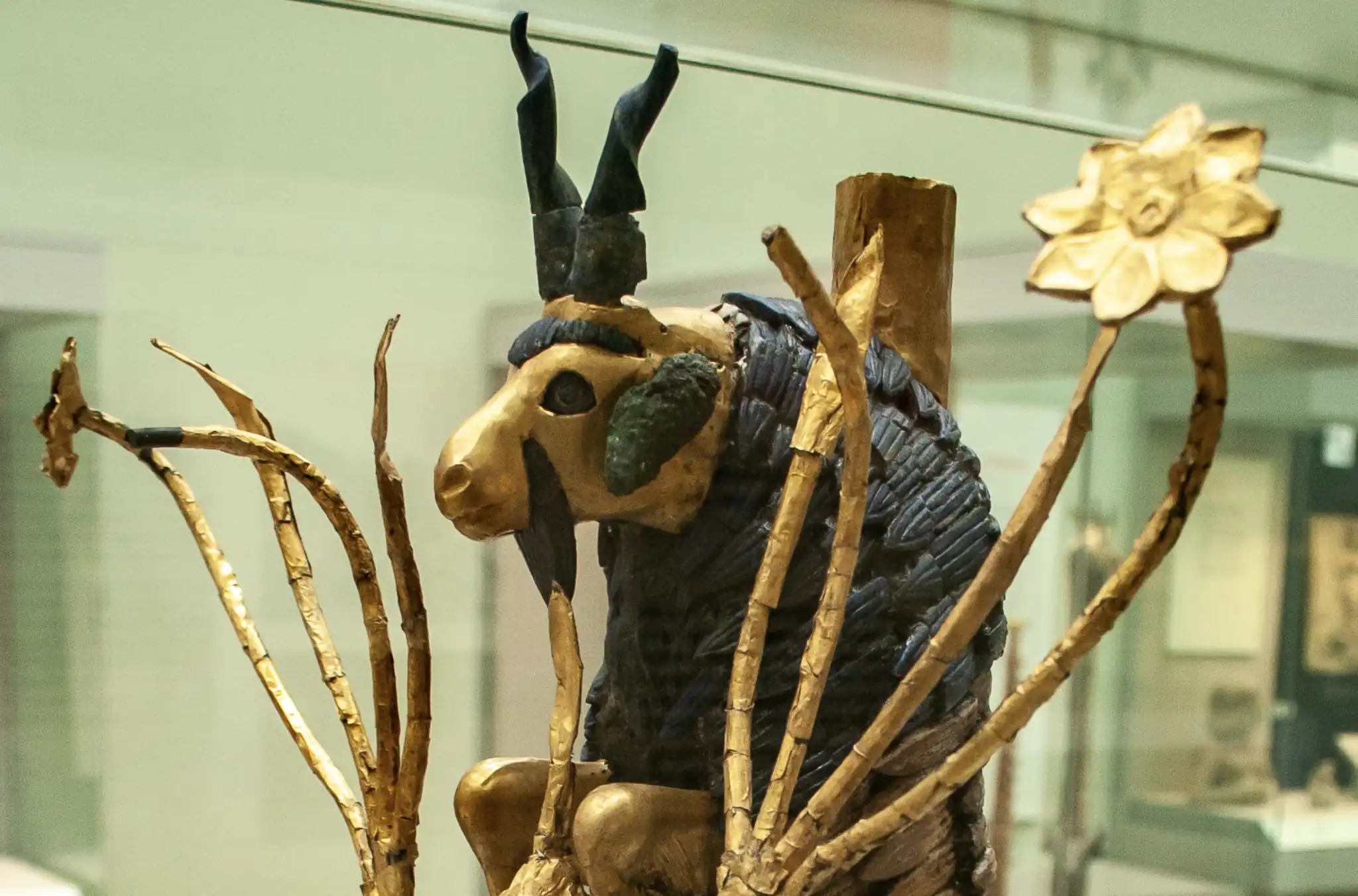
It is easy to imagine a cylinder seal belonging only to a king or priest. Finds from graves and administrative contexts show a wider range of owners. The Penn Museum, for example, records a lapis-lazuli seal found beside Queen Shubad at Ur. Its banquet scene includes women.
That burial is a specific case, not a picture of every woman’s life in Mesopotamia. It does show how a seal and its setting work together: the carved scene tells one part of the story, while the place where the object was found tells another.
What the impressions preserve
Archaeologists compare styles to help date objects, study the stones to trace material choices and trade, and examine impressions to see how institutions handled goods and documents. The images preserve a visual record from periods when few large-scale paintings survive.
A seal can show that a person took part in an administrative system; it cannot tell us whether the object was inherited, commissioned or awarded. Its design records what someone chose to carve, not everything its owner believed.
In a world where a storehouse and a legal tablet could both be closed with wet clay, the small cylinder linked people to the goods and records around them. Its impression was practical. It could also be striking enough to recognize across a room.
For another ancient object whose marks still challenge interpretation, see Curiosmos’ report on the Phaistos Disc.