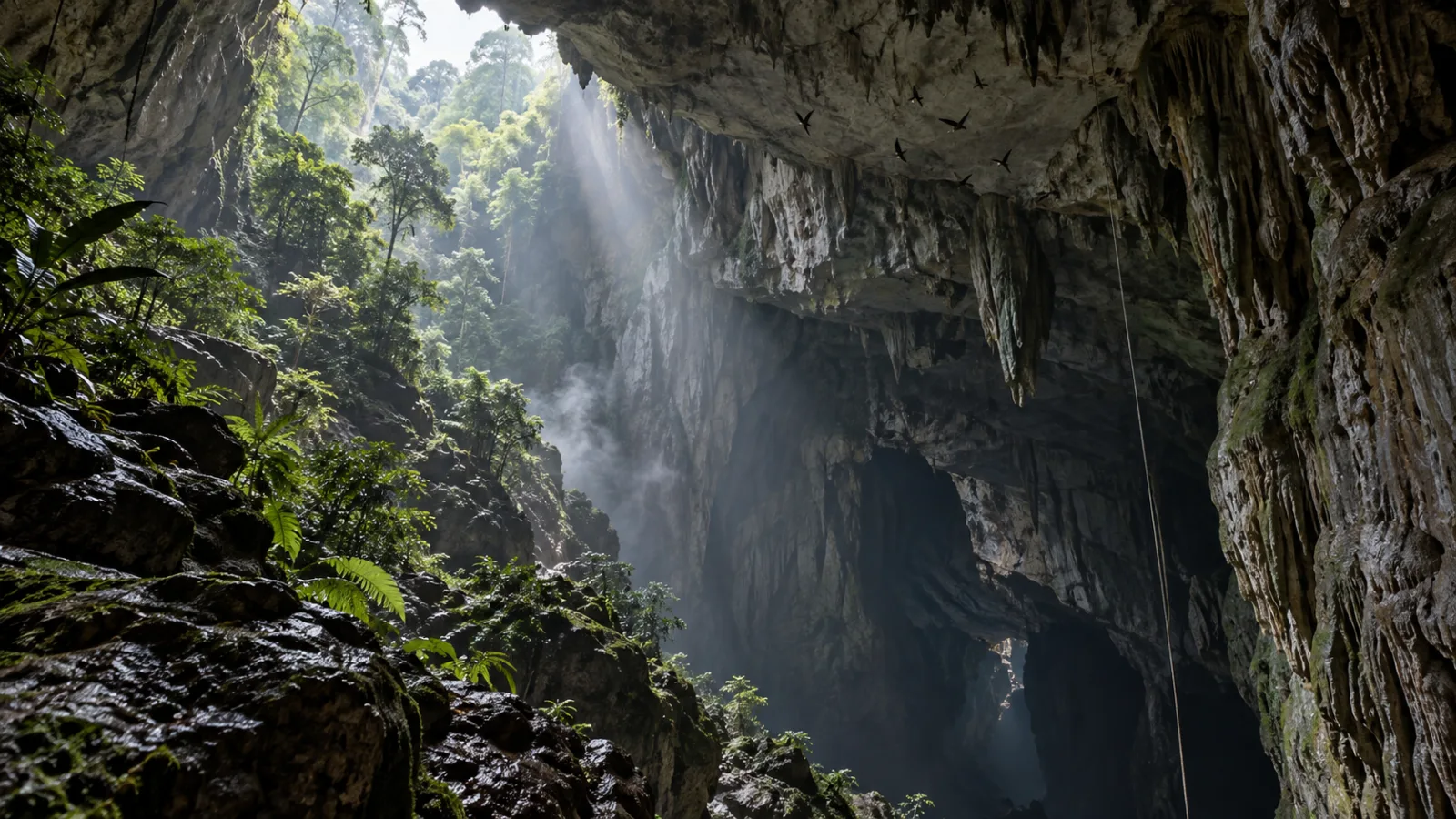
In Ecuador’s Cordillera del Cóndor, an opening in the limestone drops into darkness. Oilbirds roost in Cueva de los Tayos, and the cave’s name comes from them. The passages became famous for a different reason after stories spread about gold, a lost civilization and a library made of metal.
The 1976 expedition is often cited as if it confirmed that library. Its published record describes a serious cave survey, wildlife observations and archaeological material. It does not provide a catalogue of metallic books or an underground city.
A cave in Shuar territory
Cueva de los Tayos lies in Morona-Santiago, on the eastern side of the Andes, near the Coangos River. A 1977 report by Luis Albuja and Tjitte de Vries places it around 800 metres above sea level, in steep tropical forest within Shuar territory.
Keep exploring
Continue with Curiosmos
The entrance leads into a deep, humid system that requires specialist equipment to explore. Tayos, or oilbirds (Steatornis caripensis), are nocturnal fruit-eating birds that use caves to roost and breed. Their clicking calls help them navigate in darkness. They are part of the cave’s natural history, not a detail added to the legend later.
What the 1976 team recorded
The Ecuadorian-British expedition ran from July 4 to August 5, 1976. The Ecuadorian Cultural Centre’s catalogue lists its monograph, Las cuevas de los Tayos, as a 56-page report published in Quito that year. The British Cave Research Association preserves a parallel account with photographs and a cave map.
Mapping passages, entrances, levels and hazards is slow work. The survey gave researchers a record of the cave system and its environment. The expedition also produced zoological observations. Albuja and de Vries recorded 79 bird species from 26 families around the cave and deposited 199 specimens in the collections of Ecuador’s National Polytechnic School.
Those details have less spectacle than a metallic library, but they are the contents of the surviving field record: a route through a difficult cave, measurements and observations that other researchers can examine.
How the metallic-library story spread
The claim predates the 1976 expedition. Juan Móricz said the cave held a hidden metallic library and evidence of a lost civilization. Erich von Däniken later folded the story into ancient-astronaut speculation. Retellings added gold, machines, tunnels and records of humanity’s past.
A claim can shape a site’s reputation without being confirmed by excavation. For archaeology, the essential details are where an object was found, what surrounded it and whether that context was recorded. An artefact displayed without those details cannot establish a hidden city or explain who made it.
Reports connected with the expedition discuss archaeological material from the cave and surrounding area. Caves can preserve charcoal, bones, pottery, tools and disturbed sediment, but each find needs its own context. Was it in a sealed layer, beside a hearth or in loose deposits visited later? The expedition’s surviving catalogues do not list a set of metal books.
Natural cave, human history
Cueva de los Tayos is both a natural karst system and a place people have visited. Wildlife, geology and human activity overlap in its passages. The right questions are specific: which objects came from which layer, how old are they, and what did the cave mean to the people who knew it?
Those questions are best pursued with the Shuar communities whose territory includes the cave, alongside careful mapping and transparent study of any artefacts held in museums or private collections. Their knowledge and the physical record can inform one another.
The cave is already extraordinary: an oilbird habitat in a rainforest, a challenging limestone system and a place with a long local history. The 1976 expedition gave us a map and a record of wildlife. Future work can add to that record, without asking the legend to stand in for evidence.
For comparison, Curiosmos has reported on the carved chambers at Longyou, where researchers also study the relationship between underground spaces and human work.
Sources
- Casa de la Cultura Ecuatoriana, catalogue record for Las cuevas de los Tayos (1976).
- Sociedade Brasileira de Espeleologia, Los Tayos Expedition, Ecuador, July–August 1976.
- Albuja and de Vries, “Aves colectadas y observadas alrededor de la Cueva de los Tayos” (1977).
- Limón Indanza municipal diagnostic, Cueva de los Tayos.
- Snow, “The oilbirds of Los Tayos,” Wilson Bulletin 91 (1979).