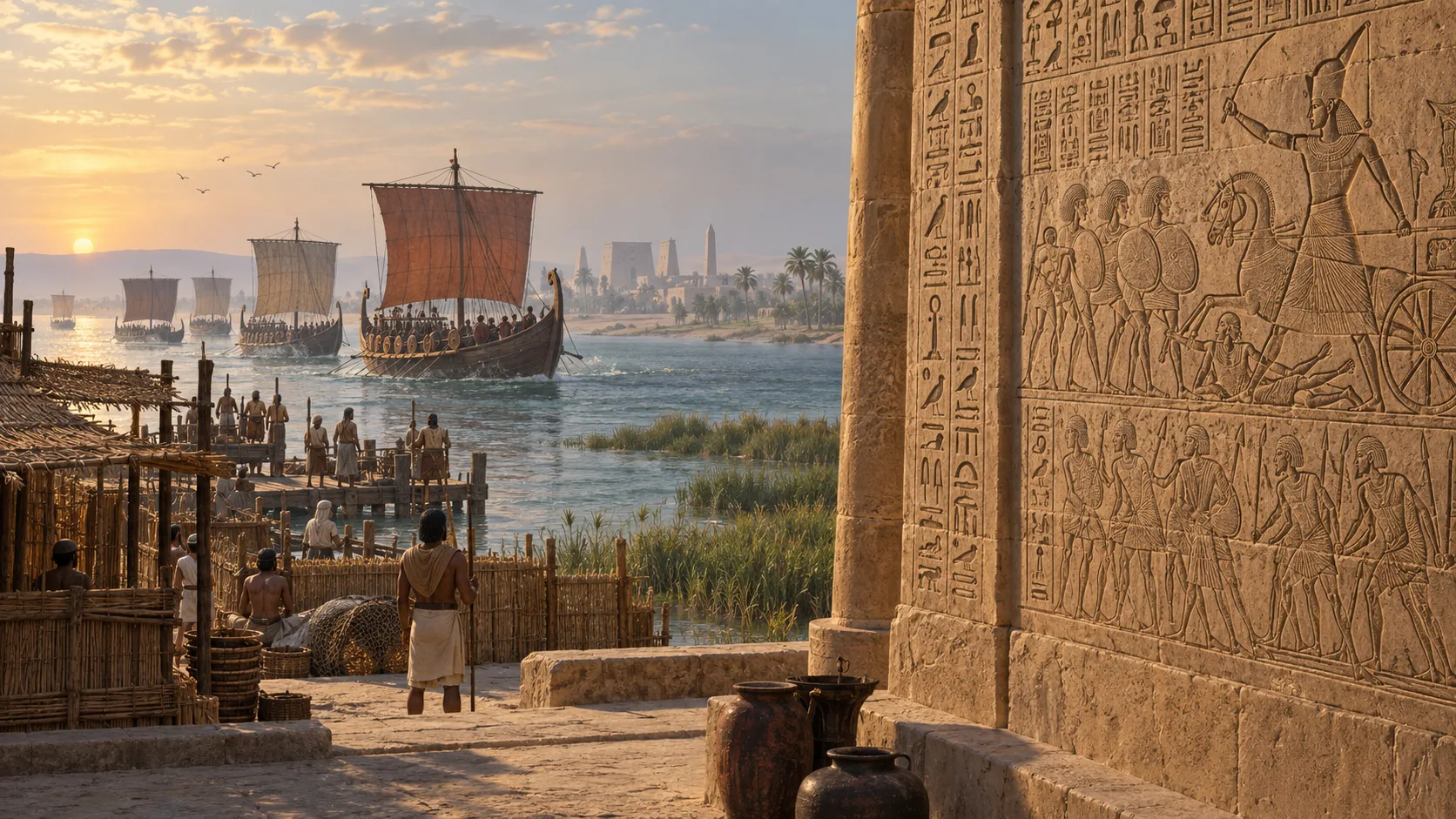
At Medinet Habu, Ramesses III had a battle carved into the walls of his temple. Ships with high prows fill the scene. Archers draw their bows, shields crowd the decks and men fall into the water. The inscription names groups including the Peleset, Tjekker, Shekelesh, Denyen and Weshesh.
“Sea Peoples” is a modern label for those names. The temple inscription is a royal victory record, not a neutral account of who every group was or where they came from. It shows that Egypt fought a serious conflict; it does not describe one nation with a single leader and capital.
Who were the groups in the Egyptian record?
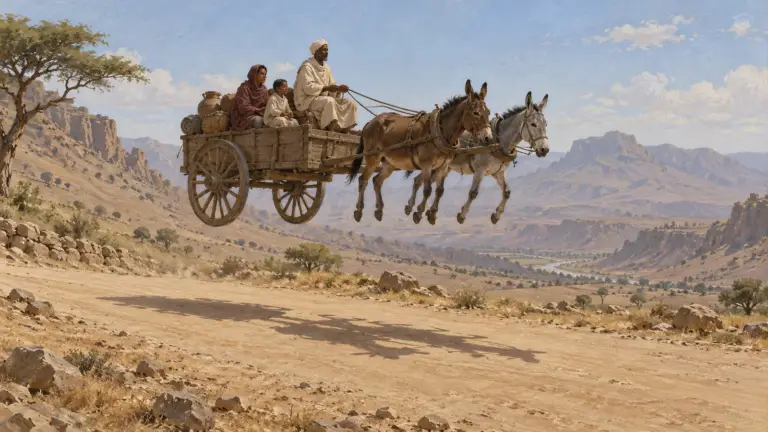
The events are usually placed in the early twelfth century BC, during Ramesses III’s reign. Some people in the Egyptian images carry weapons; others appear with carts and families. The scene is an official representation, not a census, but it leaves room for more than one kind of movement.
Some groups may have been raiders or soldiers. Others may have travelled with families and possessions. People displaced by war or hunger could fight, seek food, serve as mercenaries and eventually settle elsewhere. Those modern labels do not have to describe separate populations.
The Peleset are often connected with the Philistines, whose settlements appear along the southern Levantine coast in the early Iron Age. The resemblance between the names and the archaeological record make the link plausible. They do not provide a complete account of where the group began or how its identity changed after settlement.
A region already under pressure
The eastern Mediterranean was not stable when these groups appear in the record. The Hittite capital at Hattusa was deserted. Mycenaean palace administration ended. Ugarit, a major Syrian port, was destroyed and not rebuilt in the same form.
Letters from Ugarit’s final years describe ships offshore and pleas for help. They preserve a moment of danger, not a full explanation for the city’s destruction. The records also show how much depended on networks of ports, palaces and rulers willing to supply one another.
Copper from Cyprus, timber from the Levant, grain, textiles and luxury goods crossed the region. When one part of the network failed, another could lose the supplies or protection it relied on. Several cities faced disruption over the same broad period, but their local histories were not identical.
Drought, harvests and a connected economy
Pollen and sediment records from parts of Syria and Cyprus point to drying near the end of the Late Bronze Age. A PLOS One study linked drought with crop failure and social stress. Other research cautions that conditions differed from place to place and that drought alone cannot account for every destruction layer.
A poor harvest could strain a palace, drive people toward the coast or leave a kingdom less able to pay soldiers and maintain ships. That is one pressure in a longer chain, not a single explanation for the attacks Ramesses III recorded.
Did they cause the collapse?
The Egyptian inscription shows Ramesses III claiming victory against a collection of groups. Egypt survived, though it faced serious strain. That record tells us more about one campaign than about the end of the Hittite state or the Mycenaean palaces.
Archaeologists compare the destruction dates with pottery, population change, climate proxies, written appeals for help and evidence of rebuilding. No one source can explain the whole period. A damaged city might have been attacked, abandoned after famine, struck by an earthquake or affected by several events in sequence.
The “Sea Peoples” make a useful starting point because they appear in Egyptian records at a moment of upheaval. They become misleading when treated as the single cause. The end of the Bronze Age was a drawn-out transformation: governments lost control, trade routes shifted and people moved into new communities.
What made the region so vulnerable? A connected world can carry wealth and supplies over long distances, but it also spreads disruption. When harvests failed, rulers lost allies or ships appeared offshore, several systems could come under pressure at once.
Curiosmos has also covered the Minoan tomb discovered near Ierapetra, a small window onto life in the wider Aegean during the centuries around this upheaval.
Sources
- University of Chicago, Medinet Habu epigraphic and architectural survey.
- Metropolitan Museum of Art, Phoenicians and the end of Egyptian power.
- “Environmental Roots of the Late Bronze Age Crisis,” PLOS One.
- “The Sea Peoples,” Cambridge Ancient History.
- University of Gothenburg, research on Sea Peoples in Cyprus.