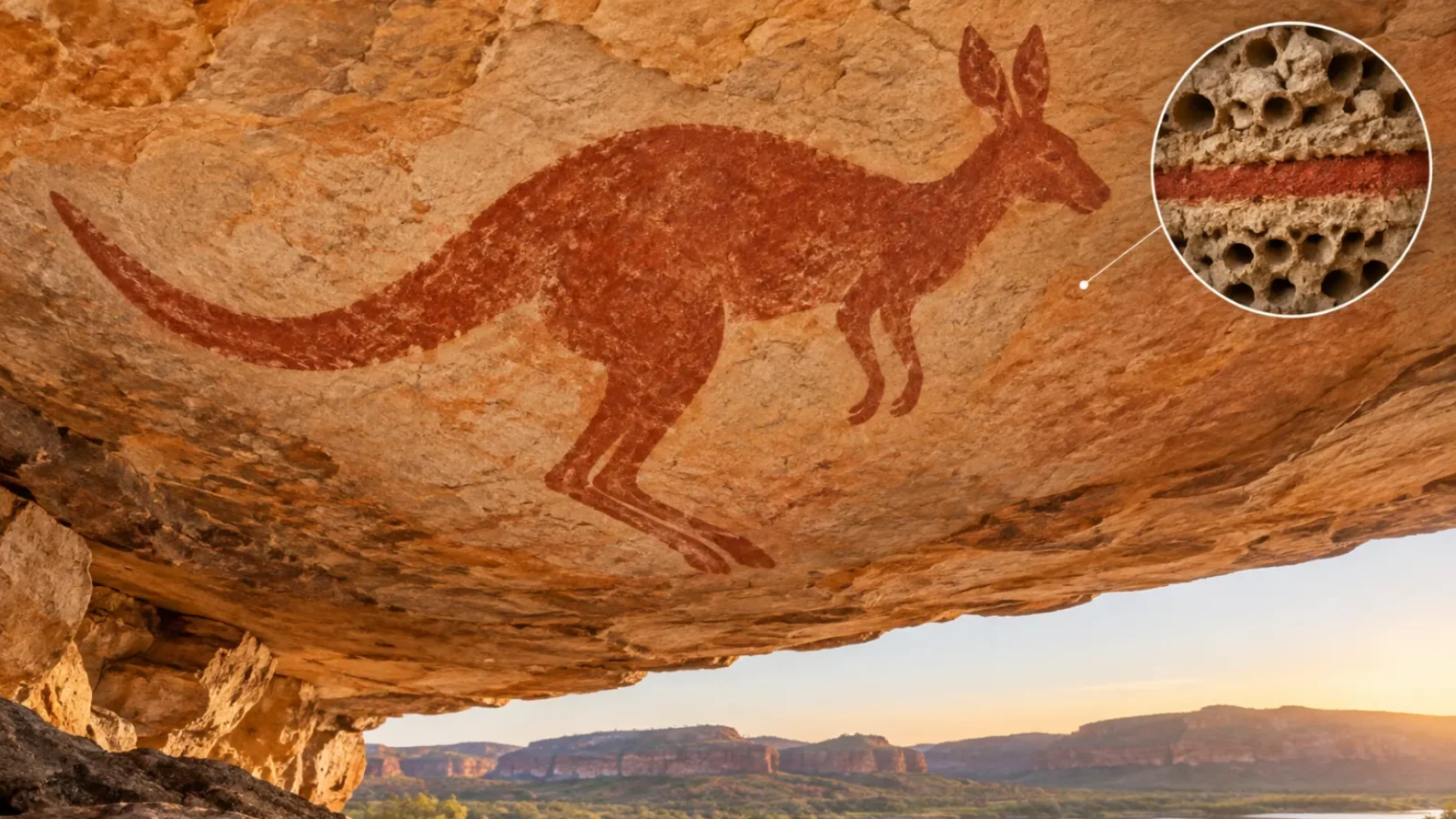
The kangaroo painting on a Kimberley rock-shelter ceiling stretches almost two metres. Its ochre pigment cannot be radiocarbon dated, so researchers looked at what had formed around it: six fossilized mud-wasp nests, three beneath the paint and three over it.
Charcoal in the nests gives the painting a date range of 17,500 to 17,100 years ago. The often-quoted 17,300 years is the midpoint, rounded to a single figure. Together, the results narrow the painting’s age to a four-century span, though they cannot pin the artist’s work to one year.
Charcoal above and below the paint
A nest beneath the kangaroo had to be there before the painting covered it. A nest that formed over the pigment came later. By dating charcoal in both groups, the team placed the image between those events.
Keep exploring
Continue with Curiosmos
The charcoal samples were tiny. The Australian Nuclear Science and Technology Organisation (ANSTO) says an average nest sample weighed about 250 milligrams, most of it sand, with only a small amount of charcoal for measurement. Radiocarbon dating estimates when once-living material stopped taking in carbon, so the lab dated the charcoal—not the red ochre itself.
This is a date bracket, not a direct measurement of the pigment. The method depends on the nests sitting on the same rock surface, with the paint clearly between them.
A painting near the start of a long tradition
The team’s 2021 study in Nature Human Behaviour reports 27 radiocarbon measurements from nests associated with 16 paintings at eight Kimberley shelters. Those dates show that the region’s Naturalistic, or Irregular Infill Animal, style was already present about 17,000 years ago and continued until roughly 13,000 years ago. The researchers say more dated nests are needed to establish the style’s full span.
How the Australian painting compares with Sulawesi
In 2021, the team described the kangaroo as the oldest known rock painting in Australia. It remained on the original rock surface, so researchers could date material layered around the image.
In 2026, a Nature study reported a hand stencil on Muna Island, Sulawesi, at a minimum age of about 67,800 years. The researchers used uranium-series dating on calcite that had formed over the pigment. Since the crust grew after the stencil, the image must be older than 67,800 years; the method gives no exact year.
For the kangaroo, the nests bracket the painting between two events. For the Sulawesi stencil, calcite formed over the pigment later, so its date is a minimum rather than a narrow range.
The location remains with its Traditional Owners
Balanggarra Aboriginal Corporation, Rangers and Traditional Owners worked with the research team. At their request, the published study does not identify the exact locations of the sampled paintings. The dates and method are public; the coordinates remain private.
Australia’s rock art includes many regional traditions. Curiosmos has also reported on the Maliwawa figures in Arnhem Land, a different body of paintings with its own subjects and chronology. The Kimberley kangaroo belongs to another region and another dated sequence.
On the rock, six wasp nests barely palm-sized frame a kangaroo almost two metres long. Charcoal in those nests places the image within a four-century span around 17,300 years ago.
Sources and further reading
- Finch et al., “Ages for Australia’s oldest rock paintings,” Nature Human Behaviour (2021)
- ANSTO, “Radiocarbon dating at ANSTO informs date of oldest known Aboriginal rock art”
- University of Melbourne, “Australia’s oldest rock painting is a kangaroo”
- Oktaviana et al., “Rock art from at least 67,800 years ago in Sulawesi,” Nature (2026)