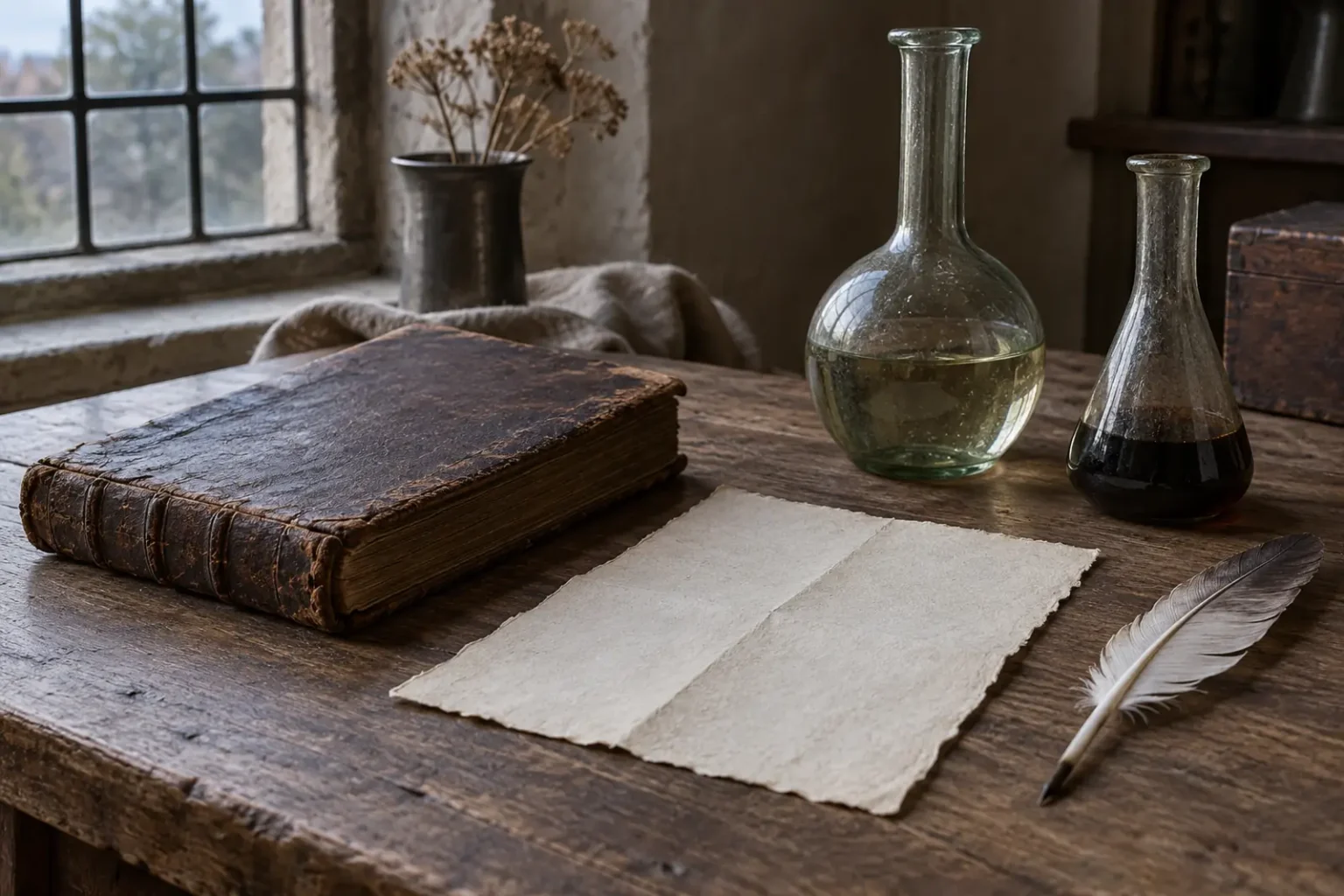
A few folded sheets in Isaac Newton’s papers contain a text about the Sun, the Moon, wind and earth. Nearby, he works through what those images might mean. The writing is in brown ink, and the manuscript holds both English and Latin versions of the same short work: the Emerald Tablet.
The scientist we associate with gravity spent years reading alchemical works. Here, in a manuscript now held at King’s College, Cambridge, he copied the Emerald Tablet, translated it and tried to work out what its cryptic lines meant.
What could a paragraph of strange imagery offer a reader with that much curiosity about nature? His notes let us follow him from a copied sentence to the workings of an alchemical vessel.
The tablet that survives on paper
The Emerald Tablet is a brief text attributed to Hermes Trismegistus. Its language brings together the heavens, the earth and a transforming substance or process. Readers have treated it as an account of creation, a statement about correspondences in nature and instructions for alchemical work.
Attributing the work to Hermes gave it the prestige of an ancient sage. Its actual author and date remain uncertain. What survives for historians to examine is a history of copies, translations and commentaries.
The Newton Project catalogue identifies Newton’s manuscript as Keynes MS 28, now at King’s College, Cambridge. It contains a Latin copy, an English rendering and a commentary. Reading the three together lets us compare the words he copied with the meaning he gave them.
Beside the copied sentences, Newton asks how an alchemist might put them to work.
The Sun, the Moon and a thing that travels
Newton’s English version opens with a declaration of truth, then describes a relationship between what is above and what is below. The wording is familiar today in the abbreviated phrase “as above, so below,” though translations do not all phrase the passage in the same way.
Later, the Sun is a father, the Moon a mother, wind carries something and earth nourishes it. The text then turns from these family images to actions: separate earth from fire, distinguish the subtle from the gross, and allow a thing to rise and descend.
In the scholarly edition of Newton’s manuscript, these lines are short enough to read alongside his commentary. The movement is striking. The text begins on the scale of a world, but its verbs can also sound like work being done to a material.
For a reader interested in creation, the passage offered an image of the world’s beginning. For an alchemist, it raised practical questions: what substance had a solar and lunar parentage, how could wind carry it, and what would separating or circulating it achieve?
The text does not specify an ordinary list of ingredients, quantities and temperatures. It leaves room for interpretation at almost every step. Newton filled some of that space with the alchemical vocabulary available to him.
Newton reads the images as operations
His Latin commentary connects the text with alchemical sulfur and mercury, fixed and volatile substances, and processes of separation and reunion. The names need care. Alchemical “mercury” or “sulfur” may describe principles or prepared substances, not simply the modern elements taken from a laboratory bottle.
The contrast between fixed and volatile is easier to picture. One part remains while another can be driven off or carried upward. The language of rising and descending could therefore suggest a substance moving through repeated operations rather than a traveller moving between literal worlds.
Newton’s commentary discusses sublimation and other transformations. In a sublimation apparatus, material can leave one place and collect elsewhere. A poetic line about ascent gives an interpreter an opening to think about an observable movement inside a vessel.
He also brings the language of creation into his explanation, including chaos and the formation of things. For him, an account of matter’s transformations could sit beside a larger account of how the world came to be.
The commentary preserves Newton’s interpretation, rather than a record of successful experiments. Whether the text’s earliest writer imagined the same ingredients or apparatus is a question these pages cannot settle.
A manuscript with more than one date
Newton returned to the Emerald Tablet over a period of years. The manuscript’s sections appear to have been written at different times.
The catalogue reports a handwriting-based chronology developed by historian Betty Jo Teeter Dobbs. The Latin text is assigned to the early 1680s, with commentary following it. The English translation is placed later, in the late 1680s or early 1690s, and was made from a French version. Further annotations may be later still.
He was still making room for the text as his other work developed. The successive versions preserve a long interest in its few, puzzling lines.
These dates depend on the assessment of handwriting; the pages do not supply an exact day for each section.
Alchemy across languages
Newton was reading within a tradition that had crossed languages and intellectual settings. The Science History Institute’s account of Arabic alchemy describes authors drawing on Greek philosophical ideas, using revered names and asking how the qualities of matter might be changed.
Some texts circulated under the names of older authorities. Attribution could give a work prestige even when its actual author was uncertain. That practice helps us understand why Hermes mattered to alchemical readers, but it cannot by itself supply a biography for the author of the Emerald Tablet.
Ideas about matter also differed from modern chemistry. An alchemist might think in terms of qualities, maturation, purification and the relationship between a material’s visible behaviour and its hidden nature. Experiments with heat and vessels took place within that framework.
In these pages, Newton’s attention is on matter: what could sentences about Sun, Moon and earth tell him about substances changing under heat?
Other manuscript traditions joined knowledge with sacred authority in different ways. The medieval Ars Notoria, for example, promised learning through prayers and figures. It offered prayers and figures where Newton looked for the behaviour of matter. Both traditions gave written words a role in acquiring knowledge.
The words changed with their readers
A short text can be difficult to date precisely because it travelled through translation, copying and interpretation. It can also gather meanings that were not present in its earliest surviving form.
In a modern essay hosted by Harvard Divinity School, Joseph Azize compares different renderings of the opening relationship between higher and lower things. He also proposes a Christian Syriac setting for its origin. That is a scholarly interpretation to consider, rather than a settled identification of the first author.
The surviving manuscript takes us back to Newton’s desk, even where the text’s earlier history remains disputed.
A copied line describes wind carrying a thing; beside it, Newton asks what that could mean for matter. The short text kept him busy for years. His pages preserve the effort to turn its elusive images into something an alchemist could do.
Sources
- The Newton Project: catalogue record for Keynes MS 28, ALCH00017.
- The Chymistry of Isaac Newton, Indiana University: normalized edition of the manuscript, edited by William R. Newman.
- Science History Institute: Al-Kimiya, notes on Arabic alchemy.
- Joseph Azize: discussion of alchemy and the Emerald Tablet, Harvard Divinity School.