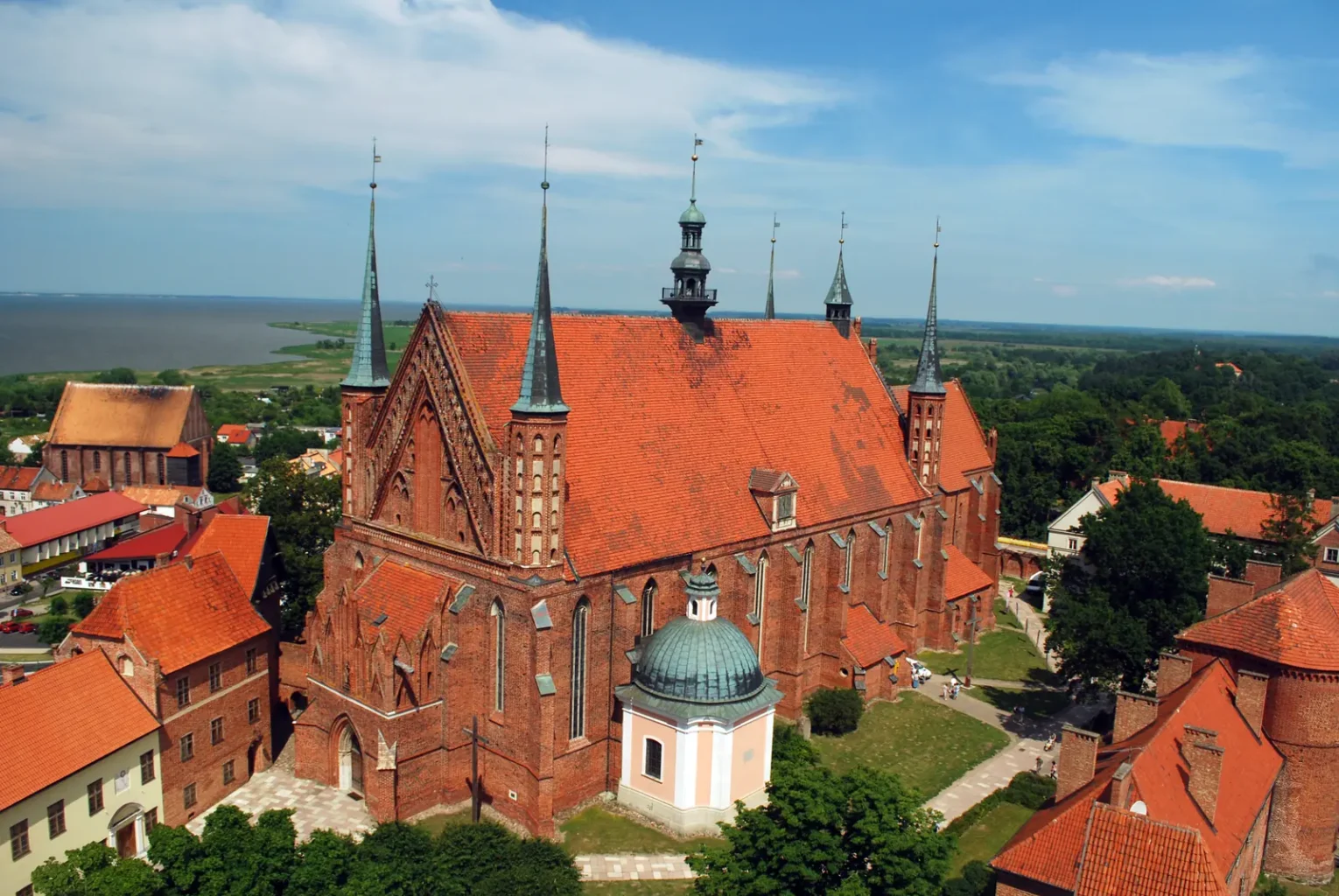
A few hairs caught in an old astronomical book became an unexpected link to a burial beneath a Polish cathedral. They were small enough to overlook, but they offered something the search for Nicolaus Copernicus’s grave badly needed: material to compare with the remains.
The resulting DNA study appeared in PNAS in 2009. It supported the identification of remains excavated at Frombork Cathedral in 2005 as those of the astronomer who placed Earth in motion around the Sun.
The story is often reduced to a perfect DNA match. The original research describes a more interesting process, in which an archaeological location, a book’s history and several genetic results had to fit together.
Finding a person among unnamed burials
Copernicus died in 1543. The cathedral contained numerous burials, many unnamed, so finding human remains there was only the beginning of an identification.
The search focused near the altar associated with his duties as a cathedral canon. One incomplete skeleton, recovered in 2005, appeared consistent with an older man. A facial reconstruction contributed to the investigation.
The location narrowed the search. The estimated age and appearance helped assess a candidate. Neither could provide a comparison sample for a genetic test.
That problem is easy to miss in historical DNA stories. A laboratory can obtain a profile from a skeleton, but a profile does not arrive with a name. It needs something independently connected with the proposed individual.
A library carried across the Baltic
The reference material came from hairs inside Johannes Stöffler’s Calendarium Romanum Magnum, a volume Copernicus had used. It survived at Uppsala University.
Uppsala’s account of the collection traces the books’ journey to July 1626, when Frombork surrendered to Gustav II Adolf. The Swedish forces seized the chapter library. Its books went to Stockholm, were catalogued, and were subsequently donated to the university library.
That journey explains why a book associated with a man buried in Poland could supply evidence in Sweden. It also reminds us that a volume can have many readers during a long life.
A hair found between its pages is therefore a candidate reference sample, not automatically Copernicus’s hair. The comparison had to be evaluated alongside the volume’s connection with him.
What matched in the laboratory
The published study reported matching mitochondrial DNA profiles from teeth and bone, and from two hairs in the book. Two other interpretable hair profiles differed. Three laboratories confirmed the tooth profile.
Mitochondrial DNA follows maternal inheritance and can be shared by different people. A matching profile supports a connection, but it is not the same as a uniquely identifying full genetic fingerprint.
That distinction was made explicitly by geneticist Marie Allen in Uppsala’s contemporary announcement. The material was limited and degraded, and the mitochondrial result needed to be assessed with the archaeological, anthropological and facial-reconstruction evidence. A random match remained possible.
It would be misleading to turn the frequency of a profile in a reference population into a percentage certainty that this skeleton was Copernicus. Those are different questions. One asks how often a genetic result occurs; the other also depends on the reliability of the proposed reference sample and the burial evidence.
The book preserves an ordinary trace
There is something appealing about the scale of this discovery. The argument turned on traces left during the handling of a working book. The volume’s survival made those traces available centuries later.
Old libraries can preserve much more than the words their readers sought. Our account of the Library of Alexandria explores the history of collected knowledge; the Copernicus investigation adds a physical connection between a reader and a page.
The hairs did not solve the case alone. Their importance came from the way they joined evidence gathered in very different places. A cathedral floor and a Swedish library shelf, separated by centuries of history, could finally be examined as parts of the same search.