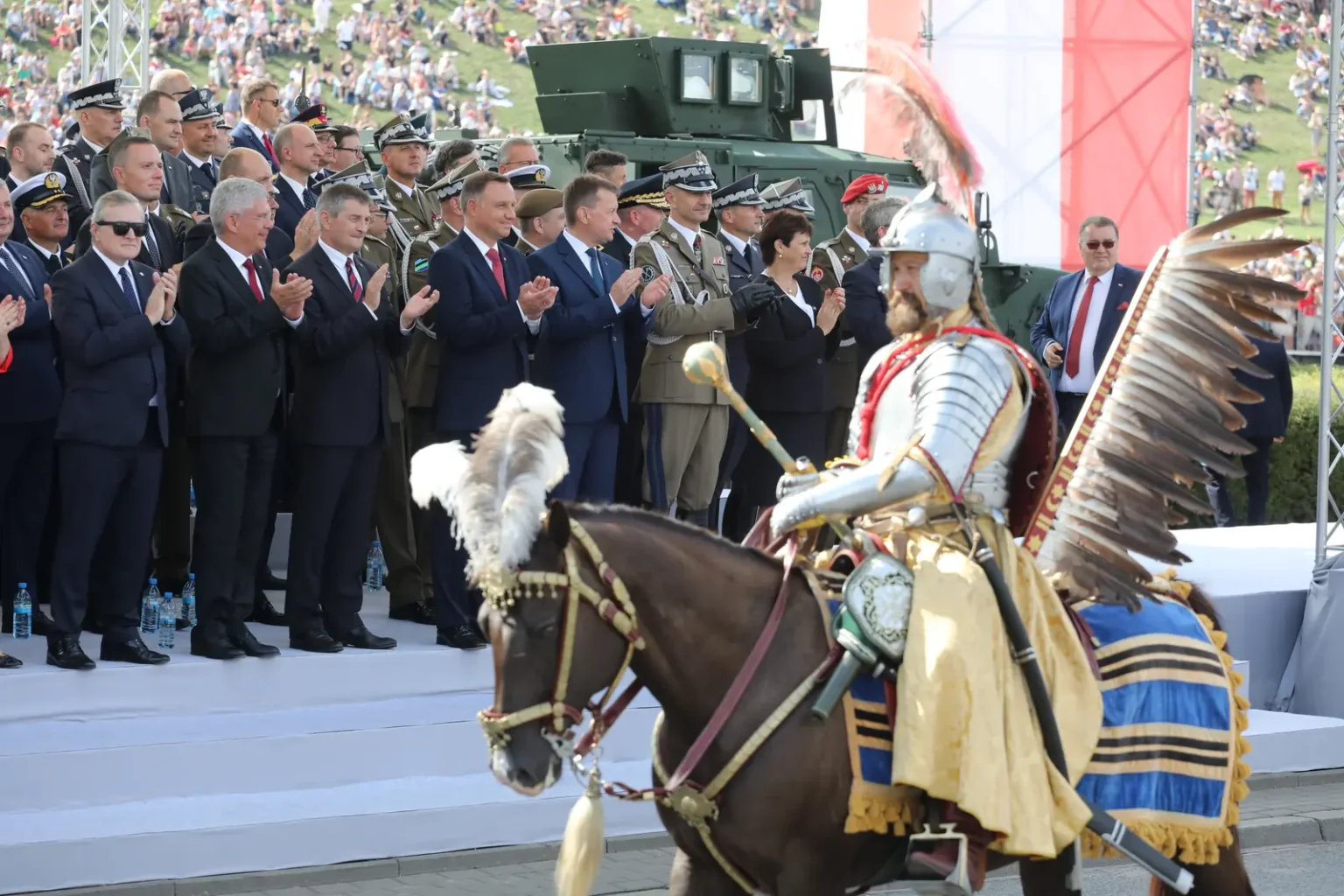
A horseman in steel armour, with two enormous feathered wings rising behind his shoulders, is hard to forget. The Polish winged hussar has one of the most recognisable silhouettes in military history. How often, though, did those towering wings appear on a battlefield?
The answer varies with the period, the rider and where his wings were attached. Surviving armour and early images give us several versions of the hussar. Some wore a single wing on the saddle. Others appear without wings. The spectacular pair mounted high on a rider’s back belongs to a longer history of display, remembrance and changing equipment.
Feathers before the familiar silhouette
The National Museum in Kraków’s account of hussar wings places their appearance in the Polish-Lithuanian Commonwealth around the middle of the sixteenth century. It traces the fashion to Near Eastern and Ottoman cavalry traditions involving feathers, wings and animal skins.
King Stephen Báthory’s recruitment letters mentioned wings, the museum notes, although they were not a universal requirement. Their visual effect could help intimidate an opponent. A conspicuous frame also added weight and could restrict a rider’s movement. Where the wings were attached mattered, too.
A saddle-mounted wing moved with the horse; one fixed to a backplate moved with the rider. That difference helps explain why a fitting, often hidden in a museum display, can be as revealing as the feathers above it.
A parade painting and a battle painting disagree
Witold Głębowicz’s study for the Polish Army Museum compares two revealing images. The Stockholm Roll, depicting a royal entry into Kraków in 1605, shows single wings attached behind the saddle. Peter Snayers’s later painting of the Battle of Kircholm, fought that same year, depicts hussars without them.
The two paintings show different occasions, and neither gives us a complete inventory of hussar equipment. Their contrast does suggest that the wings displayed at a royal entry were not necessarily worn into combat.
Głębowicz also describes a wooden wing in Sweden’s Skokloster collection, associated with the mid-seventeenth-century Swedish capture of Polish material. It lacks the fittings expected for mounting it on a backplate, supporting a saddle attachment. The fittings point to a different silhouette from the familiar pair of wings rising behind a rider’s shoulders.
What surviving armour can show
The Kraków museum points out that most surviving hussar half-armour has no wings. Winged examples are often eighteenth-century equipment used at weddings, funerals and military reviews.
That observation cannot tell us precisely how many wings appeared in an earlier battle. Detachable pieces can become separated; collections preserve some kinds of equipment more readily than others. It does explain why the date and history of a museum display matter as much as its dramatic appearance.
Ceremonial uniforms still distinguish a procession from an ordinary working day. The museum evidence suggests that hussar dress also changed with the occasion, as well as over time.
The image that outlived the equipment
The wings reward looking closely at historical art: where do they begin, how many are there, and what is the rider doing? A painted procession can preserve details that a battle scene leaves out, while an armour fitting may challenge both.
The museum evidence gives the winged hussar several silhouettes, rather than one fixed costume. Feathers belonged to the cavalry’s history, but their size, placement and use changed. A reconstruction based on the 1605 procession could therefore look quite different from one based on an eighteenth-century armour display. Looking for its dated model brings us closer to the rider behind the famous image.