Some of the smallest “hands” on a rock wall in southwestern Egypt are barely longer than a matchstick. Their fingers taper to points, and their palms look unusually short. For years, they were taken to be the hands of babies.
A different possibility emerged when researchers measured them: people may have held a reptile’s forefoot against the sandstone and blown pigment around it. Among the human handprints, an artist may have left the outline of an animal’s foot.
The 2016 study led by Emmanuelle Honoré concerns Wadi Sura II, often called the Cave of Beasts. Why choose an animal’s foot for a stencil, then place it among human hands?
A wall crowded with people, animals and strange beings
At Wadi Sura II, daylight reaches beneath the rock overhang at the foot of the Gilf Kebir. The Cologne research project’s catalogue describes about 8,000 figures, including hybrid creatures, in paintings made roughly 8,000 years ago.
That crowded surface makes the tiny outlines easy to miss. Paintings overlap, and neighbouring figures may help explain how an image was used. A close-up of a tiny “hand” gives us its shape; a view of the wall shows where someone chose to put it.
The Cologne team documented the shelter with high-resolution photography and 3D laser scanning. Its catalogue presents the art at a scale of 1:2 across 220 double-page spreads. That record lets researchers return to the positions, overlaps and neighbouring figures when they test an interpretation.
How researchers tested the baby-hand explanation
Of the 13 tiny stencils identified at the shelter, Honoré’s team studied the 11 complete enough to measure and compared them with 36 hands of full-term newborns and 25 hands of premature babies. The small outlines averaged about 45 millimetres long. Their proportions, including the long digits relative to the palm, differed from the human samples.
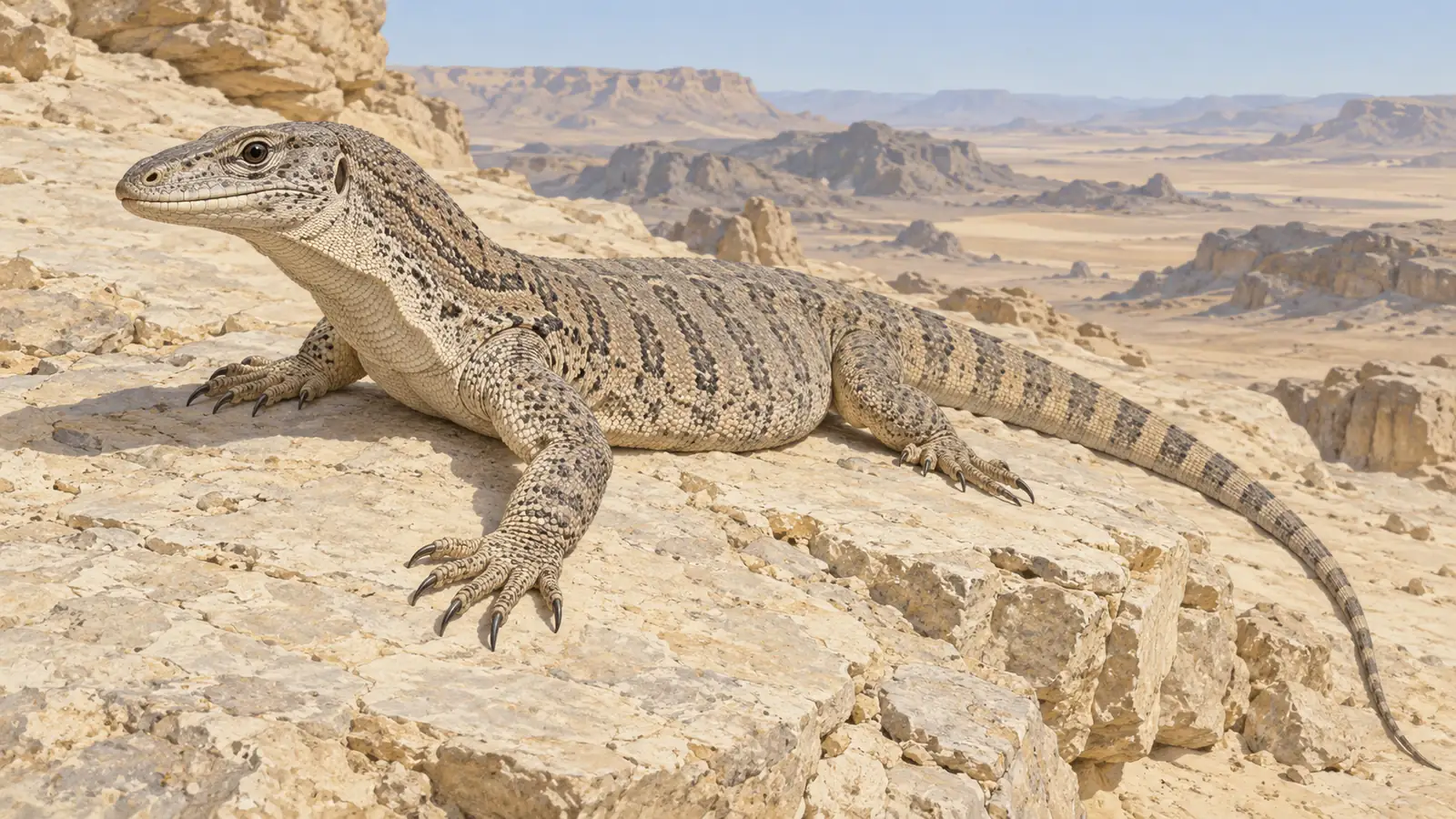
The team also compared larger prehistoric stencils with living adult hands to estimate distortion. Its conclusion favoured an animal, probably a reptile. A desert monitor lizard’s forefoot was a promising comparison; a young crocodile’s forefoot remained another possibility.
Size was only part of the comparison. The researchers also examined the proportions of the palm and digits, and the thumb’s position. A tiny human hand and an animal’s forefoot can be similar in length while differing sharply in those details.
The person behind the stencil
Even if a reptile supplied the outline, a human still selected it, positioned it and applied the pigment. Was the animal familiar, protective, feared, or connected to a story told at the shelter?
The wall may hold further clues. Some tiny stencils appear within larger human hand outlines, an arrangement the study’s authors connect with a possible relationship between people and animals. Whether that relationship involved protection, a story or another belief is still open.
Curiosmos’s coverage of Tassili n’Ajjer’s painted world offers a wider Saharan comparison. Animals appear throughout that region’s rock art, painted by communities living in landscapes very different from today’s desert.
How old are the tiny stencils?
The 2016 paper places the stencil phase tentatively around 6000 BCE using relative chronology and context. It reports no direct dating of the pigment. “About 8,000 years old” is therefore an archaeological estimate, rather than a laboratory result for an individual outline.
For comparison, the Kimberley kangaroo dated with mud-wasp nests was placed between dated layers above and below its paint. The two cases answer different questions: one constrains an image’s age; the other investigates what object made its shape.
The smallest stencils invite us to imagine the making of the picture: a person at the sandstone wall, a small forefoot held in place, pigment blown around its edges. The outline survives. The reason for choosing it is the part still waiting to be understood.