The ruler whose flight to Rome gave Emperor Claudius his excuse to invade Britain may have been a woman. Archaeologist Miles Russell of Bournemouth University argues that Verica, who led the Atrebates of southern Britain until about AD 40, was a female king, and that historians have assumed otherwise for two centuries without good reason.
The claim, set out in Russell’s book Caratacus: Great King of Britain and in the latest issue of Current Archaeology, has travelled widely this month. It has also drawn a sharp rebuttal from historian Guy de la Bédoyère. Here is what each side actually rests on.
At a glance
- Who: Verica, ruler of the Atrebates, whose territory covered much of today’s Hampshire and West Sussex.
- Why it matters: according to the Roman historian Cassius Dio, Verica’s appeal to Claudius is why Rome invaded Britain in AD 43.
- The claim: the name, the coins and the title “rex” point to a woman, Russell argues.
- The pushback: other specialists say every one of those clues fits a man just as well.
The case for a female king
Around AD 40, Verica was forced from power and fled to Rome. Cassius Dio wrote that Verica persuaded Claudius to cross the Channel, and three years later the Roman army landed. That makes Verica one of the most consequential figures in British history, whoever Verica was.
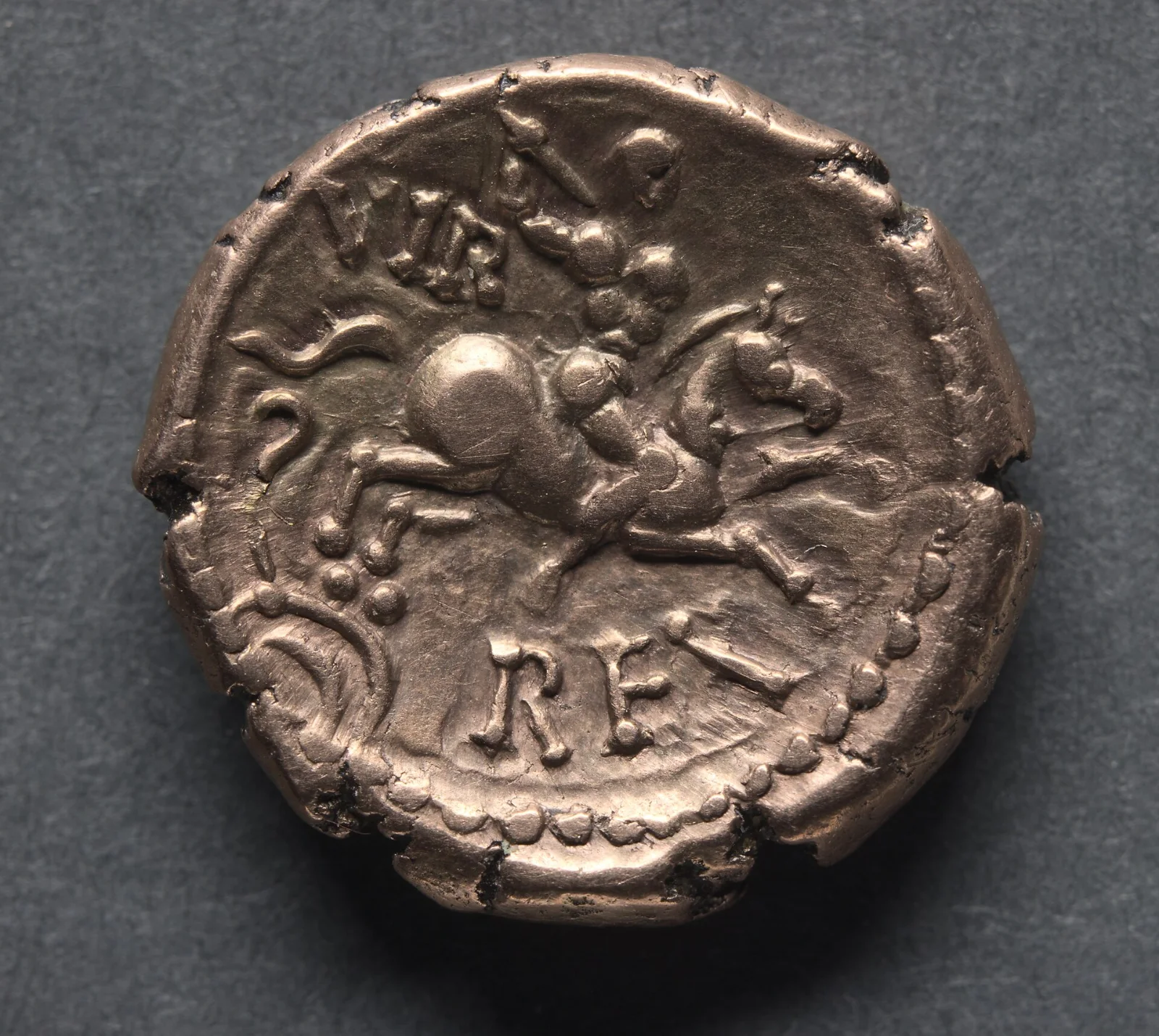
Russell’s argument has three parts, according to Bournemouth University’s announcement. First, the name: the final “-a” was common for women’s names of the period, as with Boudica and Cartimandua. Second, the title: Verica’s coins carry the Latin word rex, which Russell says Rome did not reserve for men. “Both male and female kings were recognised by Rome,” he said. Third, the imagery. On some coins, Russell says, “Verica is depicted as a slender, feminine, bare-breasted figure riding on horseback,” unlike the male warriors on other British coins.
“Verica is assumed to have been male because of the patriarchal mindset of 19th-century classical historians,” he said, as quoted by ScienceDaily. He goes further, arguing that Verica was more powerful than Boudica, and that without her, “Rome may never have invaded Britain in the first place.”
The case against
Guy de la Bédoyère, author of several books on Roman Britain and a regular on Channel 4’s Time Team, takes each point apart in a reply published on 9 November. Roman men could carry names ending in “-a”, such as Sulla and Agricola. Cicero referred to Cleopatra as regina, queen, which undercuts the idea that rex was used for women. The dots on the rider’s chest, he argues, are a standard engraving convention used across Iron Age coinage, and the horse-and-rider design was copied from a Roman coin of 82 BC.
His strongest points are two others. Some of Verica’s coins copy the portraits of the male emperors Augustus and Tiberius, an odd choice for a woman advertising her rule. And Roman writers loved stories of powerful British women. Tacitus and Dio wrote at length about Boudica and Cartimandua, and Claudius was often mocked for being steered by women. If the ruler who brought him to Britain had been a queen, it would be strange for no ancient writer to say so.
Our take: an argument worth having, not a settled fact
Headlines saying Verica “was” a woman go further than the evidence. As far as we can find, Russell’s case has not appeared in a peer-reviewed paper; it is set out in a book and a magazine feature, and its clues are ambiguous. But his larger point stands: the assumption that Verica was male was never proven either. It was the default of scholars who rarely imagined women in power.
What would settle it? Probably nothing we have now. A new inscription, or a coin series that shows the ruler unambiguously, could. Until then, the honest answer is that we do not know, and that is more interesting than either confident version. For another woman who took on Rome, see our story on Queen Zenobia of Palmyra. For more Roman Britain, read about the Ring of Senicianus.
Sources4
- Bournemouth University via EurekAlert!: New research reveals Iron Age king was female (4 November 2026)
- Current Archaeology: Verica Rex, searching for a lost queen of the British Iron Age
- Guy de la Bédoyère: No, the British tribal leader Verica wasn’t a woman
- ScienceDaily: interview quotes from Dr Miles Russell