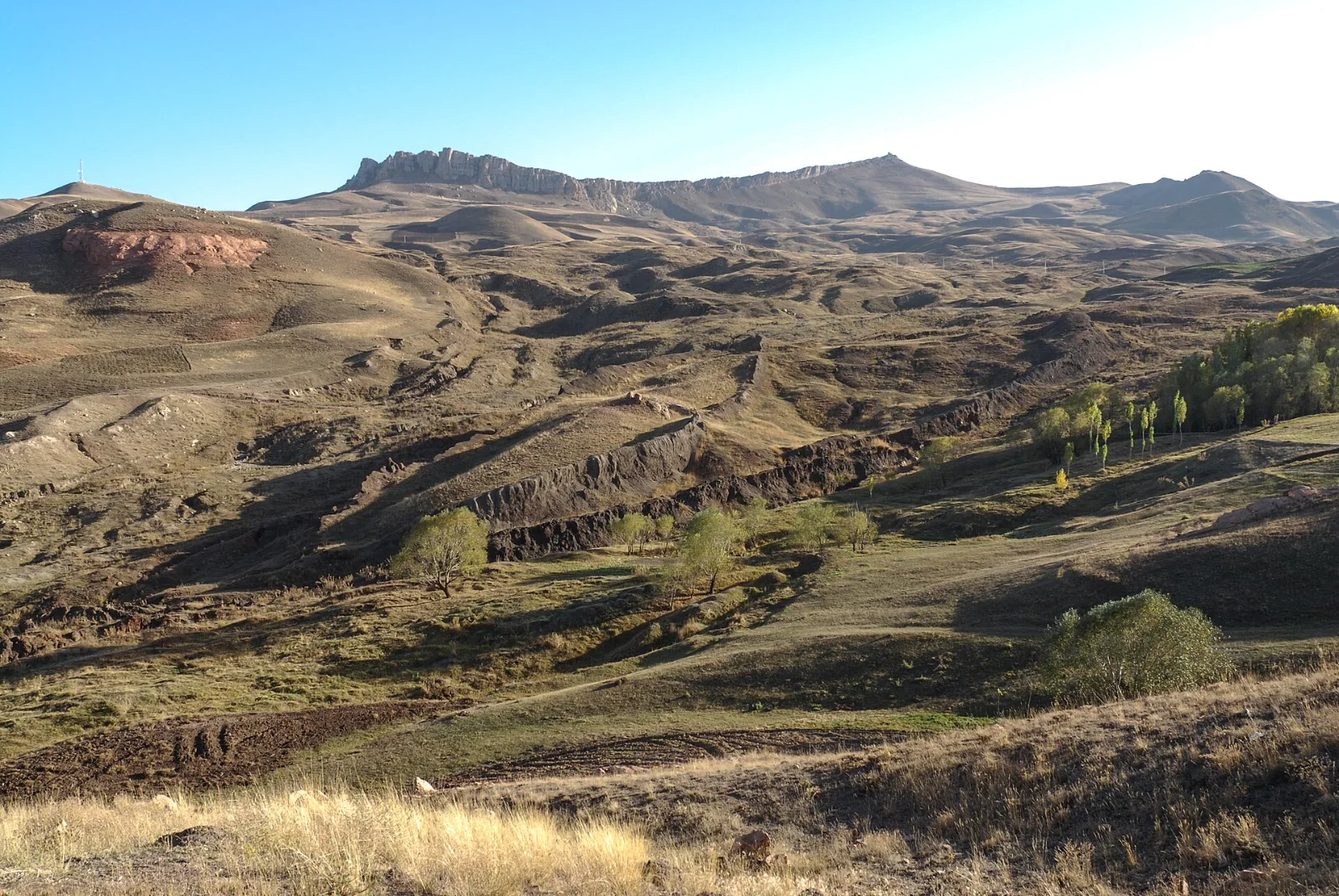
Researchers working at the Durupınar formation, the boat-shaped landform in eastern Türkiye long linked to Noah’s Ark, say two wood samples from the site have been radiocarbon-dated to about 4,300 years ago, between 2400 and 2200 BC.
The results came from a laboratory in the United States and were announced on 22 November by Professor Cenker Atilla of Sivas Cumhuriyet University. The team’s own deputy leader, Andrew Jones, cautioned that “the dating results alone do not establish that the Durupınar Formation represents” Noah’s Ark.
At a glance
- Where: Durupınar, near the village of Üzengili in Doğubayazıt, Ağrı Province, eastern Türkiye.
- Result: two wood samples dated to 2400-2200 BC by a US lab. Labs in Switzerland and Türkiye have not reported yet.
- Caveat: no scientific report has been published, and earlier geological studies concluded the formation is natural.
What the team did
About 20 researchers from five countries surveyed the site from 28 June to 30 September 2026. In September, Noah’s Ark Scans, a group taking part in the project, said it had begun core drilling to depths of up to 18 metres. Over the season the team combined geology, geophysics and archaeology. They collected samples described as wood and carbonised material and sent them to laboratories in the United States, Switzerland and Türkiye, including labs associated with Türkiye’s science agency TÜBİTAK.
Only the US results are in. Jones said the two dated samples correspond to some proposed chronologies of the biblical flood.
The flood story itself is older than the Bible: several ancient flood epics predate it, and even the ark’s shape is debated, with one reading of a Dead Sea Scrolls text suggesting it was pyramid-shaped.
What a date can and cannot show
Radiocarbon dating gives the age of organic material, not its history. A 4,300-year-old date does not show whether the wood was shaped by people, whether it was part of a structure, or how it came to be at the site.
Geologists who studied Durupınar in earlier decades concluded that its boat-like outline formed through natural processes. The new dates do not overturn that work, and full laboratory measurements, calibration data and details of where exactly the samples were taken have not been released.
What happens next
The Swiss and Turkish laboratories are still to report. A published study with the full data would let independent scientists check exactly where the samples came from and how they relate to the formation.
How Durupınar became “Noah’s Ark”
The formation drew attention after Turkish Army Captain İlhan Durupınar spotted its boat-like outline in a Turkish Air Force aerial photograph taken in October 1959, and the site carries his name. It is about 164 metres long. From the late 1970s, American Ron Wyatt promoted it as the ark, and in 1985 he joined an expedition with David Fasold and geophysicist John Baumgardner.
Fasold later changed his mind. In 1996 he and geologist Lorence Collins published “Bogus ‘Noah’s Ark’ from Turkey Exposed as a Common Geologic Structure” in the Journal of Geoscience Education, concluding that it is a natural formation that only resembles a boat. Since 2011, work at the site has been overseen by a board of professors from Ağrı İbrahim Çeçen University. The new radiocarbon dates will be judged against that long and contested history.
Sources4
- Wikipedia: Durupınar site (history and 1996 Collins and Fasold paper)
- Arkeonews: Wood samples from Noah’s Ark research site dated to 4,300 years ago, 23 November 2026 (citing İhlas News Agency)
- Noah’s Ark Scans, press release via GlobeNewswire, 11 November 2026
- Noah’s Ark Scans: Core drilling begins at Durupınar site, GlobeNewswire, 23 September 2026