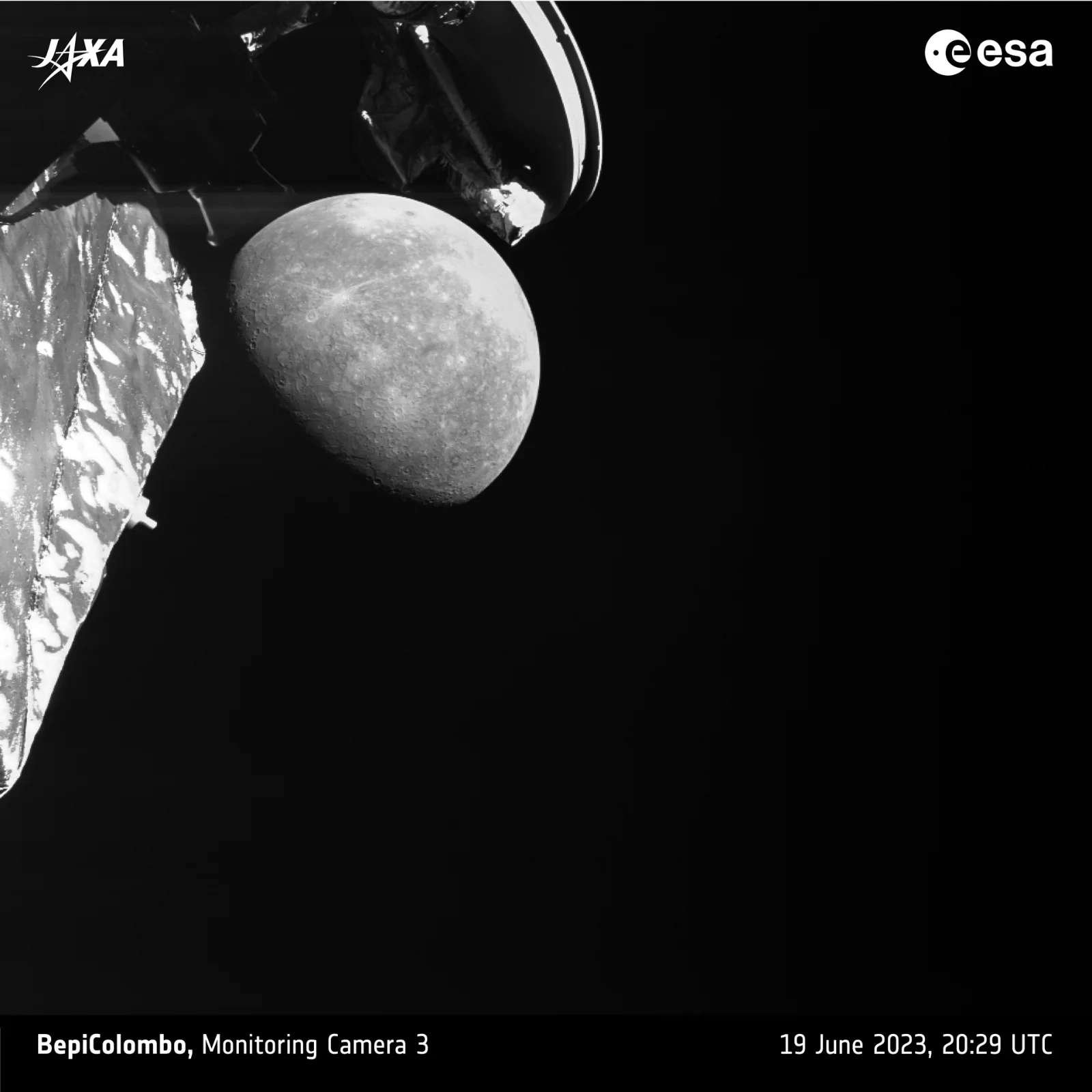
After nearly eight years and 9.9 billion kilometres, Europe and Japan’s BepiColombo mission is in orbit around Mercury. The spacecraft was captured by the planet on 21 November, using a technique never before used to enter orbit around another planet. The arrival was not entirely smooth: a software glitch cut a thruster burn short and put the spacecraft into safe mode. ESA says it is now secure and on track.
At a glance
- Arrived: orbit insertion began on 21 November 2026 at 18:24 UTC.
- The glitch: an early end to a thruster burn triggered safe mode. The orbit is now 75 hours long instead of the planned 58.
- Next: the two orbiters, ESA’s MPO and JAXA’s Mio, separate on 9-10 December 2026.
- Science: due to begin in April 2027.
How BepiColombo got into orbit
Reaching Mercury is a braking problem: a spacecraft falling toward the Sun picks up enormous speed and has to shed it. BepiColombo, launched in October 2018, did this with nine planetary flybys and years of ion-engine thrusting. Its electric propulsion was switched off in June, and the Mercury Transfer Module that carried it was released on 3 September.
For the final step, the mission used what ESA calls “weak stability capture”, a gentle approach that lets Mercury’s gravity take hold of the spacecraft gradually rather than relying on one large braking burn. According to ESA’s arrival updates, it is the first time the method has been used to enter orbit around another planet.
The safe-mode scare
During the capture sequence, a thruster burn ended early and the spacecraft went into safe mode. ESA traced the cause to a software glitch. The result is a 75-hour orbit rather than the 58-hour one that was planned, but the team adapted the remaining manoeuvres without needing extra burns, and the December separation of the two orbiters is not affected.
What happens next
BepiColombo is really two spacecraft. ESA’s Mercury Planetary Orbiter (MPO) will map the surface and interior, while JAXA’s Mio studies the planet’s magnetic field and the space around it. They split on 9-10 December, and a sunshield and interface structure called MOSIF leaves MPO on 16 December. The MPO’s instruments have already been tested: its BELA laser altimeter fired more than 700,000 pulses during checks. Full science operations start in April 2027.
Our take: why this mission matters
Mercury is the least explored rocky planet. Only NASA’s Mariner 10 and MESSENGER have studied it up close, and they left big puzzles: why such a small planet has a magnetic field, why its surface is so dark, and how much water ice is hidden in permanently shadowed craters at its poles. Two orbiters working together, one inside the magnetic field and one mapping the ground beneath it, is the best chance yet to answer them. The glitch is a reminder of how fine the margins are this close to the Sun, and that a mission eight years in the making still had to get the last step right.
We covered the module separation in September: BepiColombo begins its arrival at Mercury. For the bigger picture, see our guide to the solar system.