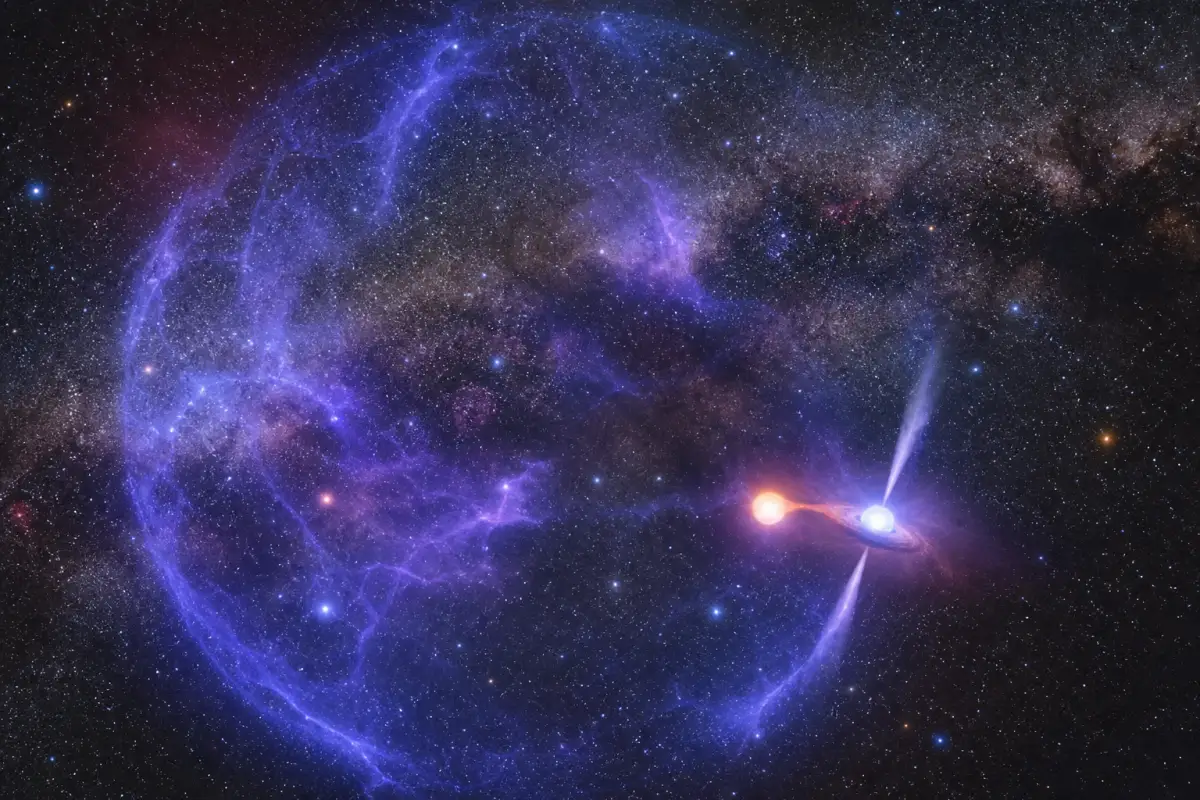
Something enormous is glowing in the direction of Cygnus. The structure, known as the Cygnus Bubble, spans hundreds of light-years and shines in gamma rays—the most energetic form of light. Astronomers have long associated it with Cygnus X, a crowded region where massive stars are being born. A new study proposes a different engine for the most extreme part of the emission: a compact binary called Cygnus X-3.
The idea comes from a paper by Zhaodong Shi and colleagues, accepted for publication in *The Astrophysical Journal Letters*. The researchers argue that Cygnus X-3 can explain the bubble’s highest-energy gamma rays more naturally than a broad population of young stars alone. It is a strong proposal, not a settled identification.
A binary with a powerful reputation
Cygnus X-3 is a microquasar, a binary system containing a compact object—probably a black hole or neutron star—pulling material from a companion star. As gas spirals inward, some of the system’s energy can be channelled into jets and fast-moving particles.
That makes the binary an attractive candidate for producing cosmic rays. The new study focuses on protons accelerated to energies above 100 teraelectronvolts, with the spectrum extending toward the petaelectronvolt range. When those particles leave the binary and collide with gas in interstellar space, they can generate very-high-energy gamma rays.
Why the bubble points back to Cygnus X-3
The Large High Altitude Air-shower Observatory, or LHAASO, has detected an ultra-high-energy gamma-ray source associated with the Cygnus region. The source is variable and reaches energies approaching a petaelectronvolt. The researchers modelled how particles released by Cygnus X-3 would spread through the surrounding gas and found that the resulting halo could match the observed Cygnus Bubble.
The geometry is part of the argument. The bubble covers roughly six degrees on the sky, corresponding to a structure hundreds of parsecs across at the distance of the Cygnus star-forming region. A point-like accelerator that has been injecting particles over time can produce that kind of extended glow as the particles diffuse away from their source.
The team says the association with Cygnus X-3 becomes especially plausible above about 400 teraelectronvolts. At lower energies, the wider Cygnus X star-forming complex may still contribute substantially. The bubble may therefore not have a single simple explanation across its entire spectrum.
What remains uncertain
The paper is a model, and models live or die by future observations. Astronomers need to compare the predicted gamma-ray shape, energy spectrum, and variability with a larger set of measurements. They also need to test whether the surrounding gas has the density and composition required for the proposed hadronic process.
There is another practical difficulty: Cygnus is a crowded region. Massive stars, supernova remnants, stellar winds, and other compact objects all occupy the same broad neighbourhood. Separating their contributions is difficult even for instruments that detect gamma rays rather than visible light.
Still, the proposal gives the bubble a sharper story. Instead of treating the Cygnus region as one diffuse accelerator, it asks whether a single microquasar has been steadily feeding the surrounding space with the particles that make the largest structure visible. The answer will come from the next generation of gamma-ray observations, not from the striking shape of the bubble alone.
The result also connects two scales that are usually discussed separately. Cygnus X-3 is a binary system only a few astronomical units across, while the bubble stretches across a region measured in hundreds of parsecs. A stream of particles from that tiny engine would have to survive and spread through the interstellar medium for a very long time before producing the glow astronomers see.
If the connection holds, Cygnus X-3 would join a short list of known particle accelerators in the galaxy. It would also help explain why the most energetic emission is concentrated toward one part of the larger cloud. But the distinction between a convincing source model and a confirmed source will depend on measurements that can separate the binary’s contribution from the rest of Cygnus X.
Read our related coverage of ancient quasars in the young universe and the Milky Way’s three-dimensional structure.
Sources and further reading: The Astrophysical Journal Letters paper on Cygnus X-3 and the Cygnus Bubble; arXiv version of the research; Phys.org research report.