Some of the brightest objects in the universe are also among its oldest. The European Space Agency’s Euclid mission has identified 31 quasars whose light began its journey when the universe was still in its first billion years. Two of them belong to the most ancient group yet found.
The result, reported in Astronomy & Astrophysics, gives astronomers a much larger sample of early quasars than they usually get from targeted searches. That matters because the objects are not simply historical curiosities. They are clues to how the first supermassive black holes grew so quickly.
What Euclid actually found
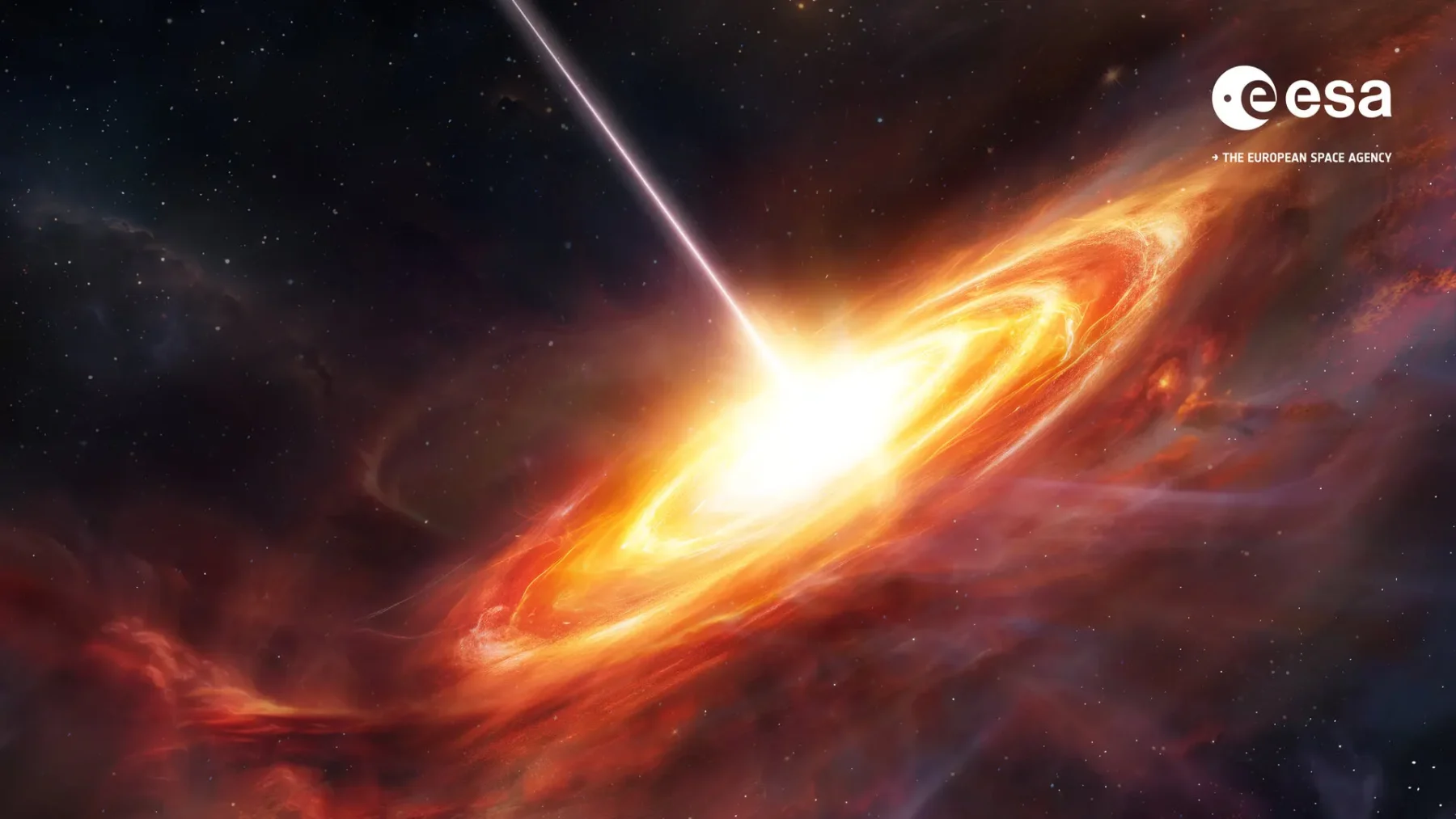
A quasar is the brilliant centre of a galaxy powered by material falling towards a supermassive black hole. The black hole itself does not shine, but gas and dust in its immediate surroundings can release enormous amounts of energy as they spiral inward. A single quasar can outshine all the stars in its host galaxy.
Euclid’s survey identified 31 quasars at redshifts between about 6.6 and 7.8. Redshift measures how much the expansion of space has stretched an object’s light. At those values, the telescope is seeing the universe as it was roughly 650–800 million years after the Big Bang. The two most distant objects in the sample date from around 670 million years after the beginning.
That is not the age of the quasars today. It is the age of the universe when the light left them. The galaxies and black holes have had more than 13 billion years to evolve since then.
Why a larger sample matters
Finding one very distant quasar can be exciting, but it is difficult to know whether it is typical. A group of 31 allows researchers to compare brightness, colour, redshift and sky position. They can ask whether early quasars were common, whether they preferred particular environments and how rapidly their black holes were feeding.
Euclid is especially useful because it is designed to map such a large area of sky. Its wide survey can find rare objects that narrow observations might miss. The mission’s initial release is therefore less a final census than a demonstration of what the full survey could uncover.
The team reports that these quasars are extremely luminous, with the brightest shining at the equivalent of about a trillion Suns. That brightness makes them visible across most of the observable universe, but it also introduces a bias: the first objects found are the easiest to see, not necessarily the most representative.
The puzzle of early black holes
Supermassive black holes are thought to grow by pulling in gas, merging with other black holes and possibly starting from massive “seed” black holes created by the first stars. The difficulty is time. Some of the black holes powering these quasars already had masses of hundreds of millions or billions of Suns before the universe was a billion years old.
That does not break cosmology, but it does narrow the range of possible growth histories. A black hole has to feed efficiently, avoid long interruptions or begin from a heavier seed than the remnants of ordinary stars. A bigger, better-characterised sample gives theorists a way to test those possibilities against the real population rather than against a handful of extraordinary examples.
How the observations are checked
Euclid’s images identify promising candidates, but confirmation requires spectroscopy and observations at other wavelengths. Spectra reveal the characteristic emission lines that distinguish a quasar from a cool star or a less distant galaxy. Follow-up work can also estimate the mass of the central black hole and the rate at which it is consuming material.
This is where Euclid works alongside other observatories. The James Webb Space Telescope can study the faint host galaxies around some early quasars, while ground-based telescopes measure the detailed spectra needed to refine their distances. The combination is more informative than any single image.
A map of the early universe, not a photograph of its beginning
Even the most distant quasar in this release is not seeing the Big Bang itself. It is a lighthouse from a later period, after the first stars and galaxies had already formed. The 31 objects sit within a universe that was young, rapidly changing and still clearing the fog of neutral hydrogen left from its earliest stages.
As Euclid’s survey expands, the mission should find more of these rare lighthouses and improve estimates of how many exist. That will help connect the story of early black holes with the larger questions of galaxy growth and cosmic expansion—questions we have explored in our guides to why the observable universe is so much larger than its age suggests and how astronomers detect black holes they cannot see.
For now, Euclid’s 31 quasars do something important without solving every mystery. They turn a small collection of spectacular early objects into the beginning of a population study. The next discoveries will show whether these ancient black holes were rare exceptions—or the visible tip of a much larger story.