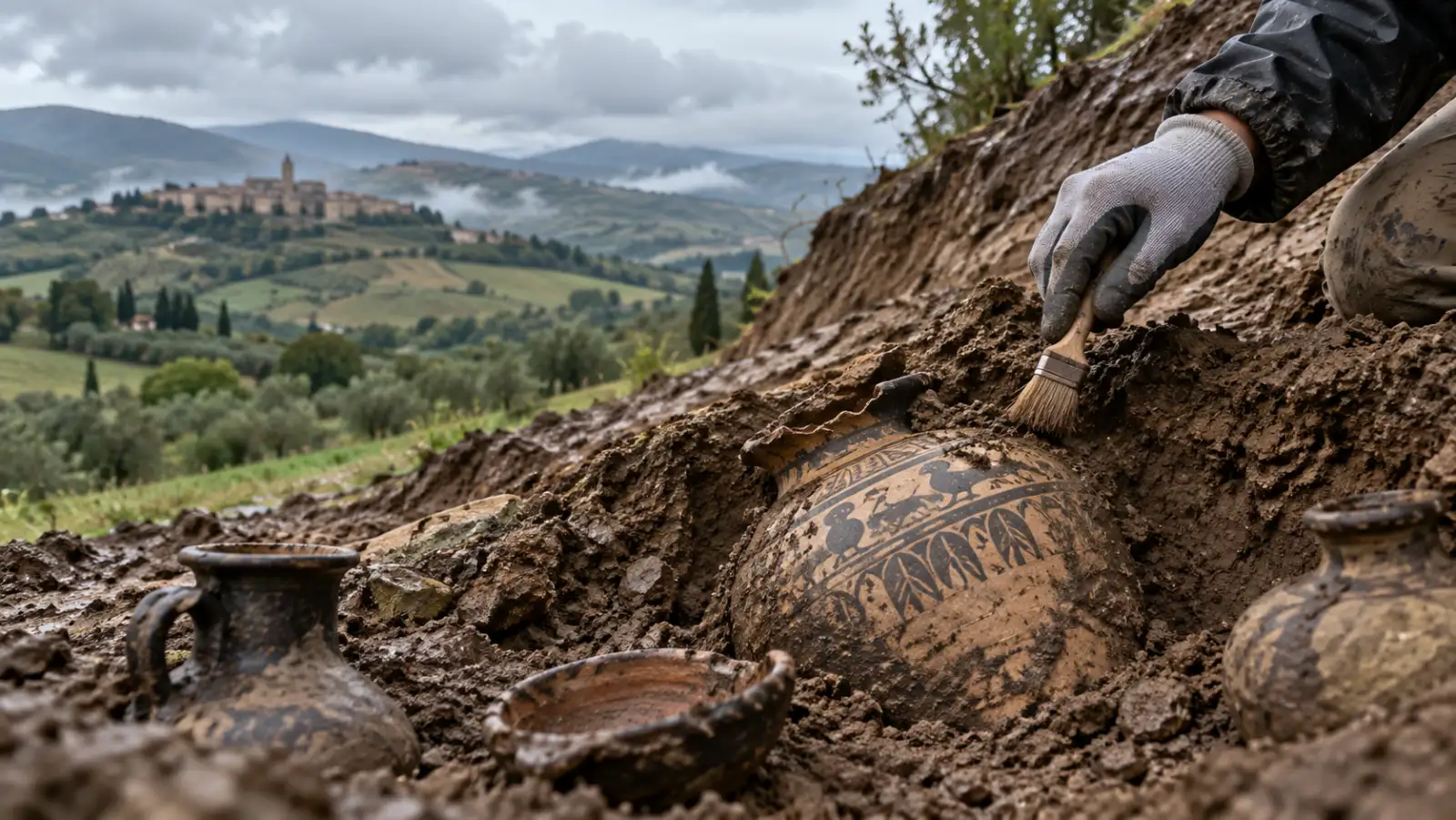
A hillside near Sant’Elpidio a Mare gave up a small part of its past after heavy rain cut into the soil. The first clue was a ceramic vessel. Archaeologists then identified the find as part of a Picene burial, provisionally dated to the sixth century BCE.
What survived is modest—a group of vessels rather than a spectacular monument—but the discovery opens a window onto a pre-Roman community that lived along Italy’s Adriatic coast and traded far beyond it.
A vessel appeared on a rain-cut hillside
The discovery was reported near the town cemetery at Sant’Elpidio a Mare in the Marche region of central Italy. According to the official notice from Italy’s Superintendency of Archaeology, Fine Arts and Landscape for the provinces of Ascoli Piceno, Fermo and Macerata, staff inspected the area on September 8, 2026, after a report of archaeological material emerging from the ground.
The object proved to be part of a more substantial group of ceramic containers placed inside a tomb. The Superintendency’s preliminary assessment associates the burial with the Picene culture and places it in the sixth century BCE. Archaeologists documented the find, removed the exposed pieces and moved them into protective storage. Conservation and detailed study are still to come.
That sequence matters. The date is not a final laboratory result, and the officials have not yet published a complete inventory of the grave goods. At this stage, the secure information is that a burial was exposed, that several vessels were recovered, and that specialists are examining them.
Who were the Picenes?
The Picenes were communities that occupied much of the central Adriatic side of the Italian peninsula before Roman expansion. Their settlements and cemeteries are known from the Marche and nearby regions, where people farmed, made local pottery and participated in exchange networks that reached across the Adriatic.
Archaeology Magazine notes that Picene ports handled imported pottery, bronze objects and other goods from Greece. Some of those goods continued into other parts of Europe. A single tomb therefore raises questions that reach beyond the hillside itself: who was buried there, what did the objects signify, and how did the community fit into the wider movement of people and materials around the Adriatic?
Why archaeologists are moving carefully
A landslide can expose an object while destroying the relationships that make a burial intelligible. Soil pressure, water and the movement of the slope may separate a vessel from the body, other offerings or the original position of the grave. That is why the emergency response focused first on recording and protecting the remains.
The Superintendency says the recovered objects will undergo restoration and further study. Those steps can reveal manufacturing traces, firing methods, residues and patterns of wear. The vessels may also help archaeologists compare the burial with other Picene sites in the region. If more of the grave survives below the disturbed area, future investigation could show whether this was an isolated burial or part of a larger cemetery.
The location has already produced accidental archaeological finds in the past, according to the official notice. Local authorities and the Superintendency are now discussing how the objects might eventually be displayed and made available to the public.
What can a small tomb tell us?
It is easy to overlook a burial that offers no gold mask or monumental architecture. Yet ordinary containers can preserve a more intimate record. Their shapes and fabrics may identify local workshops or imported goods. Their placement may point to ritual practice. Traces inside them can sometimes reveal what was stored or poured during the funeral.
The Picene tomb also gives researchers a chance to refine a familiar story about Italy before Rome. Curiosmos has previously examined why the place where an ancient object is found matters, and this discovery makes that question unusually concrete. The period was not an empty gap between the Bronze Age and Roman rule. It was a landscape of communities with their own identities, contacts and choices. The objects in this grave may show how those choices were expressed at the level of one person and one ceremony.
For now, the most honest answer is also the most intriguing one: the rain revealed a Picene burial, but the burial’s full story is still underground—in the position of the vessels, the material they contain and the evidence that laboratory work can recover from them.
Sources and further reading
Soprintendenza Archeologia, Belle Arti e Paesaggio (official notice); Archaeology Magazine report.