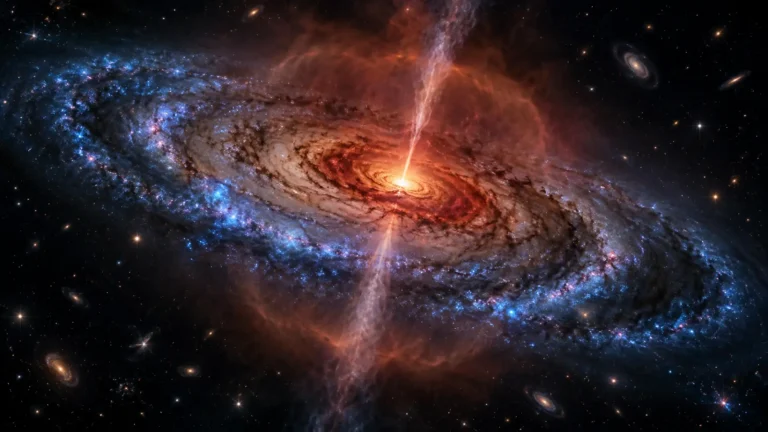
Astronomers have catalogued more than 120 molecular species in a cloud near the centre of the Milky Way. The finding matters because the cloud contains several compounds associated with the chemical building blocks of life, and it closely resembles another unusually rich cloud studied for years.
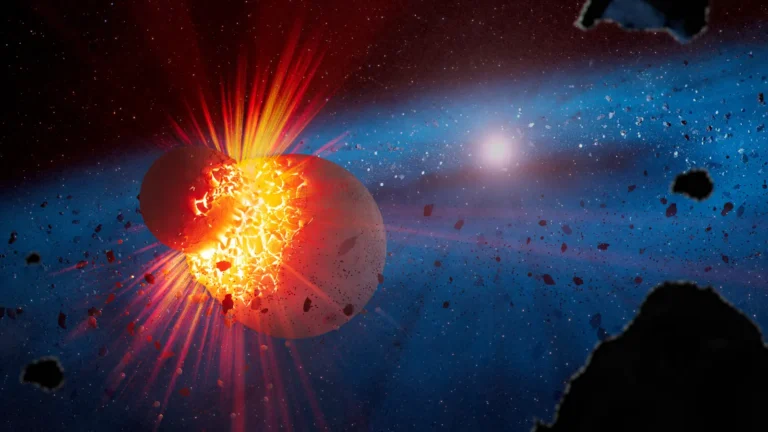
The newly examined cloud is called G+0.633-0.0604, or G+0.633. It lies about 32 light-years from G+0.693, the better-known molecular cloud that contains roughly 40 percent of all molecules detected in interstellar space. Neither cloud is actively forming stars. Their chemistry appears to be driven instead by warmth and low-velocity shocks that disturb icy coatings on dust grains.
How the molecules get into space
Those shocks may release molecules that were frozen onto dust particles. Once in the gas, the molecules emit radio signals that telescopes can separate and identify. The new survey found signatures from more than 120 species containing carbon, hydrogen, oxygen, nitrogen, phosphorus and sulphur—the six elements most commonly associated with terrestrial biology.
Several detections are especially notable. Ethanolamine, a component of the membranes surrounding living cells, has now been seen in space for only the second time. Sp-glycolamide has a structure related to glycine, the simplest amino acid, and was also detected for only the second time. The researchers additionally found all three forms of cyanomethanimine, compounds that can participate in pathways toward adenine, one of the information-bearing bases in DNA and RNA.
A second chemical laboratory
The observations do not show that life exists in the cloud, nor do they reveal a complete route from interstellar chemistry to biology. They do provide a second laboratory in which the same kinds of molecules can be studied. If similar inventories turn up in other clouds, the chemistry once thought to be a peculiarity of G+0.693 may prove to be a repeatable outcome of common physical conditions.
That distinction is important. Astronomers have identified almost 350 molecules in interstellar space, but many were found in a small number of exceptionally well-studied locations. Finding a chemical twin so close to the Galactic centre gives researchers a way to compare environments rather than treating one cloud as an isolated curiosity.
The team now has a larger target list for follow-up observations. Measuring how the molecules are distributed, how their abundances change and which reactions can make them will help clarify whether complex organic chemistry is widespread before planets form. The result is a new piece of evidence about where the raw ingredients of biology can assemble.
Source: Phys.org; D. San Andrés et al., The Galactic Centre G+0.633-0.0604 Molecular Cloud: A New Gold Mine for Astrochemistry, DOI 10.48550/arXiv.2608.14381.