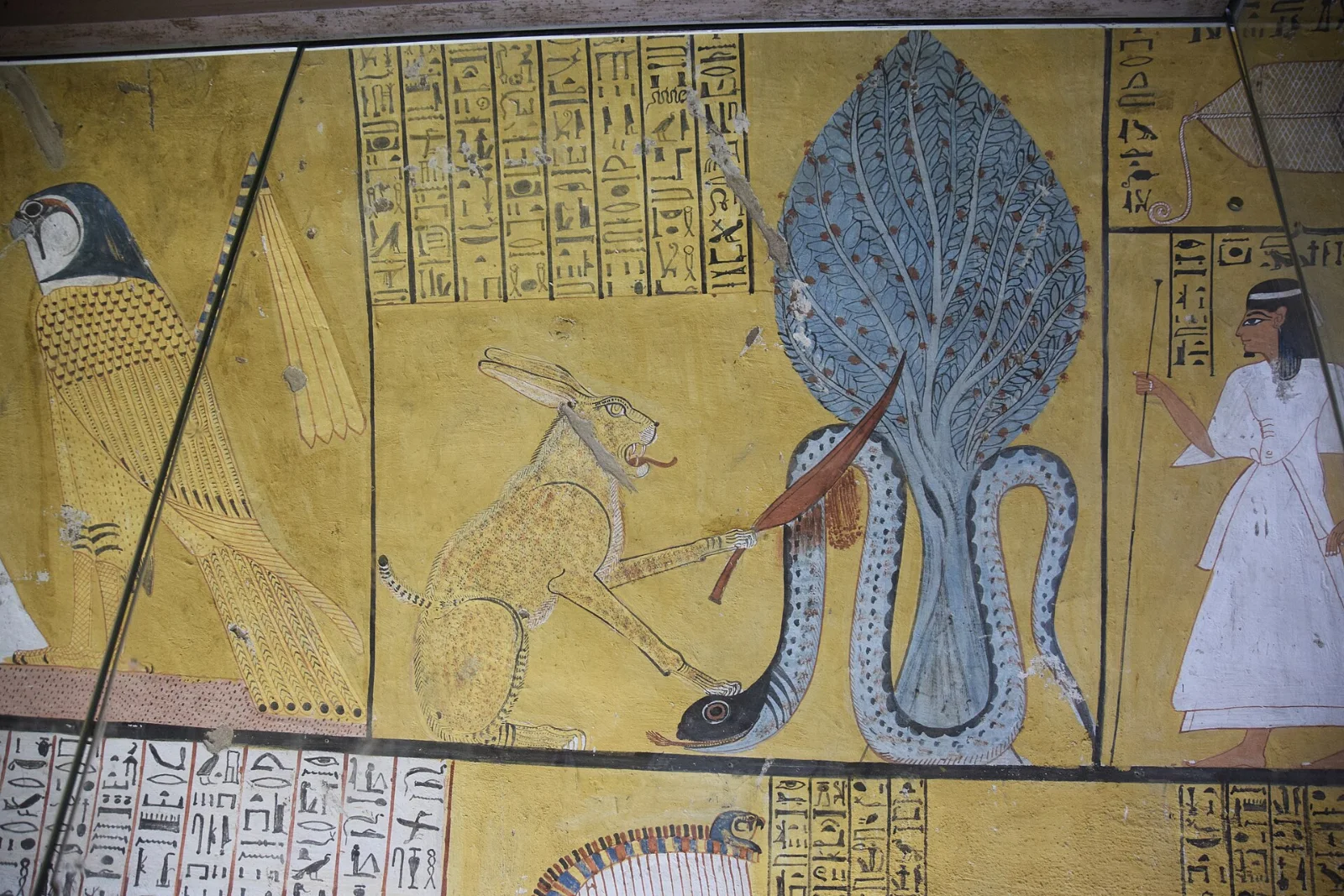
Every night, the ancient Egyptians believed, the sun god Ra sailed through the underworld and had to fight his way past a giant serpent called Apophis. If the snake ever won, the sun would not rise. So the Egyptians helped. They drew the serpent, wrote his name in red ink, stabbed the picture with a knife and set it on fire.
Until now, the only direct record of that curse came from a ritual manual written in the late fourth century BC. A new study shows the ritual is much older than that, and that it was done so often that the curse sheets were made in batches.
Forty scraps from a temple rubbish heap
Egyptologist Fredrik Hagen of the University of Copenhagen and his colleagues found 40 small papyrus fragments in a rubbish deposit at the mortuary temple of Pharaoh Thutmose III in Thebes, modern Luxor. None of the pieces is bigger than half a postage stamp. All of them are charred, and many are pierced.
When the team pieced together the drawings and text, they turned out to be the remains of the Apophis ritual. The fragments are about 3,400 years old, from Egypt’s New Kingdom. That makes them the earliest physical evidence that the ritual was actually carried out, and it pushes the ritual’s known history back by roughly 1,000 years.
The results are published in the journal Zeitschrift für Ägyptische Sprache und Altertumskunde under the title “Cursing Apophis: Text and Material Culture of an Egyptian Execration Ritual”.
How the curse worked
Apophis (also written Apep) was the serpent of chaos, the enemy of order and of Ra, the sun god. According to the University of Copenhagen’s summary of the study, the ritual worked like this:
- A priest or scribe drew Apophis as a snake on papyrus and wrote his name in red ink, the colour of danger. Sometimes a wax figure was used instead.
- The image was trampled, spat on and stabbed with a knife.
- Finally it was burned while spells were recited. Burning was essential: without it, the ritual did not count.
That last step explains why the fragments are so small and scorched. They are what was left after the fire.
Snakes played a double role in Egyptian belief. The cobra goddess Wadjet protected the king, while Apophis threatened the whole cosmos. We looked at that contrast, and at why serpents appear in so many mythologies, in our piece on snake symbolism in ancient cultures.
Signs of mass production
The most surprising detail is not the age. It is the repetition. The researchers found the same drawings and phrases again and again, which suggests that the curse sheets were prepared in bulk, ready to be used.
That changes how scholars see the ritual. Rather than a rare ceremony, it looks like routine temple work. Hagen’s headline conclusion, quoted by the university, is that “it must have been widespread in ancient Egypt”.
Over time the ritual also spread beyond its original purpose. It began as a way to protect Ra on his nightly journey. Later versions were adapted to treat illness, keep away bad weather, bring personal success or harm an enemy. Hagen notes that literate people outside the priesthood also offered magic and healing, and that ordinary Egyptians went to scribes both for protection and for help attacking their rivals.
Why a rubbish dump matters
Temple inscriptions show the ideal version of Egyptian religion: carved, official, built to last. Rubbish heaps show what people actually did. Other fragments from the same area belong to the temple’s administrative archive, so the curse sheets were thrown out alongside everyday paperwork.
It is a reminder that some of the most revealing finds in Egyptology are not golden treasures but scraps. Reading damaged or burnt texts has become a field of its own, as we explained in how scientists read scrolls burned 2,000 years ago.
Our take
The Apophis ritual is often presented as an exotic piece of temple theatre. These 40 scraps suggest something more ordinary and more human. Egyptians were anxious about chaos, illness, storms and enemies, and they had a standard, mass-produced tool for dealing with all of them. The serpent never had to be defeated just once. He had to be defeated every day, and someone had to keep making the paperwork.
For more on how ancient beliefs hold up against the evidence, see our fact-check of 26 ancient world myths.
Sources4
- Hagen, F. et al. (2026). Cursing Apophis: Text and Material Culture of an Egyptian Execration Ritual. Zeitschrift für Ägyptische Sprache und Altertumskunde. doi:10.1515/zaes-2026-0004
- University of Copenhagen via EurekAlert!: Discovery of curse ritual in rubbish dump surprises Egyptologist
- Phys.org: Discovery of curse ritual in trash dump surprises Egyptologist
- Discover Magazine: Ancient Egyptian rubbish dump reveals 3,400-year-old fragments of famous curse ritual