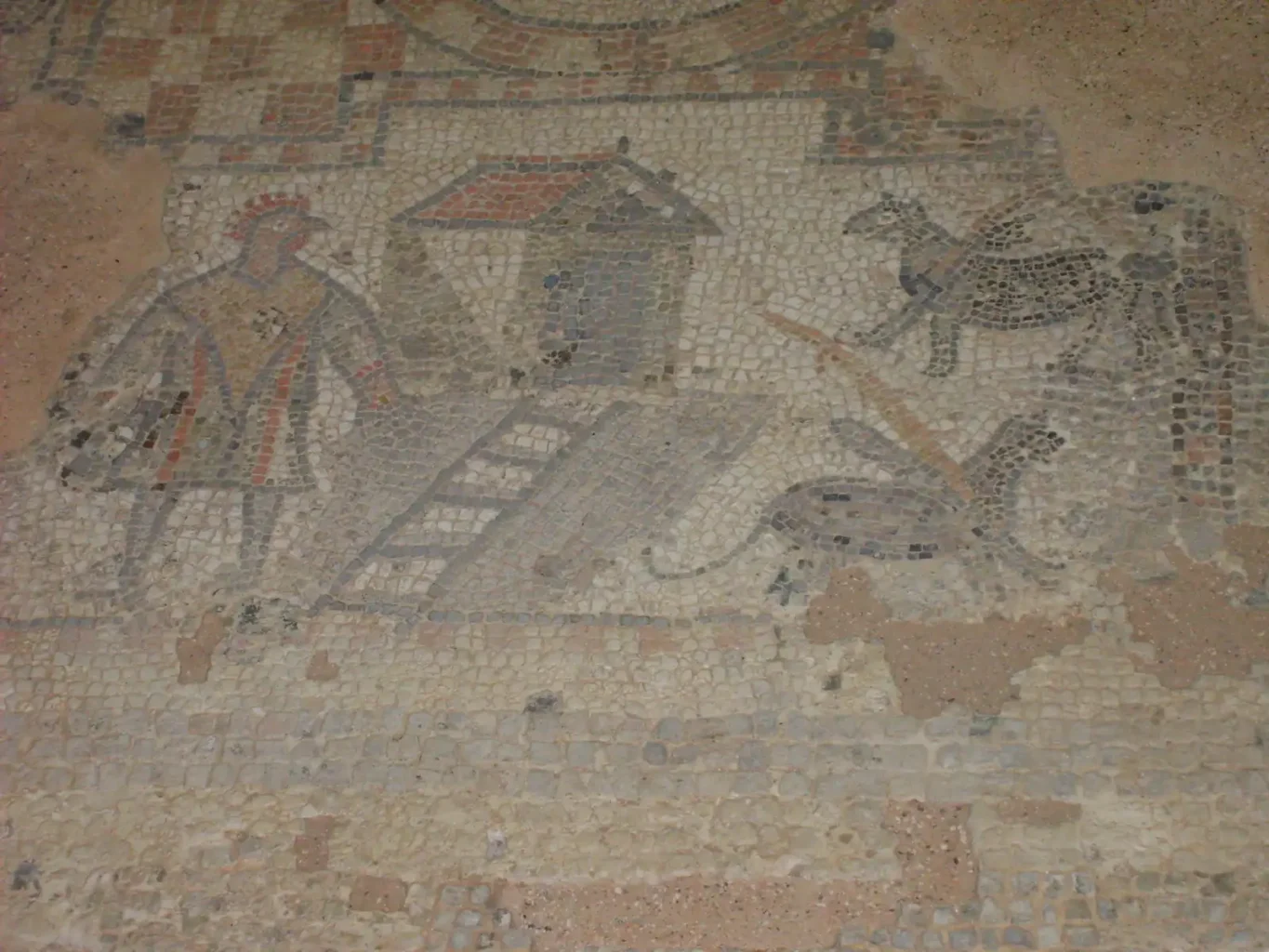
For more than a century, visitors to Brading Roman Villa on the Isle of Wight have come to see its mosaics: Medusa, Bacchus, geometric patterns and the evidence of a household that once had money, connections and a view across the water. Yet another part of the site has never sat easily beside that picture. Human bones were found scattered through rooms, rubbish deposits and the ground outside the villa.
They were not laid out in a cemetery. They were mixed with ordinary debris. Some had cut marks; others had been disturbed by animals. Until recently, no one could say with much confidence whether they belonged to Roman Britain, a later period, or a succession of unrelated burials.
A new study in Britannia gives the mystery a sharper outline. Radiocarbon dates from the remains place them in the Late Roman period, and the authors ask whether a violent episode in the fourth century could lie behind the strange distribution of the bones. They are not claiming to have proved a massacre. They are asking whether a villa that once represented comfort and status became caught in a much darker moment in Roman Britain.
A villa with an uncomfortable second story
Brading was already known as an important site when it was excavated in the 1880s. Its mosaics made it famous. The building was large, repeatedly altered and clearly occupied by people with the means to commission decorated reception rooms.
The human remains were less carefully recorded. Nineteenth-century excavators recovered bones from several rooms, but they did not document their positions to modern standards. Later work in the 1990s and 2000s found more remains, including bones outside the building and an adolescent buried in a well with three young dogs.
That poor early record matters. Archaeologists cannot now match every bone to a named individual or reconstruct a complete sequence of events. The new dating programme does not remove those limits. What it does show is that the sampled remains are not a random medieval or post-Roman intrusion. They belong to the final centuries of Roman occupation.
The study identifies at least four adults, an adolescent and an infant in the wider assemblage. Four of five selected bone samples produced dates. Together, they point to a single event or a short series of events somewhere in the Late Roman range. That alone makes Brading unusual. Human bone does turn up at Roman settlements, but scattered remains inside and around a wealthy villa demand an explanation.
Why the 340s and 350s matter
The authors combine those dates with a second clue: coins. Brading produced about 90 Roman coins, but the sequence has an unusual gap between roughly AD 330 and 348. They suggest that the interruption may fit a brief abandonment or disruption at the villa.
That opens the door to a historical possibility. After the defeat of the usurper Magnentius in AD 353, the emperor Constantius II ordered reprisals against suspected supporters in Britain. Ancient writer Ammianus Marcellinus described arrests, torture, executions and confiscations. Could people at Brading have been caught up in that political violence?
It is possible. It is not established.
The authors are careful on this point, and Curiosmos should be too. A coin gap and radiocarbon dates cannot identify the people whose bones were found, name their enemies or prove that imperial agents arrived at the villa. The historic purge is one scenario that fits the timing. It is not a solved case.
Still, the circumstances are difficult to dismiss as routine. The bones were dispersed across spaces where a Roman household once lived and entertained. Some were mixed with domestic rubbish. There are indications that parts of the villa were reorganised after the middle of the fourth century, including the abandonment of its grand reception suite. Something had changed.
What archaeology can—and cannot—recover
The force of the Brading story comes from the way small kinds of evidence begin to speak to one another. A cut mark is not a narrative. A radiocarbon date is not a witness statement. Coins can be lost for all sorts of reasons. But when dates, bones, rebuilding and an odd break in the coin sequence converge, they make a violent episode harder to ignore.
The study also shows why old excavation archives are worth reopening. The bones were not newly discovered. They had been there in museum stores, reports and partial records for decades. New dating techniques turned an uncomfortable collection of fragments into a precise historical question.
Roman Britain is often discussed through roads, forts, villas and mosaics. Brading reminds us that the end of Roman rule was also lived at a human scale: households lost, estates reorganised, and people whose deaths were not recorded by any historian. The mosaics still survive. The people who may have died among them do not have names.
For more on how excavators turn fragmentary material into chronology, see our guide to how archaeologists date pottery and our explainer on what ancient DNA can tell us about lost populations. Brading is a different kind of evidence problem, but the principle is familiar: the past rarely gives archaeologists a complete story. They have to build one carefully, and leave room for what remains unknown.
Sources and further reading
- Michael Fulford and Derek Hamilton, “Brading Roman Villa: Evidence of a Late Roman Massacre?” Britannia (2026), DOI: 10.1017/S0068113X26100816.
- Open-access copy of the study
- Historic England: Brading Roman Villa