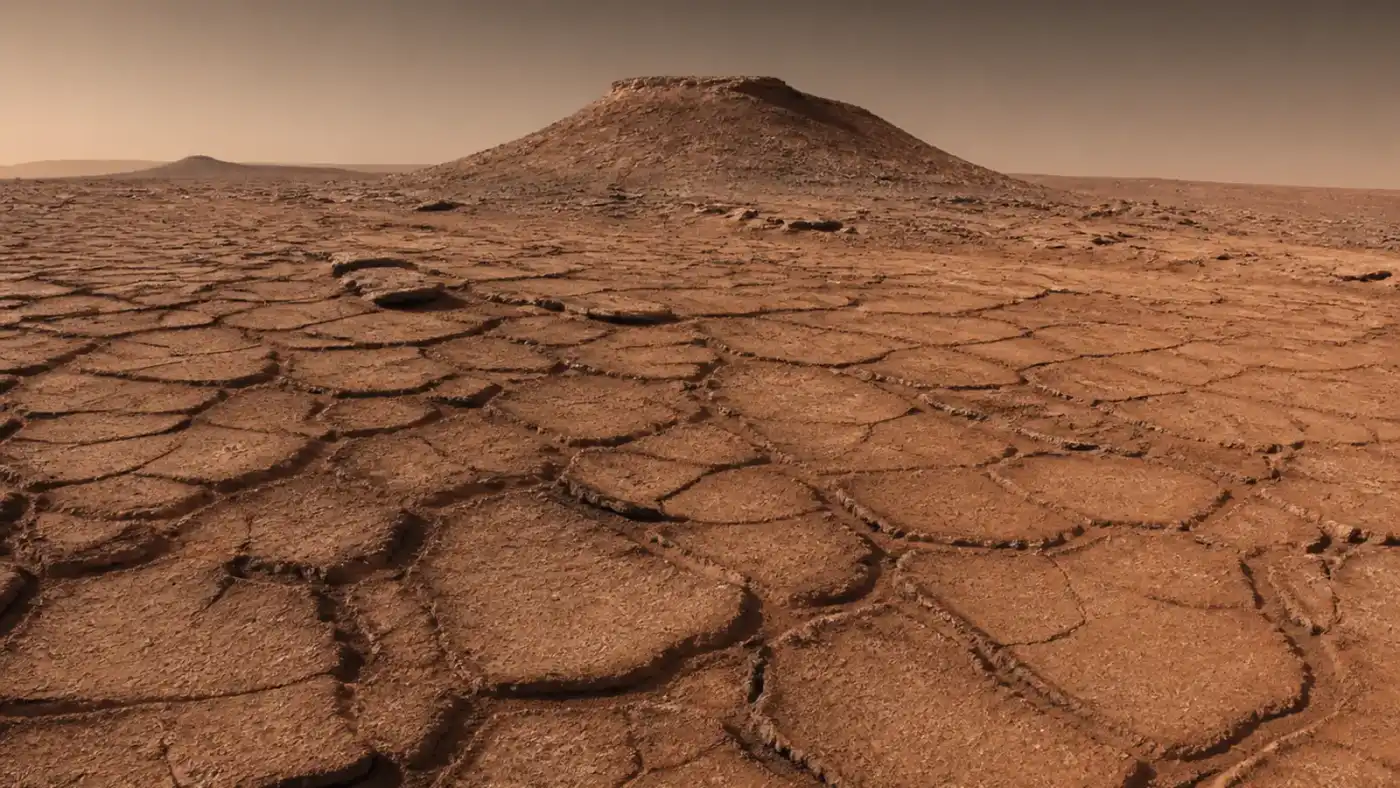
NASA’s Curiosity rover has reached a stretch of Mars that looks almost manufactured. Across the floor of a valley called Valle Grande, the ground is broken into a broad field of honeycomb-like polygons. From a distance they resemble paving stones. Up close, they are irregular fractures in ancient sediment, each one only a few centimetres across.
Curiosity photographed the landscape in a 360-degree panorama on June 19 and 20, during the mission’s 4,930th and 4,931st Martian days. The view shows the geometric textures extending in every direction and wrapping around a nearby butte nicknamed Miraflores, which rises about six metres above the valley floor.
The shapes are not new to Mars. Curiosity has encountered smaller patches of similar polygons before. What surprised the mission team was the scale of this field and the chance to study the fractures with the rover’s cameras, instruments, and laboratory tools.
A pattern made by a changing landscape
Polygonal fractures form when a surface contracts, dries, or is squeezed. On Earth, the most familiar example is a mud flat breaking into a network of cracks as water evaporates. Mars can create similar patterns, but the details matter. Different combinations of water, temperature, sediment, burial, and pressure can leave broadly similar shapes.
NASA says some of the smaller polygons seen by Curiosity clearly formed as mud cracks. Other processes are also possible. Repeated cycles of warming and cooling can stress a surface. Compression can force water out of sediment after it has been buried. Chemical changes can weaken the material along particular lines, allowing cracks to join into a geometric network.
That is why the rover is not treating the honeycomb appearance as a simple answer. The pattern is a clue, not a label that tells scientists exactly when or how the ground formed.
Curiosity’s project scientist, Ashwin Vasavada of NASA’s Jet Propulsion Laboratory, said the team measured the shapes and chemistry carefully in the hope that the data would reveal how the features formed. The chemistry is crucial. A camera can show the pattern, but mineral measurements help distinguish a surface shaped by drying mud from one altered by pressure or temperature.
Valle Grande is a geological record book
The rover began climbing through the Martian valley after travelling across Gale crater for more than fourteen years. Each layer records a different part of the region’s history. The rocks preserve evidence that ancient Mars once had water, the right chemistry, and nutrients that could have supported microbial life.
That does not mean the new polygons are proof of life or even a direct sign that the surface was habitable when they formed. They are one geological chapter in a much longer story. The same landscape can record a wet period, later burial, a dry interval, and repeated changes in temperature as Mars lost much of its atmosphere.
The rover’s location makes the discovery especially valuable. Curiosity can approach the field, place instruments against the rocks, and compare the fractures with the surrounding sediment. Scientists can then ask whether the polygons are made of the same material as the valley floor, whether their edges contain different minerals, and whether they were later filled or cemented by groundwater.
Why Mars keeps surprising us
Mars is often shown as a red desert, but its surface is not a single landscape. It contains river channels, lake sediments, volcanic plains, wind-carved ridges, mineral veins, and rocks altered by water. The honeycomb field adds another texture to that record—one that looks simple until the chemistry is examined.
The rover has already found sulfur crystals, meteorites, and other unusual geological features. The value of the new panorama is not that it makes Mars look like a science-fiction set. It is that a familiar process—cracking sediment—has appeared on a scale large enough to be studied in context.
That context matters because the central question in Mars exploration is not simply whether water existed. Scientists want to know how long it remained, how deep it moved through the ground, and whether the environment changed gradually or in sharp episodes. Features such as these fractures can help narrow down the answer.
For a wider look at how planetary scientists read ancient surfaces, Curiosmos has also covered the discoveries that changed what we thought we knew about Mars and why a distant object can appear to be part of the universe’s past.
Curiosity will continue up Valle Grande, adding close-up measurements to the panoramic view. The honeycomb pattern may eventually be explained by a familiar process, or it may turn out that several processes worked together. Either way, the field is a reminder that Mars keeps its history in the ground—and that the most useful clues are often the ones that first look ordinary.
Sources
- NASA/JPL, “NASA’s Curiosity Mars Rover Discovers Field of Honeycomb Textures,” July 29, 2026: https://www.nasa.gov/missions/mars-science-laboratory/curiosity-rover/nasas-curiosity-mars-rover-discovers-field-of-honeycomb-textures/