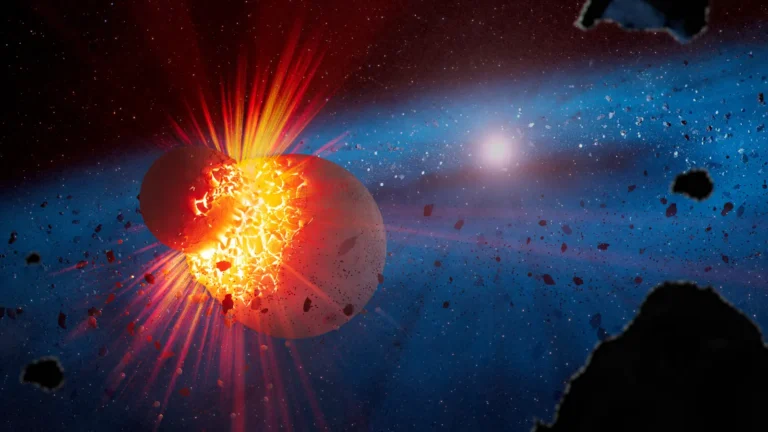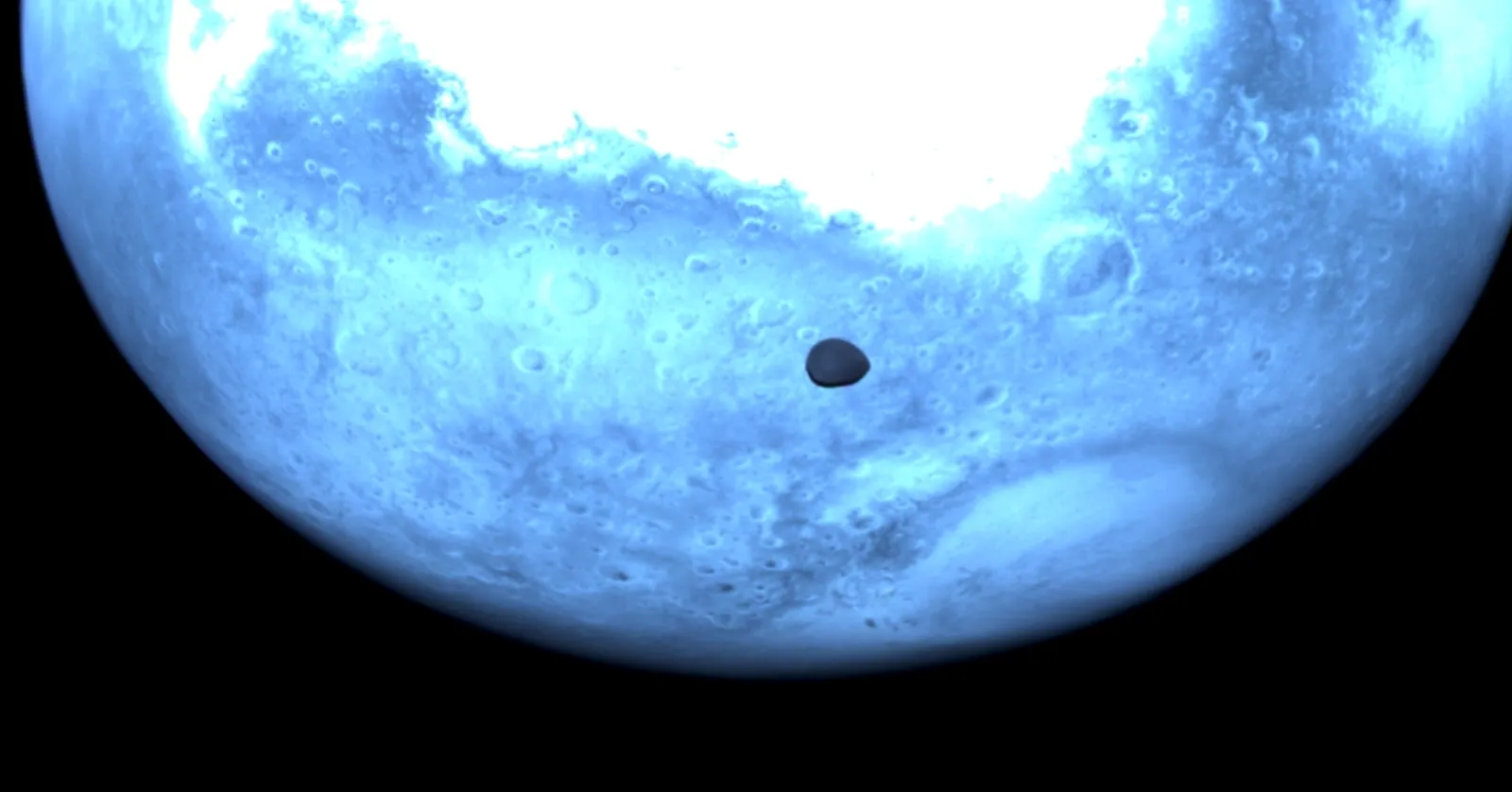
A Deimos asteroid impact may explain why Mars’ small outer moon has a smooth, dusty surface and a deep depression near its south pole. A study announced on August 18, 2026, in Nature Astronomy argues that both features may have been produced by one asteroid impact—violent enough to move material across the moon, but not powerful enough to break it apart.
An international team led by Sabina Raducan, formerly at the University of Bern and now at the International Space Science Institute and Vrije Universiteit Brussel combined high-resolution impact simulations with observations from the European Space Agency’s Hera spacecraft. Hera is travelling to the asteroid Dimorphos, but it used a Mars flyby in March 2025 to observe Deimos at close range. Those images provided a new set of details for testing ideas about the moon’s surface and interior.
The researchers ran about a hundred simulations, changing the impactor’s size, speed, angle, and the strength of Deimos’ material. The scenario that best matched the observed depression involved an asteroid roughly 320 metres across striking at about 45 degrees. The collision redistributed material around the moon and created a global layer of debris, while leaving Deimos intact.
The result fits Deimos’ appearance. Unlike Phobos, which is heavily scarred, Deimos looks smoother because loose regolith covers much of its older surface. The simulations suggest that the upper layers are weak and the interior is highly porous, more like a loosely assembled rubble pile than Earth’s Moon. The authors stress that this does not prove Deimos is a captured asteroid; it could also have formed from material thrown off Mars by earlier impacts.
That distinction matters because the study is about the moon’s history, not a final answer to its origin. Several formation scenarios remain possible. The value of the impact model is that it connects the southern depression and the dust layer in one physical explanation and makes predictions that future spacecraft can test.
Curiosmos has followed how gravity assists send spacecraft through the solar system and what an asteroid’s surface can reveal about its history. Deimos offers a nearby example of the same problem: a surface photograph is the end product of impacts, dust movement, and internal structure, not a simple picture of the body’s original state.
The Japanese Aerospace Exploration Agency’s Martian Moons eXploration mission is scheduled to launch on October 20, 2026, Japan time. MMX is designed to study both Martian moons in detail and return samples from Phobos. Although it will not collect Deimos material, its observations can test the predicted thickness and distribution of Deimos’ regolith and improve comparisons between the two moons.
If those measurements match the simulations, one ancient collision will explain much of Deimos’ present landscape. If they do not, the differences will point to other processes that shaped the moon. Either outcome gives planetary scientists a sharper way to investigate how small worlds are built and changed.
The impact scenario also explains why Deimos can look older and smoother than its neighbour. Material thrown across the surface would bury earlier craters and fill low areas, while the weak, porous interior would absorb some of the collision’s energy. A single event could therefore reset much of the visible surface without producing the shattered appearance expected from a catastrophic breakup.
Future observations will have to separate impact effects from later gardening. Small craters, landslides, and the slow movement of dust can change the uppermost layer after the large collision. Measuring the depth of the regolith and the strength of the underlying material will show whether the simulated impact left the global blanket predicted by the study.
Sources
- University of Bern: Asteroid impact shaped the appearance of Mars’ moon Deimos
- Nature Astronomy: Deimos’ shape and geology explained by a sub-catastrophic impact
- Curiosmos: How does a gravity assist send a spacecraft farther into the solar system?