Archaeologists have now found what Göbekli Tepe’s old “temple on a hill” story was missing: houses. The wider landscape matters too; our backgrounder on Karahan Tepe and the other Taş Tepeler sites shows why Göbekli Tepe cannot be studied in isolation.
In October 2025, researchers announced that geomagnetic surveys, ground-penetrating radar, and LiDAR had detected quadrangular structures east and south of the excavated mound. Excavation director Necmi Karul said the buildings may have been homes. Barbara Horejs, director of the Austrian Archaeological Institute, reported that the surveys had revealed a large building and numerous residential structures.
At the time of the 2025 announcement, those underground signals awaited excavation. Their interpretation would need to be tested against floors, objects, plant remains, and other physical evidence. But the newly mapped structures do not stand alone. Smaller buildings already exposed on Göbekli Tepe’s slopes contain features that excavators identify with domestic life.
A separate excavation north of the main protected area brought the question into sharper focus in August 2026. Arkeonews reported on August 13 that rectangular buildings had been exposed there, some down to their floors. Karul considered a residential use possible, with sediment analysis still needed. Our report on the newly excavated rectangular buildings follows that work. These exposed rooms are distinct from the survey signals reported east and south in 2025.
In a 2026 NOVA documentary, field director Lee Clare examined one rectangular room with a bench, a grinding stone set into it, a storage recess, and a limestone vessel. He suggested that it may have been a household food-preparation space, perhaps used by a family. Clare believes many of the tightly packed structures around the monumental buildings were permanent homes.
This changes how the site is being read. Göbekli Tepe was long presented as a sanctuary visited by mobile hunter-gatherers who gathered, built, feasted, performed ceremonies, and then dispersed. Daily life was placed somewhere beyond the ridge.
The houses bring it back. So do work areas, thousands of grinding tools, remains of wild plants gathered through different seasons, water-management features, and burials found within domestic spaces. Göbekli Tepe now looks increasingly like a place where communal architecture and ordinary life grew together over many centuries.
Who lived beside those pillars? How permanent was the community? Did a meeting place gradually attract residents, or were homes part of the landscape much earlier than archaeologists realised? And what does a settled population living from wild animals and plants do to our familiar division between nomads and farmers?
Why the sanctuary interpretation made sense
Göbekli Tepe’s oldest and best-known structures are large round or oval buildings, some measuring as much as 20 metres across. T-shaped limestone pillars were set into their walls, while two taller pillars stood near the centre. Several reach about 5.5 metres in height. Carved arms, hands, belts, and clothing show that at least some of these stones represented stylised human figures.
These were carefully planned buildings. Their builders quarried limestone, shaped it, moved heavy pillars, prepared floors, raised walls, and returned to repair or alter the structures. Some enclosures were rebuilt several times. When their use ended, they were filled with stone, soil, animal bone, broken tools, and carved fragments in a process that appears, at least in some cases, to have been deliberate.
The animal remains also pointed toward large gatherings. Gazelle bones occur in considerable numbers, and seasonal hunting patterns have been used to argue that crowds assembled at particular times of year. The sheer quantity of food needed to sustain a building project made communal feasting a persuasive explanation.
The ridge itself supported that reading. Göbekli Tepe overlooks the Harran plain and has no convenient spring on its summit. Klaus Schmidt, who led the excavations that brought the site to international attention, described it as a mountain sanctuary built by groups who did not live there permanently. At the time, archaeologists had exposed monumental enclosures while finding little that resembled an ordinary village.
The problem was that only part of the mound had been excavated, and the monuments naturally received most of the attention.
The houses were beside the monuments all along
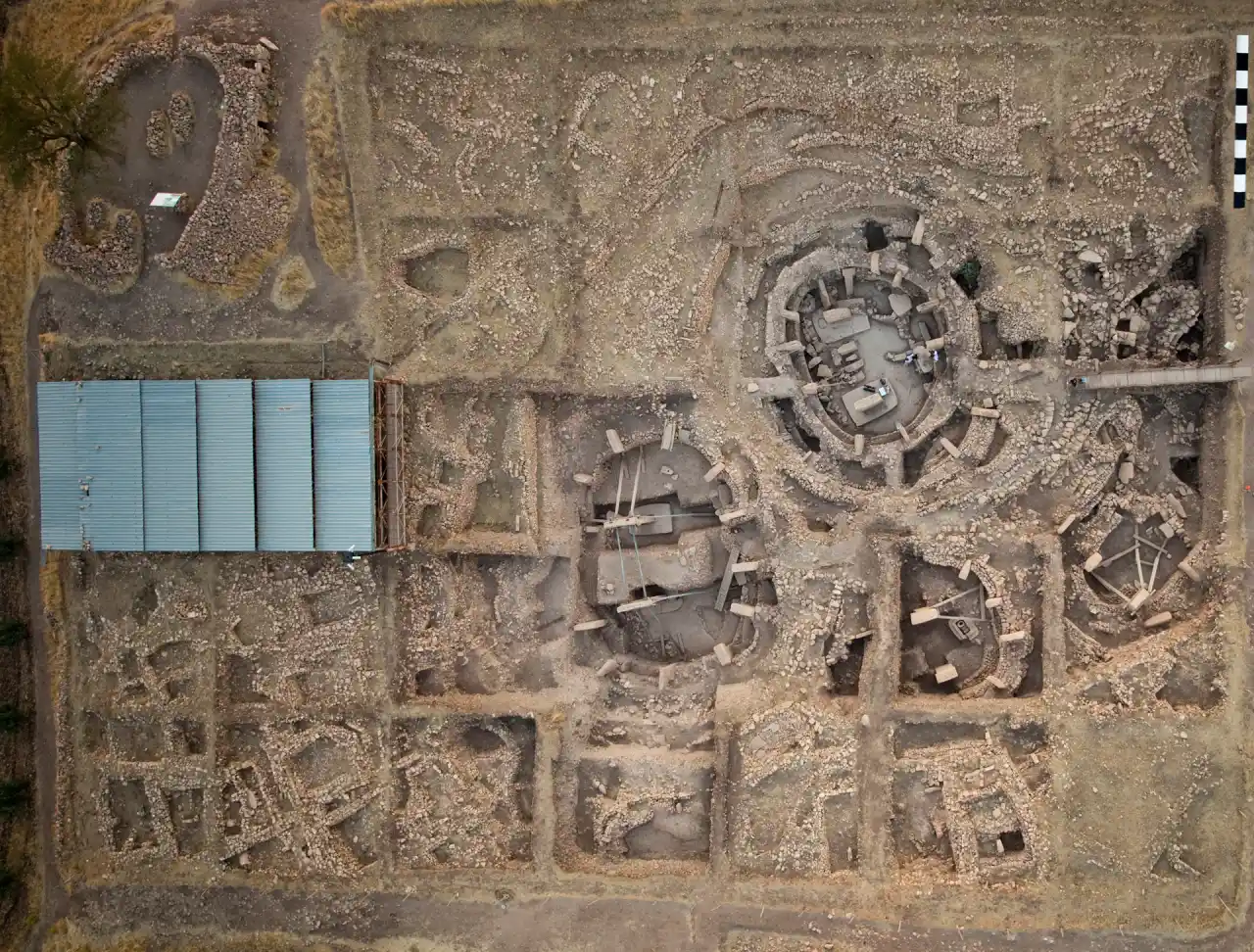
Göbekli Tepe covers a mound roughly 300 metres in diameter, and its famous enclosures occupy only a fraction of it. The Taş Tepeler project’s current overview says the buildings without T-shaped pillars are the most numerous at the site and interprets them as houses. It also states that people lived at Göbekli Tepe during its roughly 1,750 years of use.
The newly mapped quadrangular structures give that interpretation far greater physical scope. They appear concentrated east and south of the excavated areas, exactly where future digs may reveal how widely residential buildings spread across the mound. For the first time, archaeologists can begin asking where neighbourhoods formed rather than whether a few unusual rooms happened to be domestic.
The chronology remains essential. A statement that people lived at Göbekli Tepe across its long existence does not mean that every sector was occupied continuously or in the same way. Another Taş Tepeler explainer describes the famous early phase as a gathering place where ordinary houses have not yet been securely identified, followed by later phases with clearer residential activity. The old sanctuary model may still describe part of the site’s earliest life even though it no longer explains the whole mound.
This may be the key to the site. We have often asked whether Göbekli Tepe was a temple or a settlement, as if the builders had to choose one category and keep it unchanged for centuries. They did not build the entire mound at once. Generations returned, rebuilt, abandoned rooms, raised new walls, reused pillars, and altered the way space was organised.
A seasonal meeting place could have drawn longer stays. Families connected to its maintenance may have lived nearby. A resident community could have cared for buildings used by visitors arriving from a wider region. Homes, workshops, storage rooms, kitchens, meeting places, and ceremonial buildings may all have occupied the same slope.
Clare has suggested that Göbekli Tepe may have held 500 to more than 1,000 people at its peak if the entire area was occupied. Excavation will determine how close that estimate comes, but the scale he is considering is far beyond a handful of caretakers.
How do archaeologists recognize a house?
Archaeologists rarely identify a prehistoric home from its shape alone. They look for combinations: renewed floors, grinding equipment, food remains, storage, tools, refuse, and the way rooms relate to one another.
Göbekli Tepe now has several of those combinations. Rectangular buildings contain terrazzo floors, benches, storage features, limestone vessels, and tools associated with preparing food. Some stand immediately beside one another and share walls. The lack of conventional doorways suggests that people may have entered through flat roofs, as they did at other early settlements.
One recent burial adds a deeply personal detail. Excavators found the remains of a child in a niche within a domestic space. Only a few burials have been recovered at Göbekli Tepe, yet placing the dead close to the living became a powerful tradition in later Neolithic communities. Was this house already tied to a particular family or ancestry?
Most of the mound remains underground. Geophysics, LiDAR, aerial photography, and three-dimensional modelling are now tracing domestic and communal areas beyond the exposed ruins. Future excavation should reveal whether the homes formed compact neighbourhoods or looser groups arranged around the monumental buildings.
Food was being prepared on a serious scale
One of the clearest signs of sustained activity comes from an object that receives far less attention than a carved pillar: the grinding stone.
A 2019 study examined more than 7,000 grinding and pounding tools from Göbekli Tepe, including slabs, bowls, handstones, pestles, and mortars. Microscopic wear and phytoliths—durable silica structures formed in plant tissue—showed that cereals were processed extensively at the site.
Many tools were associated with rectangular buildings and with open areas around them. Some may originally have been used on flat roofs before falling into the rooms below. This was organised work carried out with standardised, efficient equipment, not an occasional handful of grain crushed beside a fire.
New plant analysis begun in 2023 has added a seasonal dimension. Wild einkorn appears frequently, alongside wild cereals and legumes available in spring and early summer and fruits and nuts gathered later in the year. These were not cultivated crops, but their availability across several seasons could support people who remained in one place rather than following a single resource across the landscape.
Exactly who was eating that food remains open to debate. The study’s authors favoured large work feasts, noting that Göbekli Tepe lacks the substantial silos expected if grain was being stored for a large permanent population. Food could have been prepared for immediate consumption when groups gathered to hunt, build, repair, or perform ceremonies.
Work feasts and residence can belong to the same settlement. The people organising large meals still needed tools, water, fuel, and places to work between gatherings. Fixed hearths remain scarce in the excavated buildings, so some cooking may have occurred outdoors, on roofs, or in parts of the mound not yet opened. The task now is to reconstruct how households, visitors, and communal events shared the site.
How did people live on a dry limestone ridge?
Water was long one of the strongest arguments against a substantial settlement on the ridge. Researchers have since identified channels, basins, and cistern-like features that could capture rainfall and runoff. Their dates and capacities are still being studied, but they show that the builders understood the problem and worked around it.
They knew where limestone could be quarried, when wild grain ripened, where gazelle moved, and how seasonal rain crossed the plateau. Longer residence may have grown from that knowledge: repeated returns becoming extended stays, and extended stays becoming a community rooted to a place that already carried meaning.
What rectangular rooms may reveal about society
The architectural shift from round buildings to rectangular ones is visible across the early Neolithic, not only at Göbekli Tepe.
A rectangular room is easier to extend, divide, and connect to its neighbours. Walls can be shared, buildings packed into terraces, and spaces assigned to different tasks. The plan alone cannot prove that a nuclear family lived behind every wall, but it can record a new way of organising work, storage, and belonging.
At Göbekli Tepe, some rectangular buildings were partially contemporary with the later lives of the monumental round enclosures. That overlap matters. It means domestic or food-processing spaces may have operated while at least some communal buildings were still active. The familiar sequence—first temple, then village—may be too rigid.
What if residence grew around a place already loaded with memory? What if the people maintaining the enclosures began to stay longer, while others continued arriving from farther away? Could households have gained particular responsibilities toward certain buildings or pillars? Did control over food, water, quarrying, or ceremony create new forms of authority?
The stone shows architecture becoming denser and more divided while daily work continued close to collective spaces. Social change often survives this way: a wall added, a floor renewed, a room divided.
“Hunter-gatherer” describes food, not human capacity
The builders of Göbekli Tepe hunted wild animals and relied heavily on gathered plants while the domestication of crops and herds was still developing. In that economic sense, “hunter-gatherer” remains useful.
The trouble begins when the term is allowed to carry assumptions it was never meant to prove. Mobility does not imply disorder. Hunting does not prevent specialisation. A community without writing can preserve complicated histories, negotiate alliances, coordinate labour, and maintain places of shared importance for centuries.
Göbekli Tepe required expertise in stone, transport, food supply, and the organisation of labour. Its carvings belonged to a visual language recognisable across generations. The builders knew which animals, gestures, and forms mattered, even though the stories behind them are lost.
Some people may have travelled widely while others stayed close to the ridge. Many probably moved between those lives according to season, kinship, and obligation. A person can be mobile and still belong deeply to a place.
The broader Taş Tepeler landscape beyond Göbekli Tepe makes this clearer. Karahantepe and other sites show related pillars, carvings, communal buildings, and settlement activity spread across a large region. Göbekli Tepe did not stand alone in an empty world. It was one part of a connected cultural landscape whose full scale is only now becoming visible.
Does Göbekli Tepe force us to rewrite civilization?
Civilization was once taught as a ladder: agriculture created permanent villages; villages produced surplus; surplus allowed specialists and hierarchy; only then could people build monuments and develop elaborate ritual systems.
Göbekli Tepe shows that communal construction was underway while domesticated agriculture was still taking shape. Gathering may have encouraged people to process more food, remain longer, manage water, and invest in lasting buildings. Ritual and settlement could have developed together.
That possibility sits at the heart of what Göbekli Tepe changed about the conventional story of civilization. The site does not fit comfortably at the bottom of a ladder. Its people possessed some forms of complexity while lacking others that later societies would consider essential.
They were not urban in the later Mesopotamian sense, and there is no evidence here for writing, kings, metal industries, or a state bureaucracy. Their path toward settled and socially complex life may instead have been shaped by shared symbols, communal labour, seasonal abundance, and attachment to place.
A lived-in place, still coming into focus
So, did people live at Göbekli Tepe?
The answer now appears to be yes. Domestic buildings, work areas, food-processing tools, and water management have made the old image of an uninhabited sanctuary increasingly difficult to defend across the site’s full history.
The remaining uncertainty concerns the shape and timing of that life. We do not yet know how many people lived there in each phase, whether occupation was continuous or seasonal, or how the residents were connected to visitors arriving from elsewhere. The earliest monumental period remains especially important. If secure houses are found beside its oldest enclosures, the debate will change again.
For now, the houses have restored something missing from the famous aerial photographs: people going about their days.
Someone repaired those floors. Someone hauled water up the ridge. Someone ground grain on a roof while work continued below. Someone looked after children, shaped tools, butchered animals, argued over labour, and remembered which buildings belonged to which stories. The pillars were never standing in silence. They were surrounded by human lives.
That is the deeper change taking place at Göbekli Tepe. The site is becoming less isolated from the people who made it. Its monumental enclosures still deserve wonder, but the homes and workspaces around them may finally tell us what kind of society could turn a limestone hill into a centre remembered for nearly two thousand years.
Sources and further reading
- TRT Haber/Anadolu Agency: Traces of possible residential structures detected at Göbekli Tepe
- PBS NOVA: Stone Age Temple Mystery, programme and transcript
- Taş Tepeler: Göbeklitepe research overview
- Taş Tepeler: Did anyone actually live at Göbekli Tepe?
- Austrian Archaeological Institute: Geoarchaeology at Göbeklitepe
- PLOS One: Cereal processing at Early Neolithic Göbekli Tepe
- Curiosmos: What Göbekli Tepe Changed About Civilization
- Curiosmos: Karahantepe and the World Beyond Göbekli Tepe