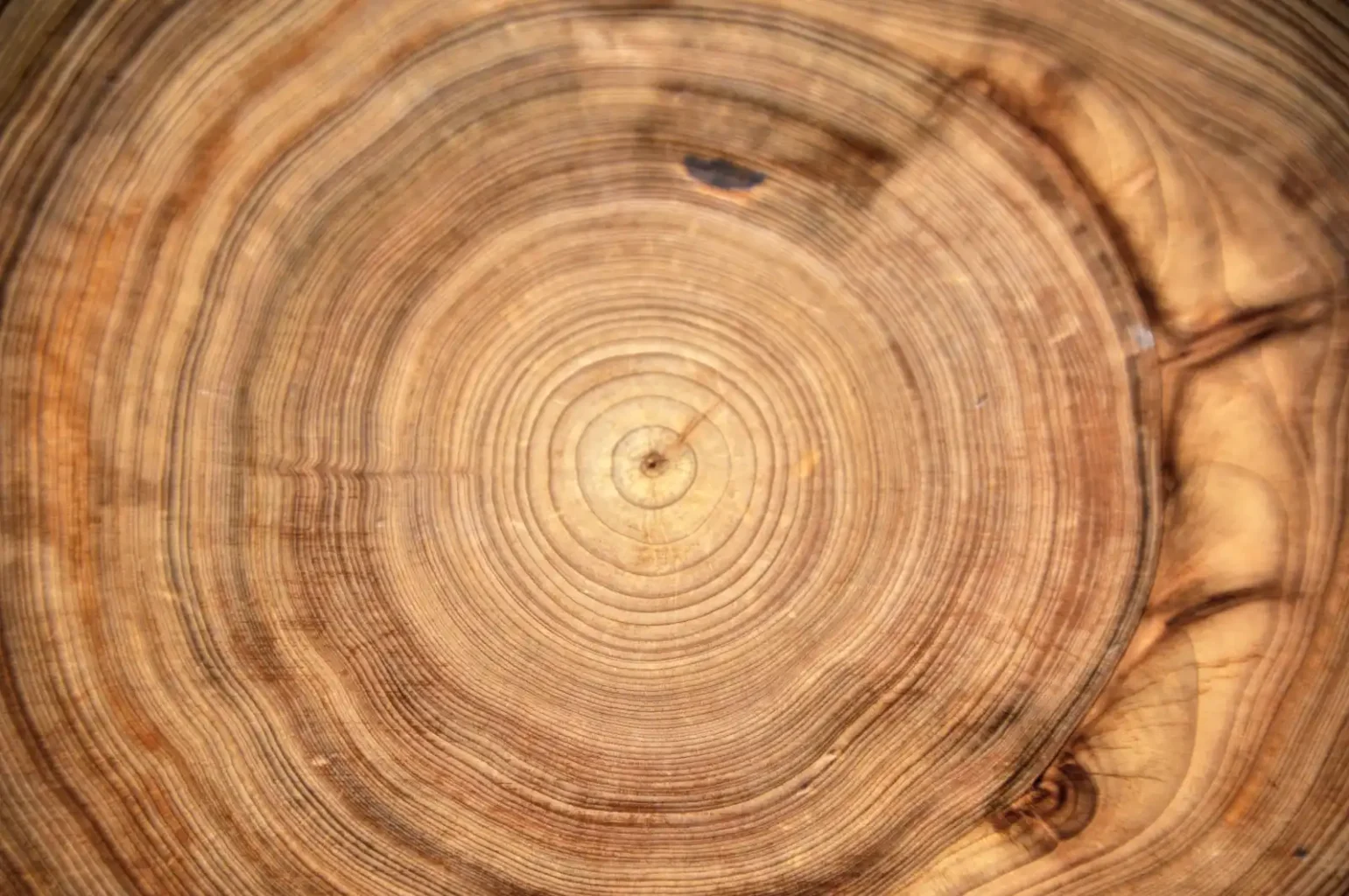
How does dendrochronology date ancient buildings? By reading the growth history recorded inside wood. In regions where trees respond to changing seasons, each year leaves a pattern of wide and narrow rings. When a wooden beam from an old structure preserves enough of that pattern, archaeologists can compare it with other trees and build a calendar that reaches back through time.
The method is often reduced to “count the rings.” Counting is part of it, but the more powerful step is matching patterns. A drought, a cold summer or an unusually wet growing season can leave a signature across many trees in the same region. Those overlapping signatures allow researchers to line up living trees, dead trees, old logs and building beams into one continuous sequence.
What a tree ring records
In a temperate climate, a tree usually adds a new layer of wood during each growing season. Early in the season, cells grow quickly and form lighter wood. Later, growth slows and the cells become denser and darker. Together they form an annual ring. The width of that ring depends on the conditions the tree experienced, including moisture, temperature, sunlight and competition from neighbouring plants.
Not every tree produces a clean, useful record. Some species grow irregularly, and a drought can produce a false or missing ring. Researchers therefore compare many samples rather than trusting one trunk. A tree-ring date is strongest when several independent sequences agree.
Crossdating turns patterns into dates
Crossdating is the central technique. A chronology begins with living trees whose outer rings can be assigned to known calendar years. Older trees overlap with those records. Dead trees overlap with older living trees, and historic beams can extend the sequence further back. If a beam from an archaeological building carries a distinctive pattern, researchers can match it to the established chronology.
The outermost preserved ring can be especially valuable. If it is the final ring formed before the tree was cut, it may identify the year of felling. That does not always equal the year of construction. A beam could have been stored, reused or taken from an older building. Archaeologists look at the position of the beam, tool marks, construction layers and other evidence before deciding what the date means.
What tree rings reveal about a settlement
At sites such as Mesa Verde and Aztec Ruins, dendrochronology has helped researchers identify building phases, repairs and periods of abandonment. A group of beams cut within a short interval may point to a major construction project. Later beams can reveal additions or rebuilding. A sudden change in the wood supply may also show that a community moved, faced a drought or changed the way it managed nearby forests.
The rings are environmental records as well as dates. A long run of narrow growth can indicate dry conditions. Fire scars, insect damage and unusual growth patterns can preserve evidence of disturbance. Archaeologists can place those environmental changes beside pottery, settlement layers and written records instead of treating the building as an isolated object.
How the method became an archaeological tool
The modern approach grew from astronomer A. E. Douglass’s work in the American Southwest. He noticed that trees in the same region responded to wet and dry years with matching patterns. By lining up those patterns, researchers could build a continuous sequence longer than the life of any single tree. The method works because a regional climate leaves a recognisable signature across many trees.
Researchers also inspect the exact end of a beam. A bark edge can show that the final growing season survived, while an inner cut can show that the tree was felled sometime after that ring formed. Those small distinctions prevent a precise ring count from being mistaken for a precise building date.
Its limits matter
Dendrochronology works only when suitable wood survives and a regional chronology exists. It dates the tree or the final growth of a beam, not automatically the whole site. Wood may have been reused, transported from another region or cut long before it was placed in a wall. For that reason, tree-ring evidence is often combined with stratigraphy, pottery studies and radiocarbon dating rather than treated as a single final answer.
That combination is what makes the method so useful. A wooden beam can preserve an exact year, but archaeology supplies the human story around it: who built the structure, how the room changed, and why the community eventually left. Tree rings are not a shortcut around interpretation. They are one of the clearest calendars the past has left behind.
Researchers often compare the result with other methods, including radiocarbon dating in archaeology. That cross-checking is what turns a date on a beam into a defensible history of a place.
Sources and further reading: National Park Service: Dendrochronology at Aztec Ruins; National Park Service: Dating archaeological sites and artifacts.