Imagine being handed a block of stone and asked to turn it into a vessel. Shaping the outside is only the beginning. Somehow, you must remove the interior while leaving a wall that holds together, a usable opening and a surface worth touching.
Ancient Egyptian stone vessels invite precisely that question. Their finished forms can conceal the work so completely that the most revealing object may be an unfinished one: a hollow left partway through, a cylinder of waste stone, or the working end of a drill.
The missing stone tells part of the story
University College London’s account of stone-vessel manufacture places highly developed production in the Naqada period, around 4000–3100 BCE. Craftspeople first roughed out the stone, then hollowed the vessel using boring tools. The surviving evidence includes borers and drill cores.
A tubular drill removes a ring of material rather than grinding away the entire circular area at once. The stone left in the middle becomes a core. Finding that waste alongside unfinished work gives researchers a way to reconstruct an operation that a polished vessel has largely hidden.
UCL highlights vessel UC 16038 as apparently worked with a drill that twisted back and forth. Its account also notes how closely stoneworking was associated with craft: a vessel-making tool became a hieroglyphic sign for a craftsman.
A workshop moment preserved on a tomb wall
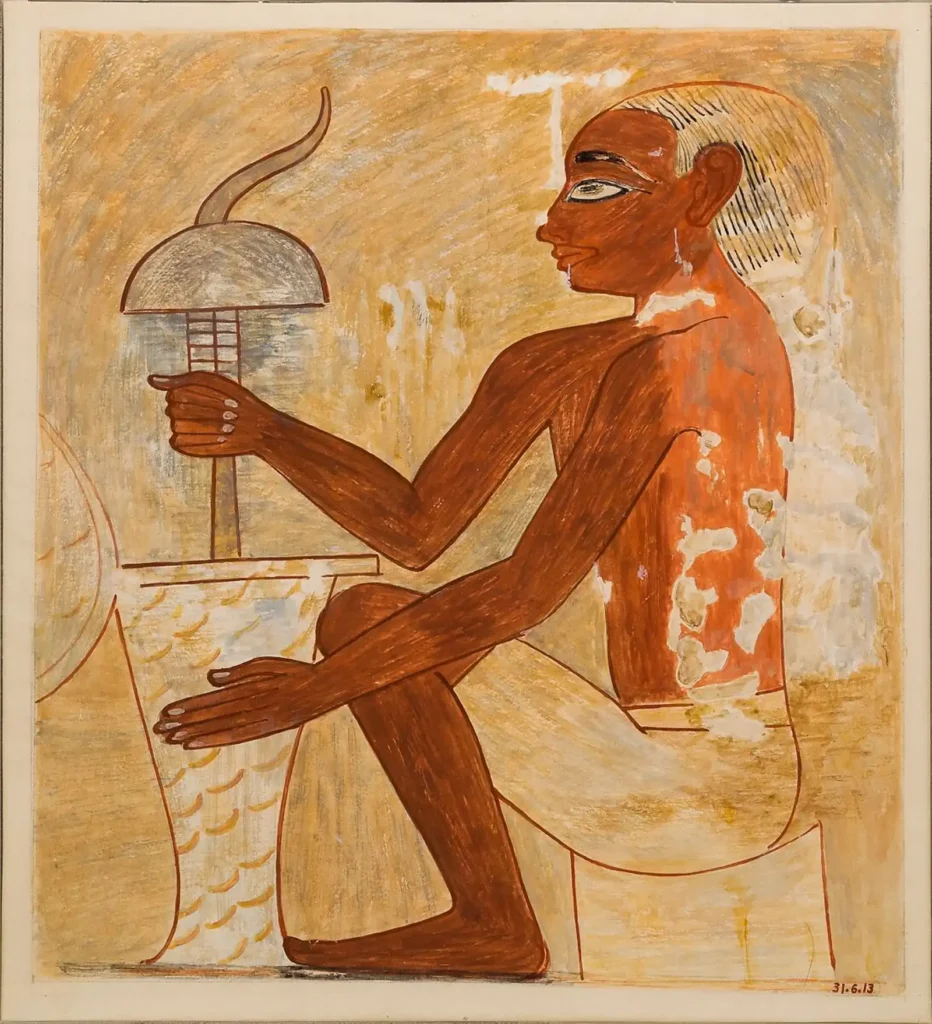
One remarkable scene brings the worker back into view. The Metropolitan Museum of Art holds Nina de Garis Davies’s facsimile of a craftsman drilling a stone vase, copied from the tomb of Rekhmire at Thebes.
The seated figure holds a vertical tool above a vessel, with one hand positioned lower to steady the work. The image makes an otherwise abstract manufacturing problem tangible: tool, container and body have to work together. This is a copy of an ancient wall painting, not a photograph of an excavated workshop.
The scene belongs to the New Kingdom, much later than the Naqada vessels. It offers evidence for a particular historical setting; it cannot serve as an instruction sheet for every vessel made across thousands of years. The Met also preserves a crescent-shaped flint drill from Lisht, dated to the Ramesside period. Tools and depictions provide different pieces of the craft’s long history.
What if the crucial tool was a powder?
Looking only at the drill can miss another participant: the abrasive between tool and stone. A small worked fragment from Amarna offered an unusually direct clue.
In a 2015 account of their analysis, Met conservator Anna Serotta and research scientist Federico Carò described material preserved around a broken drill core. Microscopy and chemical analysis identified abundant corundum grains, powdered limestone and corroded bronze particles.
They interpreted the combination as evidence for a bronze tubular drill working with a corundum-rich abrasive. The origin of that abrasive remained unresolved. Crucially, this fragment is worked limestone from Amarna; it does not establish which abrasive was used in every earlier stone vessel.
Looking beyond the polished surface
Next time you see an Egyptian stone vessel, imagine its unfinished stages. Where did the tool enter? How was the interior widened? Which traces survived the final polishing? These questions connect the beautiful object to a sequence of decisions made by a person.
Curiosmos has previously explored Egypt’s intriguing drill holes. Stone vessels bring that curiosity down to the scale of something a craftsperson could hold. Their appeal grows when we look at the work as well as the result: the waste core, the worn tool and even a few grains of powder can bring a vanished workshop a little closer.