No drill has come close to Earth’s centre. The deepest boreholes reach only a few kilometres, while the core begins roughly 2,900 kilometres below the surface. Our knowledge of the interior comes from indirect evidence: the way earthquake waves travel, the planet’s mass and rotation, and the magnetic field that surrounds us.
Curiosmos has examined the deepest holes humans have drilled. Even those engineering feats barely scratch the crust, which is why geophysicists rely on waves and gravity to investigate the layers below.
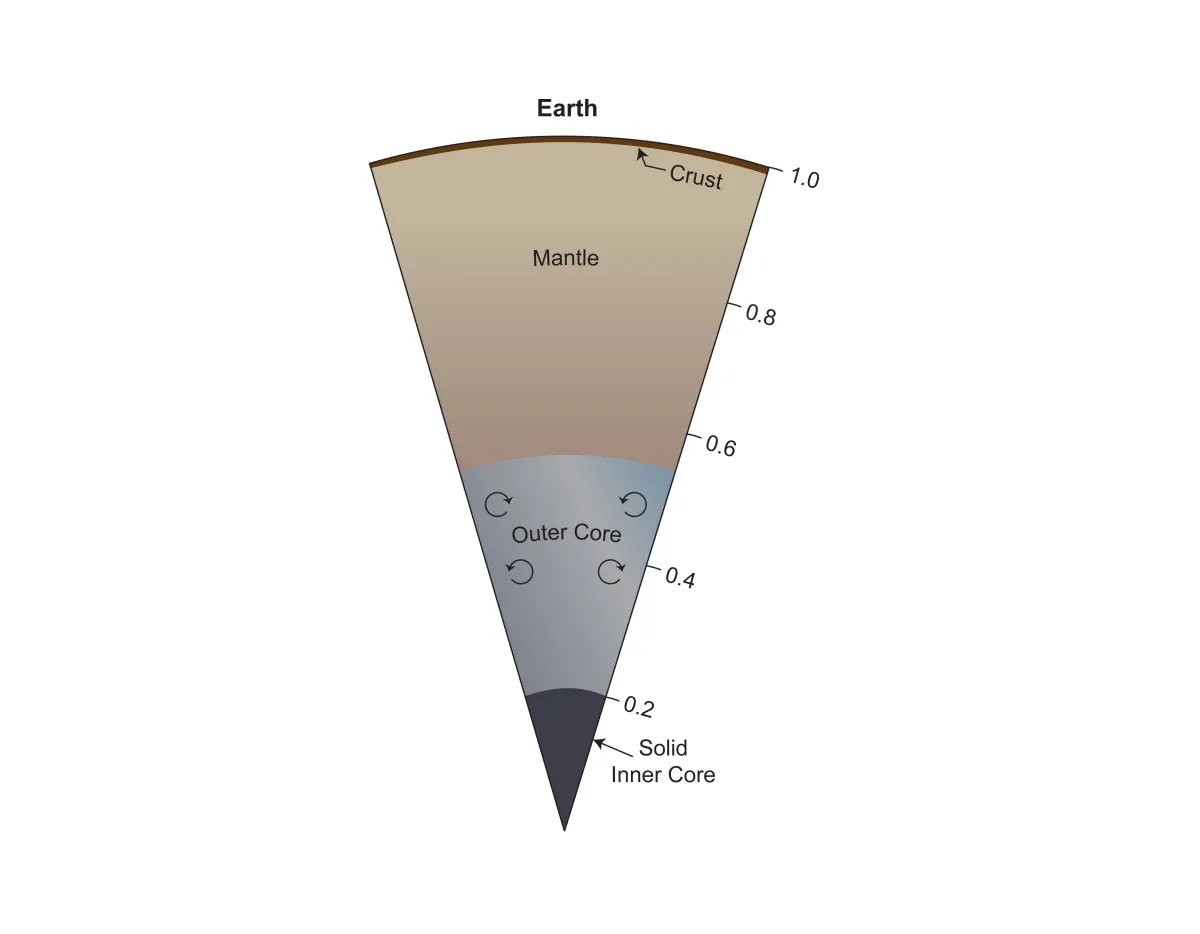
Those lines of evidence fit a layered planet. Earth has a thin crust, a rocky mantle, a liquid outer core and a solid inner core. The boundaries were not guessed from one measurement; they were built from observations that agree with one another.
Earthquakes act like a scan
An earthquake sends vibrations through the planet. Seismometers around the world record when different waves arrive, how strong they are and which directions they travelled. By comparing those records, geophysicists can map changes inside Earth even though the path is hidden.
Primary waves, or P waves, compress and stretch material. They can move through solids and liquids. Secondary waves, or S waves, shear material from side to side, and they cannot travel through a liquid. When researchers saw that S waves disappeared across a broad zone on the far side of Earth after large earthquakes, they found strong evidence for a liquid layer deep inside.
NASA and the U.S. Geological Survey explain the pattern in their overview of Earth’s interior. P waves bend and slow as they cross different layers, while S waves stop at the liquid outer core.
How the inner core was identified
P waves do travel through the outer core, but their speed and direction change. Some are reflected from the inner core, and others pass through it differently from waves travelling only through liquid. Those subtle signals reveal a central region that behaves like a solid material.
The inner core is not a simple steel ball. It is mostly iron and nickel under pressures and temperatures that cannot be reproduced easily in the laboratory. Its crystals may have preferred directions, and the boundary between inner and outer core is not perfectly smooth.
Why the core is mostly metal
Earth’s average density is greater than the density of the rocks exposed at the surface. Something much heavier must be concentrated below the mantle. Iron and nickel fit the seismic evidence, the measured density and the way the young planet separated into layers while it was hot enough for metal to sink.
Scientists test these ideas with high-pressure experiments and computer models of minerals. The laboratory cannot reproduce the entire core, but it can show how iron alloys behave under comparable pressure. Those results help turn a seismological outline into a more detailed picture of temperature, composition and phase changes.
Gravity reveals how mass is arranged
Earth’s total mass and moment of inertia provide another constraint. The planet rotates, and its rotation responds to how mass is distributed from the surface to the centre. A model with a low-density, all-rock interior would not reproduce the measured behaviour.
The core is denser than the mantle, which is why heavy elements such as iron sank toward the centre when the young Earth was hot and partly molten. The same differentiation process helped create the layered planet recorded by seismic waves today.
The magnetic field points to moving metal
Earth’s global magnetic field is generated by motion in the electrically conducting outer core. Hot material rises while cooler material sinks, and the planet’s rotation organises those flows into a self-sustaining dynamo. The field is not proof of a core on its own, but it is difficult to explain without a large body of moving liquid metal.
The magnetic field shields the surface from much of the solar wind. It also leaves a record in ancient rocks, whose magnetic minerals preserve the direction of the field when they cooled. Those rocks show that Earth’s magnetic poles have reversed repeatedly over geological time.
What we still do not know
Scientists are still refining the core’s temperature, composition and flow. The outer core may contain lighter elements mixed with iron and nickel, while the inner core grows slowly as material freezes at the boundary. The magnetic field can strengthen, weaken and shift as the flow changes.
Earth’s centre is therefore not a place that geologists have seen directly. It is a physical model tested against thousands of earthquakes, precise measurements of gravity and the behaviour of the magnetic field. The evidence comes from different instruments, but it points to the same hidden architecture.
That same habit of reading physical evidence through indirect signals appears in the study of ancient structures. Curiosmos’s report on how ancient builders responded to earthquakes looks at the traces left in stone; seismology uses waves travelling through rock to read what lies far below it.