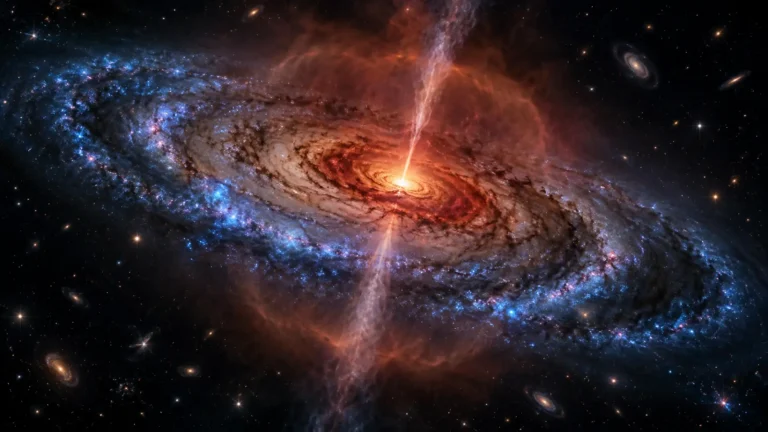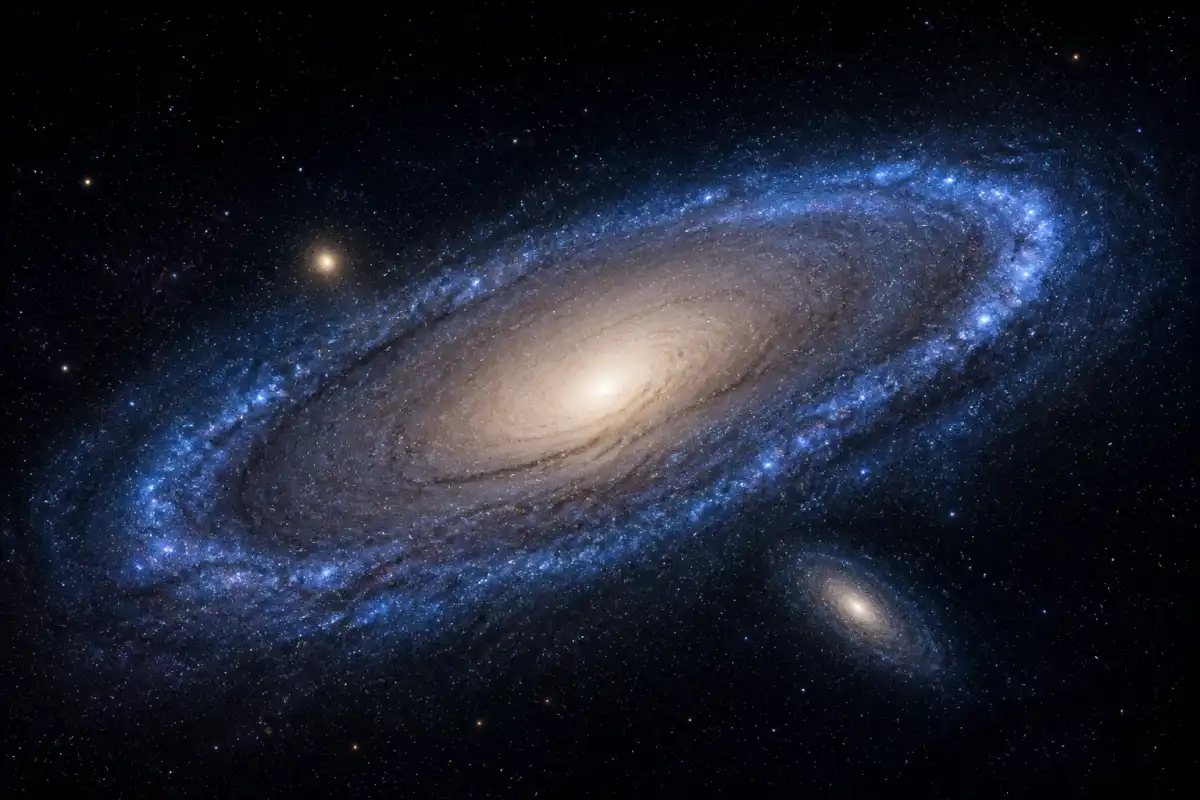
Andromeda is often described as the Milky Way’s larger neighbour and future collision partner. A new study using NASA’s Hubble Space Telescope adds another part to that story: the galaxy has been making new stars more slowly for hundreds of millions of years.
The study combines two Hubble surveys that mapped about two-thirds of Andromeda’s disk. Researchers measured the colours and ages of roughly 200 million individual stars. Those stars act as a record of the galaxy’s past because massive blue stars live briefly, while smaller redder stars can remain visible for much longer.
A long decline, then a sharper drop
About 500 million years ago, Andromeda was forming stars at a rate near one solar mass per year. Forty million years ago, that rate had fallen to roughly half a solar mass per year. Today, the estimate is about one-fifth of the Sun’s mass in new stars each year.
Those figures describe the average rate across a galaxy that is about 2.5 million light-years away. They do not mean that star formation has stopped. New stars continue to appear, but the overall pace is much lower than it was in the recent past.
A decline in this context is measured statistically, through the ages and colours of huge stellar populations. No individual star announces when a galaxy has entered a quieter phase. The pattern becomes visible only after researchers compare many regions and account for how quickly different kinds of stars change.
The decline is concentrated in a ring about 32,000 light-years from Andromeda’s centre. The ring contains much of the galaxy’s recent star formation, so a slowdown there has a large effect on the total. The researchers say the change looks more like a galaxy settling down from a more active period than a sudden loss of all the material needed to make stars.
Could M32 be involved?
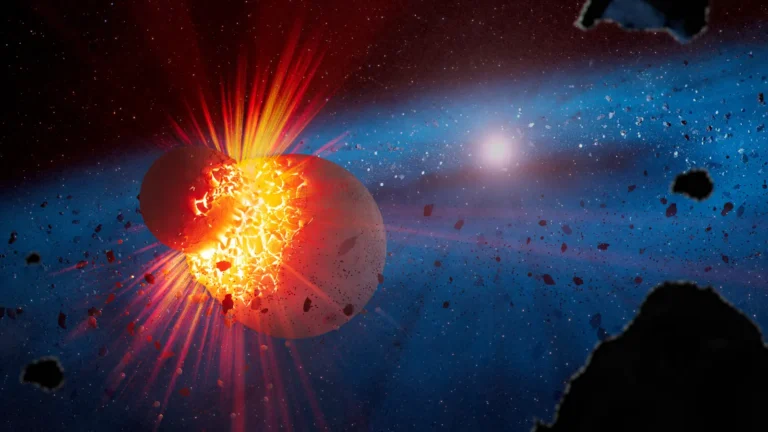
One possible clue is M32, a compact satellite galaxy near Andromeda. In the plane of the sky, it appears about 16,000 light-years from Andromeda’s disk, although its true three-dimensional distance is not known precisely. The Hubble data show that the area near M32 has a lower recent star-formation rate than other parts of the galaxy.
That pattern is consistent with an interaction, but it is not proof that M32 caused the decline. The researchers estimate that the local decrease began roughly 60 million years ago. Future work will compare the timing and shape of the changes with models of a past encounter.
Andromeda already shows signs of an older burst of star formation about two billion years ago, probably linked to a previous interaction or merger. The new result does not replace that history. It fills in the later chapter, when the galaxy’s activity gradually eased.
Why individual stars matter
Many distant galaxies can be studied only as points of light. Andromeda is close enough for Hubble to separate large populations of stars and compare regions within the disk. That makes it a laboratory for understanding processes that also shaped the Milky Way.
NASA’s Nancy Grace Roman Space Telescope may add a much wider view after its planned launch later this month. Roman’s field of view should allow researchers to image the whole disk and parts of the surrounding halo in fewer observations than Hubble needs. The combination of Hubble’s sharp images and Roman’s broad coverage could reveal how the recent slowdown connects to Andromeda’s larger environment.
Andromeda is not running out of stars. It is changing pace. By reading the colours, locations and ages of its stars, astronomers can watch that change unfold across cosmic time.
The result also gives the Milky Way a useful point of comparison. Our own galaxy is difficult to study from inside its disk, where dust hides parts of the structure. Andromeda offers an external view of a similar spiral system, allowing astronomers to test how a neighbour’s history might resemble—or differ from—our own.
Curiosmos previously explored Hubble’s huge panorama of Andromeda; the new study turns that familiar galaxy into a record of changing star formation.