The Kuiper Belt is a broad, cold region beyond Neptune where millions of icy bodies orbit the Sun. Pluto is the best-known member, but it is only one of many worlds in a population that preserves material left over from the Solar System’s birth.
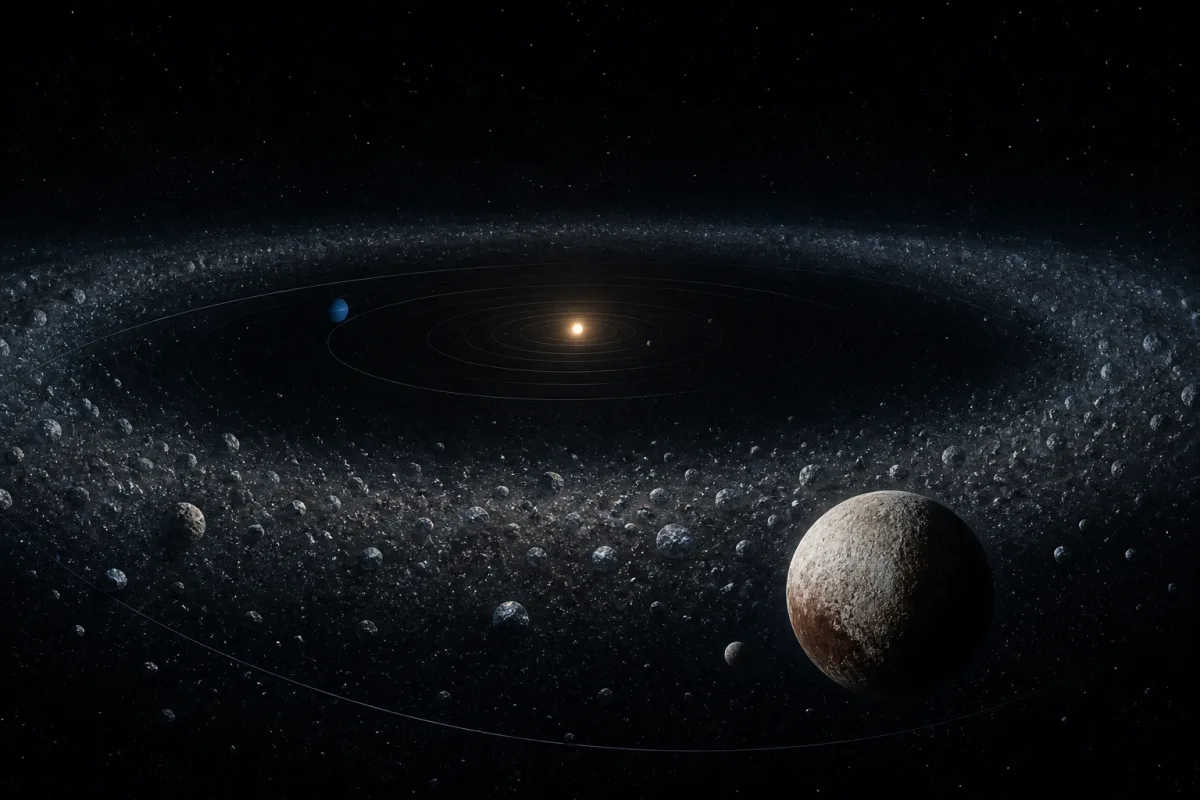
It is often drawn as a neat ring around the planets. The real Kuiper Belt is less tidy. It is a thick, overlapping set of orbital families shaped by Neptune’s gravity, ancient collisions and the slow rearrangement of the young Solar System.
Where the Kuiper Belt begins
Neptune orbits about 30 astronomical units from the Sun. One astronomical unit, or AU, is the average distance between Earth and the Sun. The main Kuiper Belt starts beyond Neptune and extends to roughly 50 AU, although the population thins into the scattered disk and other groups that reach much farther out.
That distance makes the region hard to picture. Sunlight is already much weaker at Neptune than it is at Earth, and a small dark body reflects only a fraction of what reaches it. Even the objects we have found are faint points moving slowly against the stars.
What is inside it?
Kuiper Belt objects are made mainly of rock and frozen compounds such as water ice, methane and ammonia. They range from small fragments to dwarf planets more than 1,000 kilometres across. Pluto, Eris, Haumea and Makemake belong to this wider trans-Neptunian population, although their surfaces and orbits are very different.
Astronomers group the objects by their orbits. Some travel in relatively orderly paths, while others are locked into resonances with Neptune. In a resonance, the timing of an object’s orbit and Neptune’s orbit follows a repeating pattern. Pluto, for example, completes two trips around the Sun for every three made by Neptune, a relationship that helps keep the two worlds apart.
A record of the young Solar System
The Kuiper Belt is a collection of leftovers. When the planets were forming, the outer disk around the young Sun contained ice, dust and rock. The material near the Sun was too warm for many volatile ices to survive, while the outer disk remained cold enough to preserve them.
Neptune and the other giant planets rearranged that material. Some bodies were pushed outward, some were thrown inward and some were ejected altogether. The survivors still carry clues about the conditions in the disk before the planets settled into their present orbits.
That is why Pluto’s changing nitrogen ice matters beyond one dwarf planet. Its glaciers, pits and seasonal changes are evidence of an active world, but the chemistry also tells researchers how cold bodies behave at the edge of the Solar System.
How the Kuiper Belt feeds comets
Short-period comets are linked to the Kuiper Belt and the nearby scattered disk. A gravitational encounter can alter an icy body’s orbit and send it toward the inner Solar System. When the comet approaches the Sun, sunlight turns surface ice into gas, releasing dust and creating the coma and tail visible from Earth.
The process is different from the source of many long-period comets. The Oort Cloud is thought to be a much more distant, roughly spherical reservoir surrounding the Solar System. The Kuiper Belt is a flattened disk; the Oort Cloud is a far broader shell.
Why New Horizons went there
NASA’s New Horizons spacecraft flew past Pluto in 2015 and later made the first close encounter with a Kuiper Belt object, Arrokoth, in 2019. Arrokoth’s two joined lobes look like a frozen contact binary, and its relatively undisturbed surface gives scientists a rare view of material that formed early and stayed cold.
No spacecraft has surveyed the whole belt. Each flyby samples one object, while telescopes search for the much larger population from Earth and space. NASA’s Kuiper Belt facts page notes that thousands of trans-Neptunian objects have been catalogued, probably representing only a small fraction of what is there.
A region, not a sharp boundary
The Kuiper Belt does not end at a wall. Its main population fades into the scattered disk and other distant groups, while Neptune’s gravity continues to reshape orbits. The region is best understood as a set of related populations rather than one perfectly defined ring.
That complexity is precisely what makes it useful. The small worlds beyond Neptune are not dead leftovers with nothing to say. They are pieces of the Solar System’s early architecture, still moving through the cold dark space where the planets began.