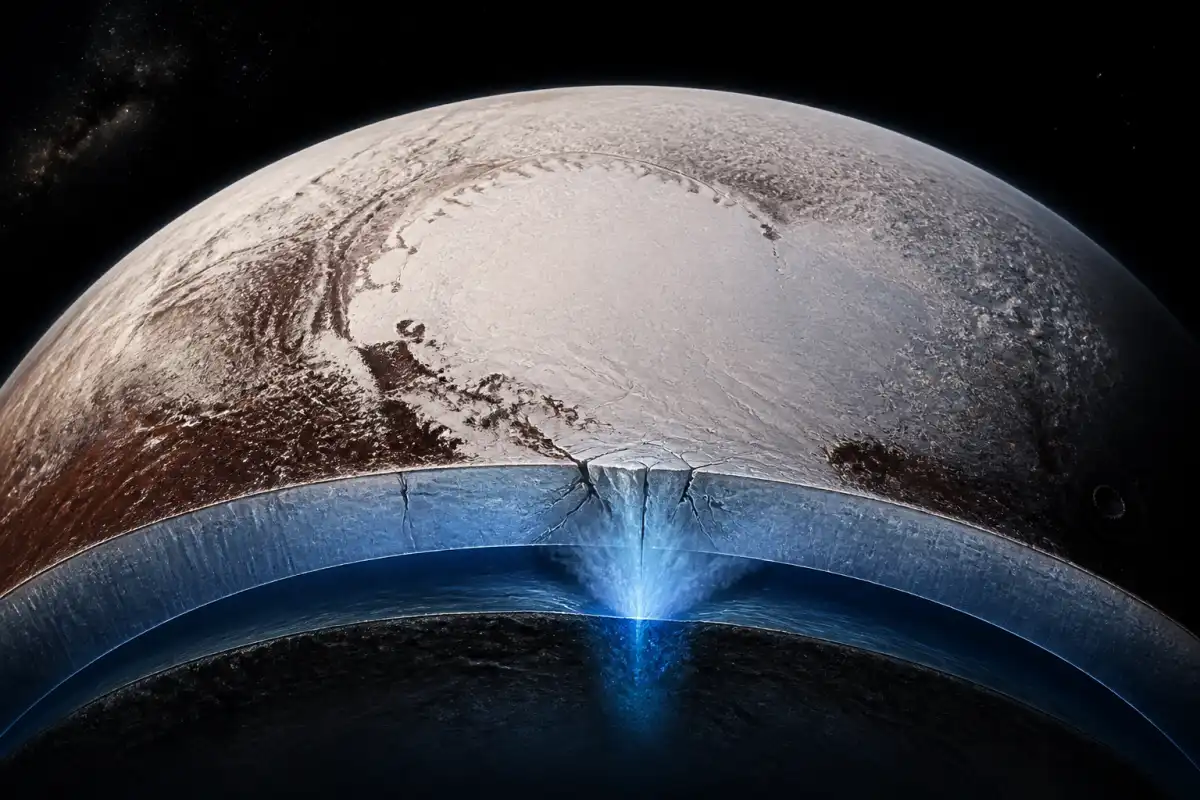
Pluto’s famous heart is not a smooth, frozen decoration. A new analysis of images from NASA’s New Horizons flyby suggests that liquid nitrogen may occasionally rise through cracks in the northern part of Sputnik Planitia, the enormous glacier that forms the western lobe of the heart-shaped region.
The study is based on observations collected during the spacecraft’s 2015 encounter. Researchers focused on thin dark lines and broader dark patches in the glacier. The patterns resemble areas on Earth where a glacier has been wetted by liquid. On Pluto, however, ordinary rain is not a plausible explanation. The atmosphere is too thin and the temperatures are too low for liquid nitrogen to fall from clouds.
A glacier made of nitrogen
Sputnik Planitia is a frozen nitrogen glacier larger than Texas and Oklahoma combined. Its surface is divided into polygon-shaped convection cells, where nitrogen ice slowly moves and renews the surface. The glacier is not made of the water ice familiar from Earth. At Pluto’s temperatures, water ice forms a hard bedrock-like material, while nitrogen can freeze, sublimate and flow on a much larger scale.
The new paper proposes that some of the dark features may be temporary wet spots. Liquid nitrogen could emerge from below the glacier, spread along a crack or shallow channel, and then freeze or evaporate again. That would explain why the markings look different from old, permanently exposed terrain.
Why the liquid would rise
The proposed process is sometimes called basal melting. Heat from Pluto’s interior can warm the bottom of the glacier enough to create small amounts of liquid nitrogen. Because liquid nitrogen is less dense than solid nitrogen, it can move upward through fractures rather than sinking through the ice.
The idea is counterintuitive only if Pluto’s ice is treated like a motionless shell. Sputnik Planitia is more like a slowly circulating frozen basin. Nitrogen can change phase as Pluto’s seasons shift, and internal heat can alter the material at depth. The surface records those changes long after the liquid itself has vanished.
Pluto does not have rivers flowing across its surface. The evidence points to intermittent, local movement that may leave a dark trace before the material freezes or disappears. If that reading is correct, the dark marks would show that Pluto’s surface is still responding to changes below it.
What the images can and cannot show
New Horizons made a rapid flyby, so it did not watch the same patch of Pluto over many seasons. The images provide a geological snapshot, not a time-lapse film. The researchers are matching the appearance of the dark features with physical models and comparisons to glacial processes on Earth.
The paper, published July 31 in the Planetary Science Journal, combines expertise in Pluto’s geology with knowledge of terrestrial glaciers. That combination matters because the proposed explanation depends on both the chemistry of nitrogen ice and the shapes left by moving liquids.
Pluto keeps the bigger questions open
The finding adds to the evidence that Pluto has a complex interior. The dwarf planet has mountains of water ice, a vast nitrogen glacier, a thin atmosphere and signs of relatively young surface activity. A small amount of liquid moving through the glacier would give scientists another way to connect the surface with heat stored below.
More spacecraft observations will be needed to test the idea. For now, the result is a careful inference from New Horizons imagery; the spacecraft did not collect a sample of liquid nitrogen. It turns a set of dark marks in a distant glacier into a question about how an icy world continues to change after its first close encounter with a spacecraft.
New Horizons did not photograph a lake on Pluto. The team argues that several physical clues fit a process in which liquid nitrogen briefly reaches the surface. A future mission could look for changes, measure the terrain in greater detail and test whether the dark features are still being renewed.
Pluto is one of several distant worlds considered in Curiosmos’ guide to places in the Solar System where hidden oceans and unusual chemistry may matter.