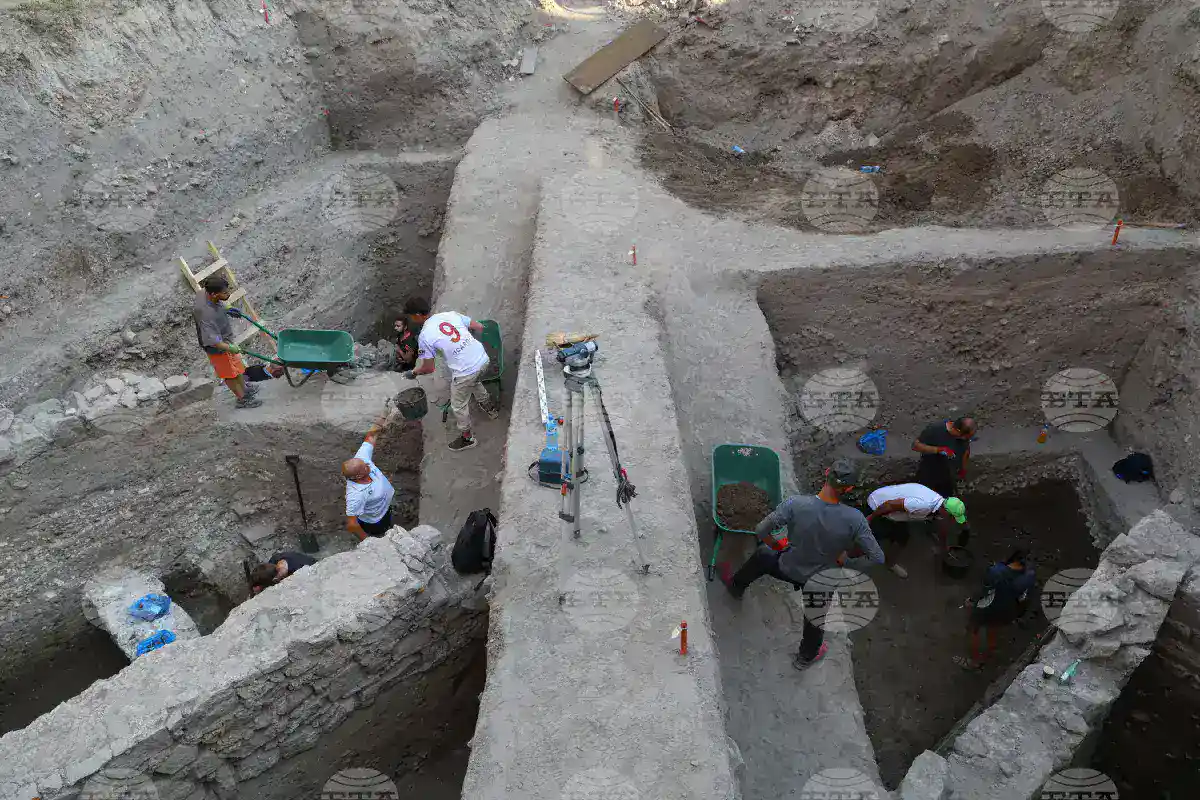
More than 200 coins have been found during rescue excavations beside the Eastern Gate of ancient Philippopolis, in modern Plovdiv, Bulgaria. Most belong to the Constantine dynasty, placing the cache in the Roman imperial period. The excavation has also exposed an ancient building and burial areas, turning one construction project into a wider investigation of how the city changed over time.
The coins were recovered near one of Philippopolis’s main entrances. The Eastern Gate connected the city with roads leading into and out of the urban centre, making the surrounding area a busy passage for residents, traders and officials. Finds from the zone can therefore speak to more than one building or household; they can show how the city’s edge worked.
A cache beside a major route
Coins are easy to lose, hide or deliberately bury, which is why their meaning depends on context. A group of more than 200 pieces can represent savings, a payment, a shop’s cash reserve or a cache hidden during a period of uncertainty. The dates and rulers represented in the group will help archaeologists establish when the money entered the ground and whether it was deposited all at once.
The early report identifies most of the coins with the Constantine dynasty, the imperial family that ruled parts of the Roman world during the fourth century. That was a period of political and religious change, when Philippopolis remained an important city in the province of Thrace. The final interpretation will depend on cleaning, conservation and a closer study of the individual issues.
Coins can also expose connections that buildings do not. A mint mark may point to a distant imperial centre, while the mix of denominations can show which kinds of payments were common in the city. When the group is catalogued, it may help establish whether the eastern entrance served local trade, military traffic or a route used by people moving through Thrace.
The coins are only one part of the excavation. Archaeologists also documented the remains of an ancient building and several burial sites. Their relationship to the Eastern Gate may reveal how the city’s defensive and commercial spaces were reorganised as Roman Plovdiv expanded, contracted or changed its priorities.
The order in which the layers were formed will be as important as the objects themselves. A later grave can cut through an older wall, while a road surface can seal coins that were already lost. Archaeologists record those contacts before removing the finds, because the position of a coin or burial is often the only way to tell whether it belongs to the city’s Roman phase or to a later community using the same ground.
Philippopolis was rebuilt many times
Plovdiv is one of Europe’s oldest continuously inhabited cities. Ancient Philippopolis occupied a strategic position on the Maritsa River and changed hands and identities across the Thracian, Macedonian, Roman, Byzantine and Ottoman periods. Each phase reused parts of the earlier city, which means a single excavation can contain layers from different communities.
That is why archaeologists treat the building, burials and coins as a connected sequence rather than as isolated objects. A wall may have been repaired after a road changed. A burial may have cut through an older floor. Coins may have been lost during daily activity and later gathered into a cache. The task is to reconstruct the order of those events from the physical relationships in the soil.
The Eastern Gate itself is a particularly useful location because movement leaves traces. Roads, gate structures, workshops, drainage channels, graves and rubbish deposits often accumulate around entrances. Together they show how people approached the city and what happened just beyond its formal boundary.
What the coins can still tell us
Once conserved, the coins may provide more precise dates than the initial announcement. Their inscriptions and portraits can identify emperors, mints and denominations. A comparison of the metal and wear patterns can also show whether the group circulated locally or arrived through longer-distance trade.
The surrounding finds may answer different questions. The building could clarify whether the area served a public, commercial or residential purpose. The burials could reveal how later inhabitants treated the former urban edge. If the layers can be dated securely, archaeologists will be able to trace how the Eastern Gate neighbourhood was used from the Roman period into later centuries.
The discovery is therefore less about a single buried treasure than about a city caught in the middle of its own history. The coins are the most immediately striking find, but the building and burials may ultimately tell the larger story of how Philippopolis lived, changed and remembered its past.
Further reading
ancient cities built on top of one another, how archaeologists date a faint Neolithic enclosure, and the Brading Roman Villa excavations