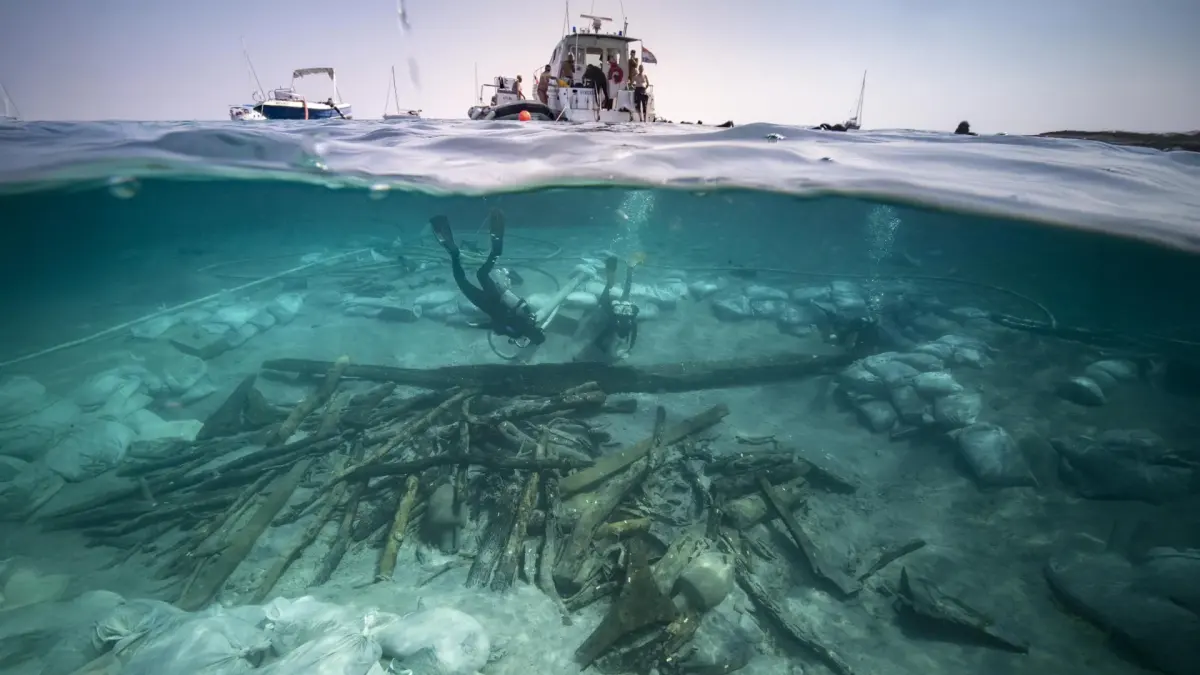
The most revealing material on a 2,200-year-old Roman shipwreck may not be the wood or the cargo. It is the dark, hardened coating that once kept seawater out. A new study of the Ilovik–Paržine 1 wreck, found off the Croatian coast, shows that its hull was covered with pine tar and, in one area, a mixture of pine tar and beeswax. Pollen trapped in those coatings has preserved a record of the landscapes the ship passed through and the places where its hull was repaired.
The wreck belongs to the Roman Republican period and sank in the Adriatic roughly 2,200 years ago. It was discovered in 2016 and has since been examined alongside its cargo, which includes logs and amphorae. The new research looks at a part of ancient shipbuilding that usually disappears from view: the organic material spread across a hull to keep out water, salt, marine organisms and the wood-boring animals that damaged ships at sea.
A waterproofing recipe with a Greek name
Researchers from France and Croatia examined ten samples taken from the wreck’s protective layers. Molecular analysis showed that every sample was dominated by heated conifer resin, or pine tar, also known as pitch. One sample contained a second ingredient: beeswax mixed into the tar.
Ancient Greek shipbuilders called this kind of tar-and-wax mixture zopissa. Adding wax made the coating more flexible and easier to spread while hot. It also improved its water resistance. The recipe was practical, but it has become valuable to archaeologists because the sticky pitch captured particles from the surrounding environment before hardening.
That includes pollen. Trees and plants release enormous quantities of pollen into the air, and some of it settles on materials being prepared or applied. Once sealed inside pitch, the grains can remain identifiable for centuries. In this case, they became a kind of environmental fingerprint.
The ship appears to have been repaired more than once
The pollen record points to several different landscapes. Some grains came from Mediterranean and Adriatic environments, including pine and holm oak forests, olive and hazel habitats, and coastal shrubland. Other pollen came from alder and ash, plants associated with rivers and shorelines. Small amounts of fir and beech point toward the mountainous terrain close to the northeastern Adriatic.
The coating pattern adds another clue. Researchers identified four or five separate batches of waterproofing material across the vessel. The stern and central sections appear to have received the same treatment, while the bow contained three distinct coating batches. That pattern is consistent with repeated repairs rather than a single application made when the ship was first built.
The ship’s ballast had already suggested a connection with Brundisium, modern Brindisi, on Italy’s Adriatic coast. The pollen evidence does not prove that every repair happened there, but it suggests that some of the tar may have been produced or applied in the region. Other layers appear to have been added farther north, near the coast where the ship eventually sank.
The researchers can compare the pollen with modern and archaeological records of Adriatic vegetation. That does not produce a precise address for every repair yard, but it narrows the possibilities and shows how environmental evidence can travel with a ship. The coating is a record of both technology and place.
That distinction matters because ship repairs were rarely recorded in written sources. A hull could be scraped, reheated and coated again without leaving a description for later historians. The pitch has survived precisely because it was designed to resist water. It now preserves the traces of the work that protected the vessel, including the plant material present when each batch was prepared.
A small sample can preserve a large story
The study combined microscopy, molecular analysis, mass spectrometry and pollen analysis. Mass spectrometry helps identify the compounds in a complex organic mixture, while the pollen provides a geographical and ecological signal. Neither line of evidence would be enough on its own. Together, they allow researchers to separate coatings that look similar but were made or applied at different times.
That is significant because ancient ships were moving technologies. A vessel could be built in one port, loaded in another, repaired somewhere else and finally lost far from its original home. The Ilovik–Paržine 1 coating record suggests that its crew and shipwrights were working within a connected Adriatic world rather than a single isolated harbour.
The wreck therefore offers more than a snapshot of a sunken boat. It preserves a chain of decisions: which materials were available, how a crew responded to damage, and how knowledge of waterproofing travelled around the ancient Mediterranean. The pollen in the pitch is evidence that even a repair layer, normally overlooked, can carry the history of a ship’s voyages.
Further reading
how archaeologists date a faint Neolithic enclosure, the Brading Roman Villa excavations, and ancient star maps found in cave art
Sources
ScienceDaily summary supplied by Frontiers · Frontiers in Materials paper