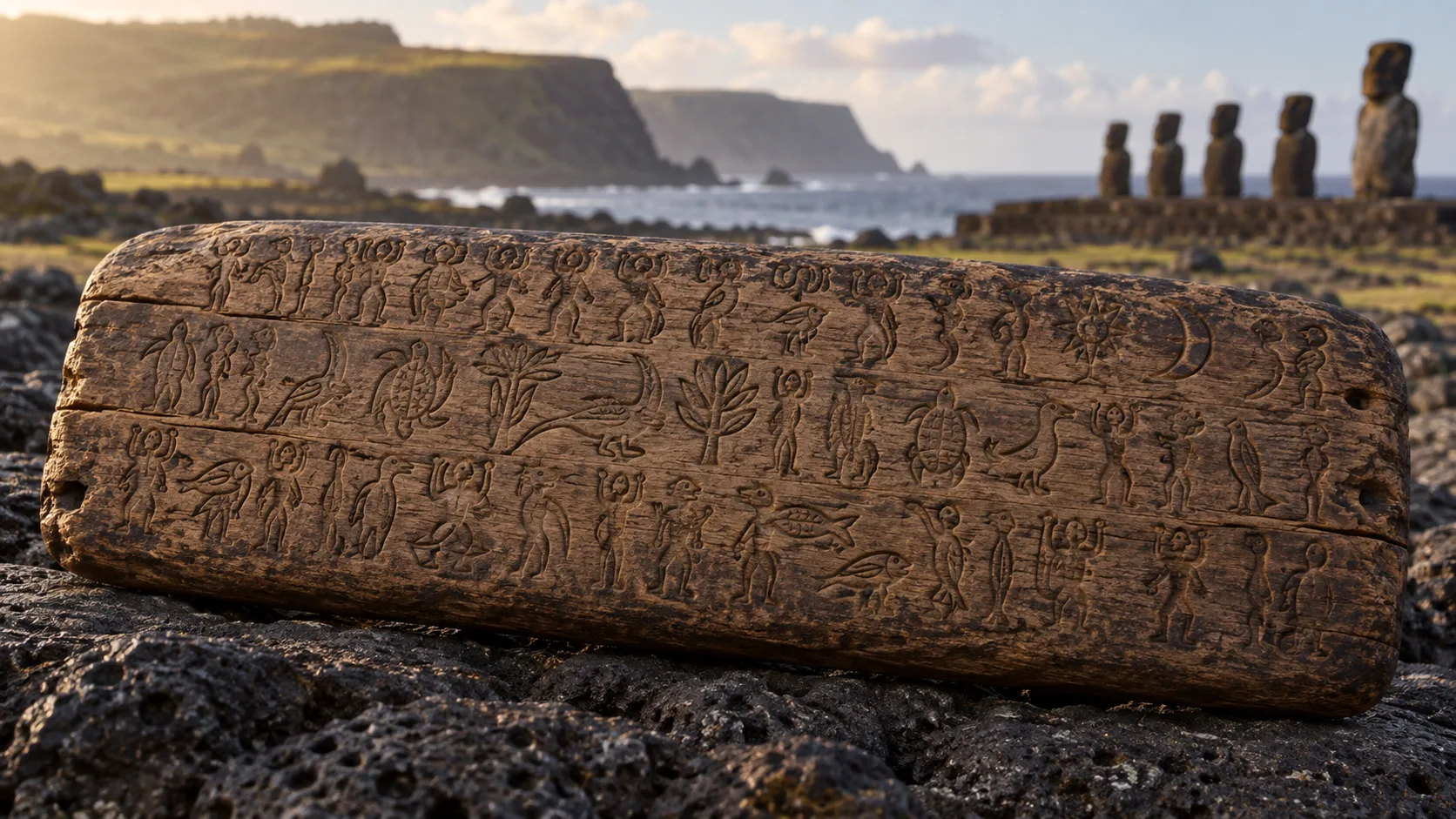
A line of signs runs across a wooden tablet, then turns around and travels back the other way. The pattern repeats across a small number of surviving objects from Rapa Nui. No one has yet read the signs with confidence, and there are so few tablets that each new piece of evidence can change the argument.
That is the puzzle of Rongorongo. The marks look ordered, not like casual decoration, but the objects came to museums after disease, forced labour, missionisation and population loss had changed island life. Researchers are trying to read a script after much of the context around it was broken apart.
A small and scattered collection
Fewer than 30 objects are generally accepted as examples of Rongorongo. The Australian Museum lists about 26 authenticated artefacts held outside Rapa Nui. Some are fragments; others are worn or have long collection histories that begin only after they left the island. They are not pages from a single, well-preserved library.
That leaves little room for the usual footholds in decipherment. There is no bilingual inscription to match against a known language, and the surviving sequences are short. Scholars have catalogued roughly 600 sign forms, but a carved mark can be a distinct sign, a variant, a damaged line or two signs joined together. Even counting the symbols takes interpretation.
Lines that change direction
Many tablets use a layout called reverse boustrophedon. Read one line, turn the tablet, and the next line runs in the opposite direction. The name comes from the path of an ox ploughing a field. It is a striking arrangement, and it shows that the marks were placed with care.
But a regular sequence does not tell us how each sign worked. Rongorongo may have recorded speech, used signs for words or ideas, or mixed different kinds of notation. Until researchers can show that a proposed reading works across multiple tablets, calling it a fully deciphered alphabet would get ahead of the evidence.
Curiosmos has covered other ancient scripts that remain unread, including five scripts that still resist translation. Rongorongo’s challenge is especially sharp because there is no known bilingual text to provide a first key.
What the wood dates can—and cannot—tell us
A 2024 study in Scientific Reports tested four tablets with radiocarbon dating. One piece of wood came from a tree felled in the mid-15th century, before sustained European contact with Rapa Nui. The other dated samples were nineteenth-century wood.
The date belongs to the tree, not automatically to the carving. Someone could have kept old timber, reused it or carved it long after it was cut. The early result makes a pre-contact origin for local inscription possible, but it does not date every groove on that tablet or settle when Rongorongo began.
That is a useful difference to keep in view when reading headlines about the study. Radiocarbon gives researchers a date for the material they sampled. The marks still need their own history.
Better records, closer readings
Photogrammetry and structured-light scanning have produced detailed three-dimensional records of tablets, including the Échancrée object. These models can show shallow strokes more clearly, help distinguish a carved line from a crack and let museums share the same surface with researchers around the world.
That work will not translate the signs by itself. It can give scholars a more reliable text to compare, which is a real step forward when every line matters. The missing pieces are still language, context and a reading that holds up across the corpus.
Rapa Nui knowledge is part of the record
Museum catalogues preserve more than measurements. The Australian Museum’s account includes knowledge from Rapa Nui cultural holders Victor Pakomio and Johnny Tuki and places the tablets within the island’s history. “Undeciphered” describes what scholars can currently read; it does not mean the objects have no meaning to the descendants of the people who made and used them.
A clearer reading may come from a new tablet, better documentation, language research or a closer partnership with Rapa Nui knowledge holders. It may also turn out that the marks do not behave like an alphabet. For now, the tablets leave a vivid question in front of us: what kind of record did their makers think they were leaving in the wood?
Sources and further reading
• 2024 radiocarbon study in Scientific Reports
• Oxford Academic study of Rongorongo and the art of writing