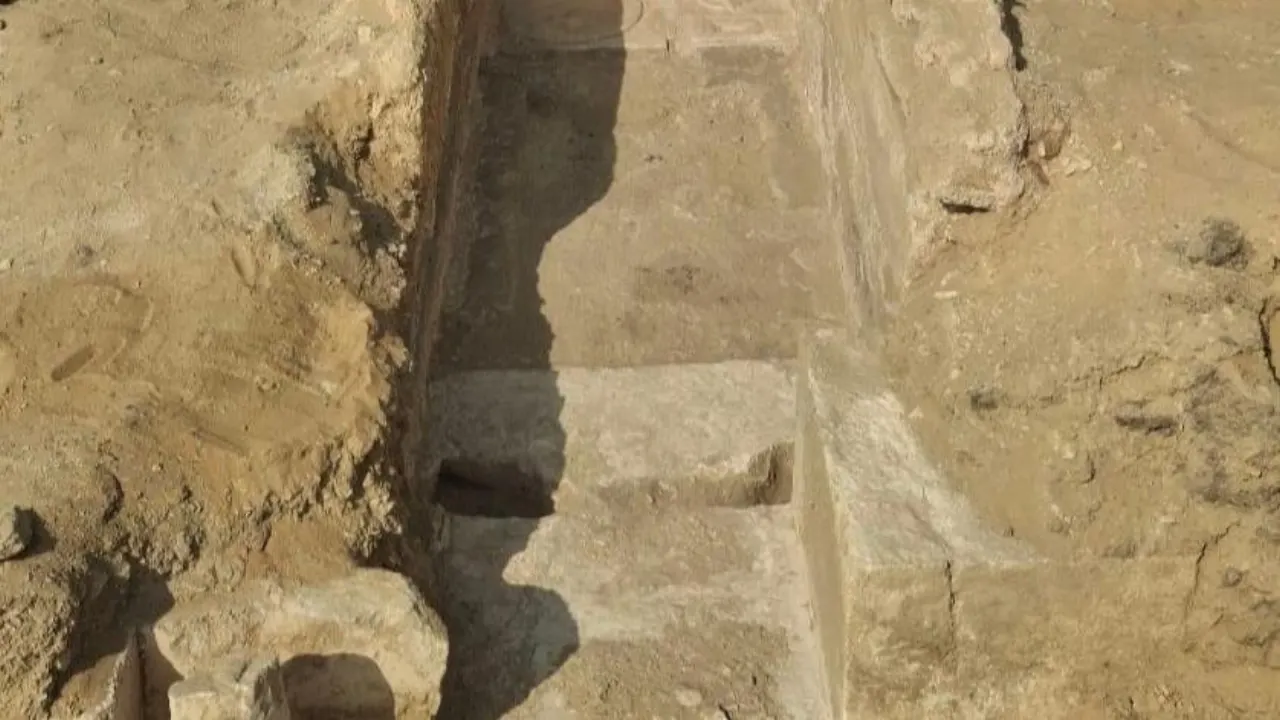
Archaeologists working at Saqqara have found the Old Kingdom tomb of a senior official named Sekhentyu-Ptah, along with burial shafts, three sealed stone sarcophagi and more than 100 ushabti figurines. The tomb’s funerary chapel still has its false door in place, giving the mission a connection between the monument, its inscriptions and the people buried around it.
According to the August 29 report published by Egypt’s State Information Service, the discovery was made during the first excavation season of an Egyptian mission in an area west of the Bubasteion. Inscriptions record Sekhentyu-Ptah’s name and several senior titles, including royal chamberlain, supervisor of the king’s works, supervisor of royal documents, priest of the goddess Maat and supervisor of scribes.
A chapel with the official’s name
The false door was a symbolic focus of an Egyptian tomb. It was treated as a point through which the deceased could receive offerings, so keeping it in its original position helps archaeologists understand how the chapel was arranged and used.
In front of the false door, the team found alabaster funerary objects, including an offering table, an offering disc and a purification basin. The inscriptions on those objects preserve Sekhentyu-Ptah’s name and titles rather than leaving the tomb’s owner anonymous.
The official’s job titles also place him within the administration of the Old Kingdom. They point to a person responsible for palace access, royal building work, documents and scribal activity, although the excavation cannot by itself reconstruct his entire career.
Sealed burials and small servants
Interconnected burial shafts around the tomb contained human remains, decorated funerary cartonnage and more than 100 faience ushabti figurines. Ushabtis were small figures placed in burials to serve the deceased in the afterlife according to Egyptian belief.
Three stone sarcophagi were still sealed when archaeologists reached them. The same area also produced a wooden falcon figure and pottery vessels, adding objects that can be studied alongside the chapel and the human remains.
The shafts do not all belong to one moment. The mission reports evidence that the necropolis continued to be used in later periods, and that some chambers were looted in antiquity. Robbers opened passages between burial spaces, leaving a record of how the tombs were disturbed as well as how they were built.
Saqqara as a changing cemetery
Saqqara was not a single, short-lived burial ground. Its monuments and shafts were reused and expanded across many centuries, which is why each new excavation has to separate the original tomb from later activity.
Our report on Saqqara’s enormous stone sarcophagi deals with a very different period and setting. The new Old Kingdom tomb belongs to an earlier chapter, but both discoveries show how much information can survive beneath the same landscape.
Connecting the finds to broader Egyptian history also requires care. A named official and his titles provide firm evidence about one person, while the surrounding shafts reveal how the cemetery grew beyond the original chapel.
Excavation is continuing
The mission will continue excavating and analysing the objects. Researchers hope the work will clarify how the cemetery developed and how burial practices changed as later communities used the area.
The finds connect a named Old Kingdom official’s chapel with a cemetery that continued to change around it. The sealed sarcophagi and ushabtis should not automatically be assigned to the original owner or his lifetime. Further study of the inscriptions, human remains and surrounding shafts will determine how this new monument fits into the long history of the necropolis.