Although Halley’s Comet will not return to our vicinity for another 35 years, a new analysis has sparked media attention with the claim that this famous object is wrongly named. Professors Michael Lewis of the British Museum and Simon Zwart of Leiden University have presented evidence that the monk Eilmer of Malmesbury recognized the comet’s cyclic nature six centuries before Edmond Halley. Despite interesting historical arguments, the chances of the astronomical community accepting this change remain minimal.
Eilmer, sometimes called Aethelmaer, was undoubtedly a peculiar historical figure. It is recorded that, long before the Wright brothers, he attached wings to his arms and legs and managed to fly a distance of 200 meters, though he broke both legs upon landing. Nevertheless, his understanding of celestial mechanics was almost certainly far below that of Edmond Halley. Halley followed in the footsteps of Johannes Kepler, whose laws enabled the calculation of planetary orbits, which were later further developed by Isaac Newton.
Using observations of comets from 1531, 1607, and 1682, Halley proved they were the same object and calculated its orbit. In doing so, he confirmed the existence of periodic comets and the ability to predict their return. His successful prediction of the return in 1758 was based not just on noting that the comet appeared every 74.7 years, but on precise calculations of its movement in the interim.
For Eilmer, such a feat would have been nearly impossible. Not only did he lack Kepler’s insights, but he was also unaware of Copernicus’s work; even if he understood that the comet orbited something, he likely would have thought it circled the Earth, not the Sun. We do not know exactly what Eilmer truly grasped because his writings have been lost. We rely on the records of William of Malmesbury, a historian and monk from the same abbey, who wrote about 50 years after Eilmer’s death.


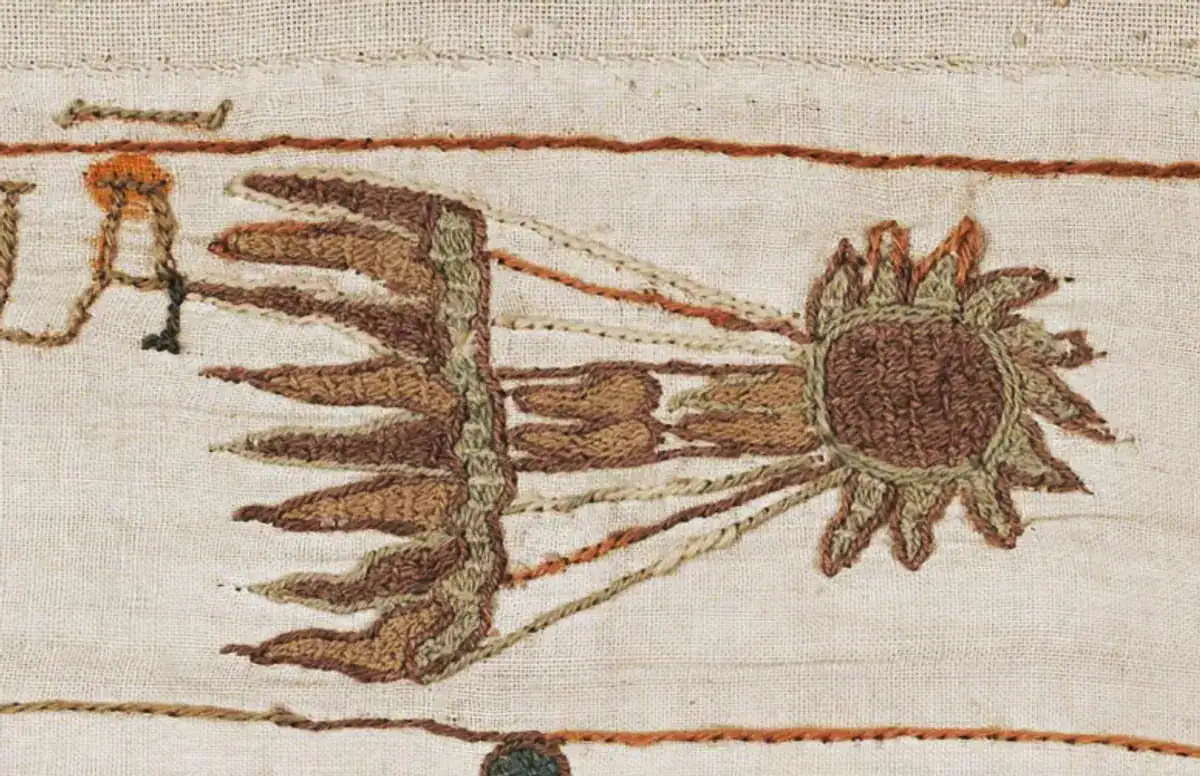
According to these records, Eilmer was more interested in what the comet’s return in 1066 meant for English politics than in its actual trajectory. William quotes his predecessor saying: “You’ve come, have you? You source of tears to many mothers. It is long since I saw you; but as I see you now, you are much more terrible, for I see you brandishing the downfall of my mother-country.” It is unclear whether Eilmer truly identified enough similarities between the comet he saw in 989 and the one that watched over King Harold’s demise, depicted in the Bayeux Tapestry, or if he simply got lucky by connecting the two brightest comets of his life.
Naming Rules and Precedents
Today, comets are named after the first person or organization to detect them and recognize them as a comet, rather than a smudge on a lens or an already known object. To achieve this, the orbit must be calculated at least approximately to rule out the return of a known body. Priority is established by reporting to the Central Bureau for Astronomical Telegrams. The fact that someone calculated an orbit earlier but did not report it properly is usually not enough for renaming. What Halley did fits the requirements for naming rights far better than the most optimistic interpretation of Eilmer’s achievement.
A good example is Encke’s Comet, one of the most famous “dirty snowballs” after Halley’s. Although it never reaches the brightness of Halley’s Comet, Encke’s Comet has a very short orbital period around the Sun of just 3.3 years. Johann Encke calculated its orbit in 1819 based on observations from the previous year and successfully predicted its return in 1822. Encke’s role was comparable to Halley’s, even though many had seen the comet before him—Pierre Méchain and Charles Messier recorded it as early as 1786.
Jean-Louis Pons spotted the comet in 1818 and noticed similarities with its appearance in 1805, but he passed the idea to Encke, who performed the complex calculations and gained the fame. Although Pons discovered a record 37 comets, his name is borne by only three, including the recently topical Pons-Brooks comet. If Pons was not credited with that fourth comet, it is hard to see why Eilmer should displace Halley.
From Laws of Physics to Birds
Most other astronomical objects do not bear the names of their finders. Asteroids are named based on the year of discovery, and only later are they assigned names of deserving individuals by decision of the astronomical community. Stars rarely bear the names of individuals, with exceptions like Barnard’s Star. There are also controversies, such as that surrounding the Magellanic Clouds, for which there are strong arguments that they should not bear the name of a slave trader and mass murderer, yet the name remains in use.
A better comparison with comets might be scientific theorems. It often happens that a law bears the name of a person who did not discover it first. For example, l’Hôpital’s rule for calculating limits was actually discovered by Johann Bernoulli, whom l’Hôpital employed under the condition that he retained the rights to his discoveries. Although l’Hôpital later acknowledged Bernoulli’s contribution, the name stuck. Officially, Hubble’s Law is now called the Hubble-Lemaître Law by decision of the International Astronomical Union, but most people still use only Hubble’s name.
The only area of science where renaming is becoming common is biology, specifically ornithology. The American Ornithological Society is changing the popular names of birds named after people, replacing them with descriptive names or those reflecting the names used by indigenous peoples. The goal is to remove names associated with racism or a violent past.
Edmond Halley, on the other hand, enjoys considerably higher standing. Not only was he a great scientist, but he was also a peacemaker who soothed conflicts among the vainer scientists of his day, without which Newton’s “Principia” might never have been published. It is unlikely that such a figure will lose the rights to the name of his comet, regardless of historical speculations about a flying monk.