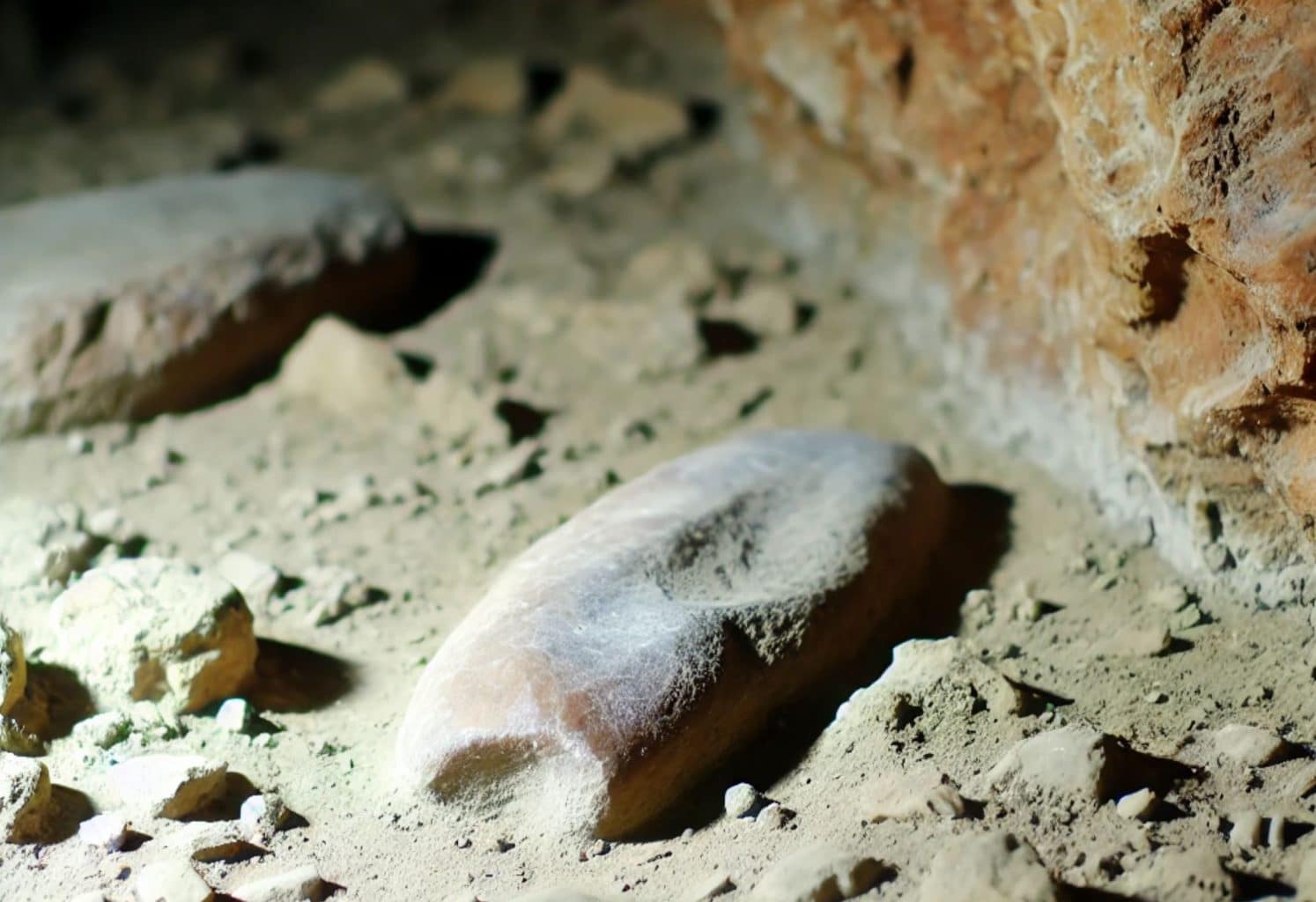
Stone tools in China’s Lower Yangtze region point to a change in how people made implements 70,000–100,000 years ago. A 2023 excavation near Chaohu Lake yielded 3,596 artifacts, most smaller than five centimetres; the makers and the reason for the shift remain unknown.
What can a pile of flakes tell us about people who lived tens of thousands of years ago? At Miaodongyingdongnan, an open-air site in China’s Lower Yangtze region, the answer lies in the way thousands of stones were struck, shaped and left behind. The assemblage is not a spectacular single object. It is a record of repeated choices.
The site’s tools and debris form a core-and-flake assemblage dated to about 70,000–100,000 years ago. The date is important because it falls within a period when the archaeological record of the Lower Yangtze shows a shift from larger, heavy-duty implements toward smaller flakes and retouched tools. This one site adds a carefully recorded example to that regional pattern; it does not identify the people who made the tools or explain what drove the change.
Where were the stone tools found?
Miaodongyingdongnan sits on a terrace beside the Paihe River, which flows into Chaohu Lake in Anhui Province. Archaeologists excavated 120 square metres there in 2023. They removed the soil in 10-centimetre increments and recorded the position and orientation of each artifact, giving researchers a way to study how the finds were distributed through the deposit.
The main artifact-bearing layer was a brownish-yellow clay. To estimate its age, the team collected sediment samples and used optically stimulated luminescence, or OSL. The method estimates when mineral grains were last exposed to sunlight before burial. It dates the sediment surrounding the finds, rather than directly measuring the age of each stone, so the reported 70,000–100,000-year range is a context for the assemblage.
What does a 3,596-piece assemblage look like?
Most of the artifacts are small: 94.67 percent measure less than 50 millimetres. Quartzite makes up nearly 90 percent of the assemblage, with quartz accounting for a further 7.87 percent. Many stones retain part of their original outer surface, a feature the researchers say suggests the raw material came from nearby river cobbles and pebbles.
The team identified 211 cores, 712 complete flakes and 619 flake fragments. A core is a stone from which flakes have been struck; the sharp flakes can then be used as cutting edges or modified into other forms. The dominant approach was freehand hard-hammer percussion, in which a harder stone is struck against a core. A second technique placed a stone on an anvil and struck it from above, helping produce flakes in a different way.
Researchers also classified 135 retouched tools, averaging about 3.3 centimetres long. The group includes scrapers, notches, borers and denticulates—tools with a toothed or serrated edge. Eleven pieces have thinning or backing near one end, which could have made them easier to hold or attach to a handle. The paper describes hafting as a possibility; it does not demonstrate that these pieces were actually mounted on handles.
Does this mark a technological turning point?
The researchers compare the site with earlier Lower Yangtze assemblages, where artifacts were generally larger and heavy-duty forms such as picks, handaxes, cleavers and choppers were more prominent. Miaodongyingdongnan instead contains a small-flake system, alongside several kinds of cores and retouched edges that show some planning in how stones were worked.
That contrast helps archaeologists track changing toolmaking practices across a large region and long stretch of time. It does not mean one toolkit was simply “primitive” and the other more advanced. The smaller artifacts show a different pattern of making and retouching; the finds alone cannot tell us which tasks they performed or whether one group replaced another.
The makers themselves remain unidentified. The study reports stone artifacts, not human fossils or DNA that would connect them to a particular hominin species. It also leaves the cause of the regional shift open. The authors suggest environmental change may have played a part, but say the drivers still need investigation.
That uncertainty is part of what makes the site useful. A single sharp flake cannot tell the story of a community. Thousands of artifacts, recorded layer by layer, can reveal how stone was selected and reduced—and where the evidence stops. For another look at how archaeologists read ancient stone technology, see our report on microblade engraving technology at Göbekli Tepe.
Primary source
Zhe Dong and colleagues, “Early Late Pleistocene core-and-flake technocomplex in the Lower Yangzi region, China,” Antiquity, published online 10 September 2026. The article is open access under a Creative Commons Attribution licence.