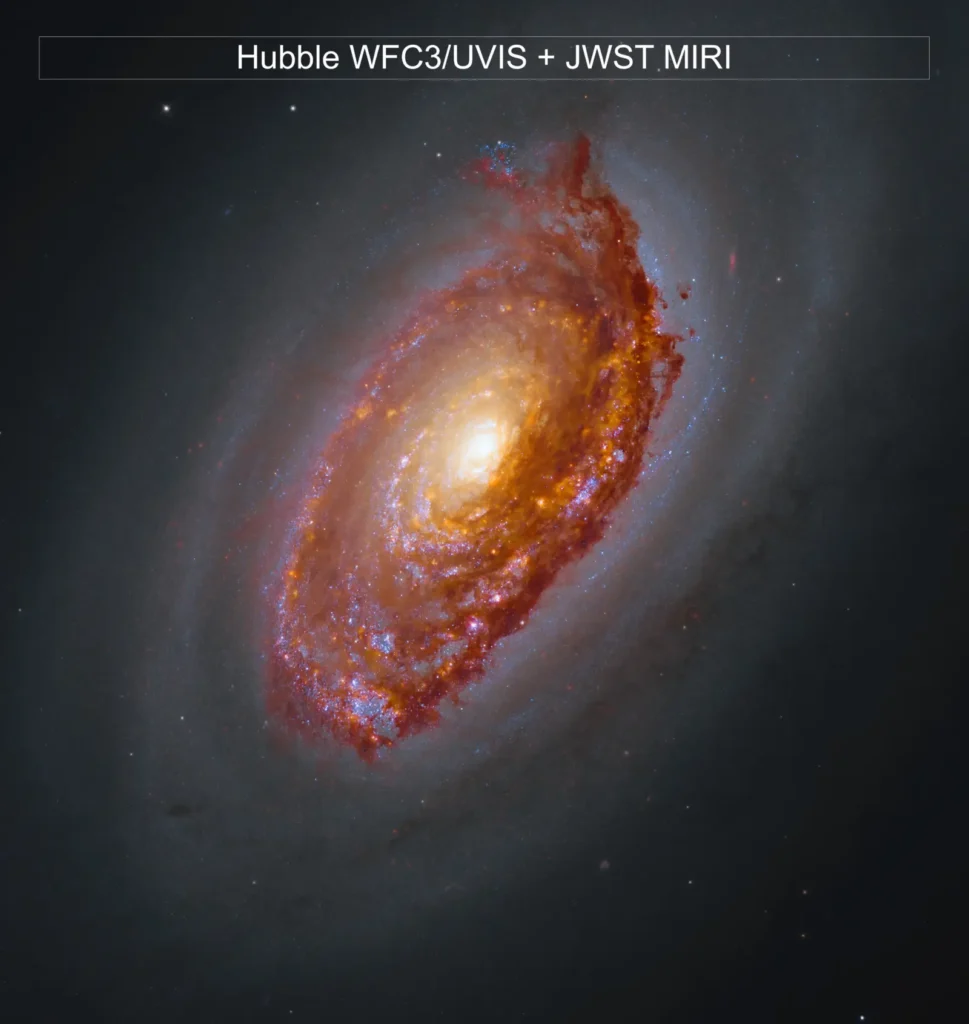
At first glance, Messier 64 looks as though someone has drawn a dark eye across the centre of a spiral galaxy. That band of dust is why M64 is better known as the Black Eye Galaxy. But what if the most revealing part of the picture is not the dark lane itself? It is the motion hidden behind it.
NASA’s new composite view combines Webb’s infrared observations with the familiar Hubble view. Webb sees dust warmed by the light of young stars, while Hubble shows the galaxy in ultraviolet, visible and near-infrared light. Together, the images turn a striking nickname into a record of a galactic encounter.
Why does M64 look like a black eye?
The dark feature is a broad lane of interstellar dust crossing the galaxy’s bright core. Dust blocks visible light, so the centre appears to have a shadow pressed against it. In infrared wavelengths, however, the same dust is not simply a blank mark. It absorbs energy and re-emits it, allowing Webb’s Mid-Infrared Instrument to trace where the material is concentrated and where stars are beginning to form.
M64 lies roughly 17 million light-years away in the constellation Coma Berenices. Its unusual appearance can be seen with modest telescopes, but the reason it looks so different from an ordinary spiral is easier to understand when astronomers measure the movement of its gas.
What does Webb add to the picture?
Webb’s infrared view brings out the warm dust and the pinkish regions where new stars are embedded. Those regions sit along parts of the galaxy where gas is being compressed. The image therefore shows more than a colourful spiral: it helps identify where the collision of gas flows is still feeding star formation.
This is why the new view matters even though M64 has been photographed before. Different wavelengths answer different questions. Hubble can reveal the light of hot stars and the dark silhouette of dust. Webb can follow the dust’s heat and the structure of the clouds around young stars. Reading both views together gives astronomers a better map of the galaxy’s history.
Why is gas in M64 moving in opposite directions?
The stars and inner gas of M64 rotate one way. Much of the gas in its outer regions rotates the other way. Two vast streams are therefore meeting inside one spiral galaxy, creating a shearing region where clouds collide, compress and collapse into new stars.
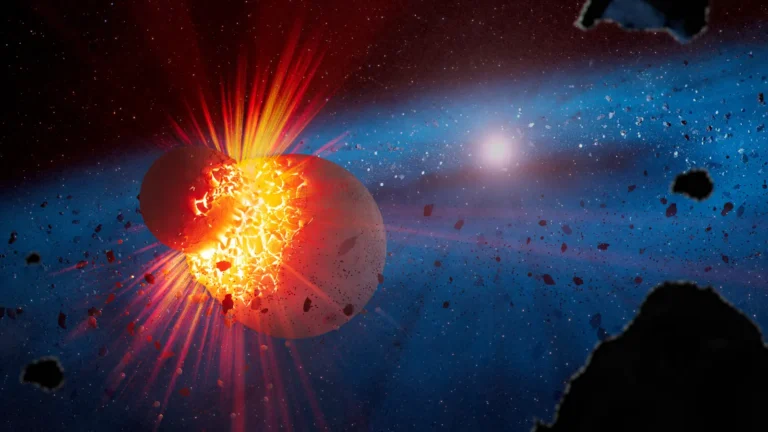
That counter-rotation is not a decorative detail. It is evidence that the galaxy did not grow in isolation. Astronomers think M64 absorbed a smaller satellite galaxy more than a billion years ago. Most of that smaller system has disappeared into the larger one, but its gas still carries a different direction of motion.
Is the merger still shaping the galaxy?
In a sense, yes. The original collision happened in the deep past, yet its consequences remain visible. Gas does not instantly forget where it came from. As the two components move through one another, friction and compression create the conditions for new stars. Webb’s image highlights the dust in those active regions, while the velocity pattern tells astronomers why the regions exist.
That makes M64 a useful reminder that a galaxy can look settled while still carrying the physical evidence of upheaval. Spiral arms may suggest order, but their gas can preserve a much more complicated story.
What can astronomers learn from this one galaxy?
M64 gives researchers a nearby laboratory for studying how mergers rearrange gas, trigger star formation and change the appearance of a spiral galaxy. The Milky Way has also interacted with smaller galaxies, so understanding M64 helps put our own galactic neighbourhood into perspective.
The new composite will be compared with measurements of the dust’s temperature, the distribution of young stars and the motion of gas at different radii. Those comparisons can test whether the old satellite-merger explanation accounts for all of M64’s structure or whether the galaxy’s history contains another chapter.
The dark eye is a historical record
There is a temptation to treat the Black Eye Galaxy as a beautiful object and leave it at that. Yet the darkness is doing scientific work. It marks where material is blocking starlight, while the infrared glow around it shows where that material is being heated. The opposing gas flows reveal an ancient collision that is still influencing the galaxy today.
What if every apparently calm spiral carried a similar record beneath its surface? M64 suggests that the Universe often keeps its most important evidence in motion—if we look at it in more than one kind of light.