When a star like the Sun reaches the end of its life, it does not simply switch off. It can spend thousands of years pushing its outer atmosphere into space, creating a glowing shell around the hot core that remains behind.
That shell is called a planetary nebula. The name is misleading: early observers thought the round, fuzzy objects resembled planets through small telescopes. They have nothing to do with planets. A planetary nebula is the changing atmosphere of a dying star.
The star’s final expansion
For most of its life, a Sun-like star balances gravity against the pressure produced by nuclear fusion. Hydrogen fuses in the core and supplies the energy that supports the star. When the core runs short of hydrogen, the star changes. It expands into a red giant and begins burning helium under conditions that make the outer layers increasingly unstable.
The star’s gravity still holds most of its material, but powerful winds begin to carry gas away. Pulsations can add to the loss. The expelled material may leave in more than one wave, which is one reason planetary nebulae often contain nested shells, arcs, or uneven knots.
Why the shell glows
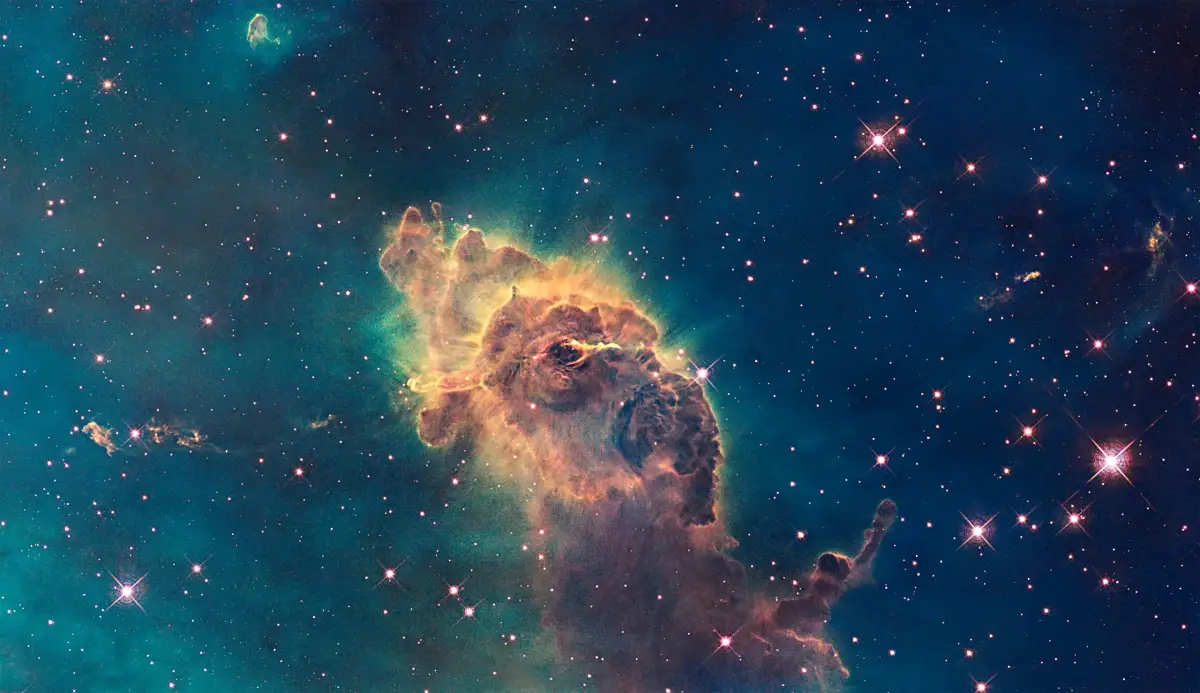
The exposed core becomes extremely hot as it contracts. Ultraviolet radiation from that core strips electrons from atoms in the surrounding gas. When the electrons recombine, the gas emits light at specific wavelengths. Oxygen, hydrogen, nitrogen, and other elements each contribute their own colours.
The colours in an astronomical image are therefore not paint on a dark background. They are a map of gas, temperature, and chemistry. Infrared telescopes add another layer by showing cooler dust and molecules that visible-light images cannot reveal easily.
NASA’s new Webb view of the Lion Nebula shows why two observatories can photograph the same object and reveal different details. Webb’s NIRCam and MIRI instruments bring out compact dust clumps, ionized gas, and the layered structure around the white dwarf.
The white dwarf that remains
The star’s core does not disappear. Once fusion stops in the centre, the remnant becomes a white dwarf, roughly comparable in size to Earth but holding a large fraction of the original star’s mass. It no longer creates energy by fusing ordinary elements. Instead, it cools slowly over billions of years.
The surrounding nebula is temporary. It expands into space and becomes too thin to shine brightly. A star’s final shell may be visible for only a few tens of thousands of years, a short interval compared with the billions of years the star spent burning fuel.
Why the shapes are so varied
Spherical shells are only one possibility. Magnetic fields, rotation, companion stars, and uneven winds can channel material into rings, lobes, jets, or clumps. A binary companion may disturb the outflow and help create a shape that a single star could not produce on its own.
The result is a set of natural experiments. By comparing many planetary nebulae, astronomers can test how stars lose mass and how their surroundings affect the last stage of their evolution. The images also connect to the broader history of the cosmos: the oxygen and carbon released by older stars can later become part of new worlds.
There is another reason planetary nebulae matter. They return processed material to the interstellar medium, where it can mix with gas that will eventually form other stars and planets. The cloud around a white dwarf is therefore both an ending and a contribution to the next generation of systems. The elements in a future rocky planet may have passed through more than one earlier star.
The shapes also warn against treating a photograph as a simple portrait. A bright ring can be a shell viewed from an angle, while a dark lane may be dust blocking light behind it. Astronomers use spectra, velocities, and multiple wavelengths to turn the image into a three-dimensional and time-dependent picture.
The next time a telescope shows a glowing bubble, it is worth looking past the colour. The shape is a record of a star changing from a red giant into a white dwarf, with the evidence still travelling across space toward us.