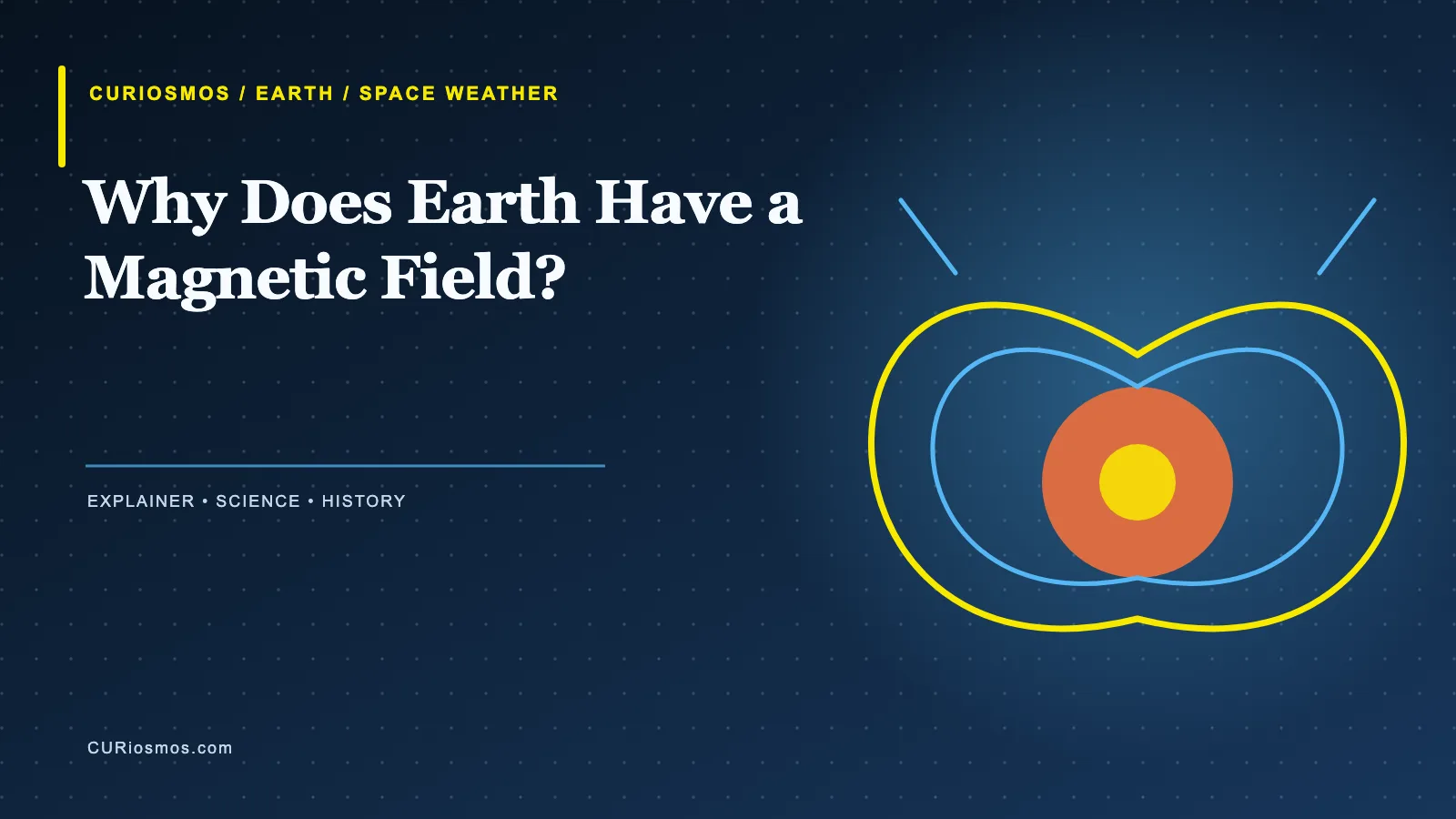
Why does Earth have a magnetic field? The answer begins more than 2,000 kilometres below our feet, in a layer of liquid iron and nickel that is constantly moving. Heat escaping from the deep interior drives convection, while Earth’s rotation organises the flow. The moving metal creates electric currents, and those currents generate the field known as the geodynamo.
Earth is not a giant permanent magnet hidden inside the planet. Its field is produced by motion. That distinction explains why the field changes over time, why the magnetic poles drift, and why the strength of the field is not the same everywhere on the surface.
The outer core is the engine
Earth’s inner core is solid, but the outer core surrounding it is fluid. It is made mostly of iron and nickel under enormous pressure. Heat from the inner core and the slow crystallisation of material provide energy that keeps the outer core in motion. Hotter fluid rises, cooler fluid sinks, and the planet’s rotation twists those flows into large-scale patterns.
A moving conductor can create a magnetic field. The currents in the outer core reinforce one another in a self-sustaining process. Scientists call this the geodynamo. Computer models try to reproduce the field using what is known about the core’s composition, heat flow, rotation and electrical conductivity.
The magnetosphere reaches into space
At the surface, the field gives a compass its direction. Far above Earth, it forms the magnetosphere, a vast region that interacts with the solar wind. The field is compressed on the side facing the Sun and stretched into a long tail on the night side. Charged particles can become trapped or guided along magnetic field lines toward the polar atmosphere.
When solar particles collide with gases high above Earth, they can produce auroras. Strong solar storms can also disturb satellites, radio communication and electrical systems. The magnetic field does not block every particle, but it changes the environment in which the solar wind meets the atmosphere.
It is not a perfect shield
Earth’s atmosphere does much of the work of protecting life at the surface, and the magnetic field is one part of a larger system. Cosmic rays still reach the atmosphere. The field is weaker in some regions, and the South Atlantic Anomaly allows energetic particles to come closer to spacecraft than usual.
The field also changes direction over geological time. Magnetic minerals in cooling lava record the direction of the field when the rock formed. Seafloor rocks preserve strips of alternating magnetic orientation, providing evidence for both plate movement and past reversals. These records show that a reversal is a natural part of Earth’s history, not an instant planetary catastrophe.
What happens when the field changes?
The poles are continually moving, and the field’s strength varies. A gradual weakening does not mean the field is about to vanish. During a reversal, the field becomes more complicated for a time, with multiple magnetic poles appearing before the dominant orientation changes. The process unfolds over thousands of years.
Scientists monitor these changes with observatories, satellites, ocean-floor measurements and ancient rocks. The measurements matter for navigation, spacecraft operations and understanding how the deep Earth works. Those measurements link the field at the surface to motion deep inside the planet, where the geodynamo operates.
Modern instruments measure both the field at the surface and the magnetic environment around Earth. Satellites can follow changes over the oceans, where observatories are scarce, while ground stations catch short-term disturbances caused by solar activity. Geologists add the long view by reading magnetism locked into lava, sediments and archaeological materials heated in ancient fires.
Those records serve different purposes. A satellite can warn operators that a solar storm is reaching Earth; a volcanic rock can show how the field was oriented thousands or millions of years ago. Together they reveal a field that is always changing, yet remains a vital part of the planet’s habitability.
The field’s shape is also more complicated than a bar magnet. Continents, oceans and currents in the upper atmosphere alter the signal measured at the ground. Models combine these local effects with the deep-field measurements so that navigation systems and geophysical studies can separate a short-lived disturbance from a long-term trend.
Earth’s magnetic field is therefore both local and cosmic. It begins in molten metal beneath the continents, but it reaches far enough into space to shape the way our planet responds to the Sun.
That connection is why new solar-weather missions matter. The PUNCH mission’s solar-storm forecasts are part of the same effort to understand what happens when the Sun’s changing activity meets Earth’s magnetic environment.
Sources and further reading: NASA Science: Earth’s magnetosphere; NASA GSFC: Geodynamo research.